
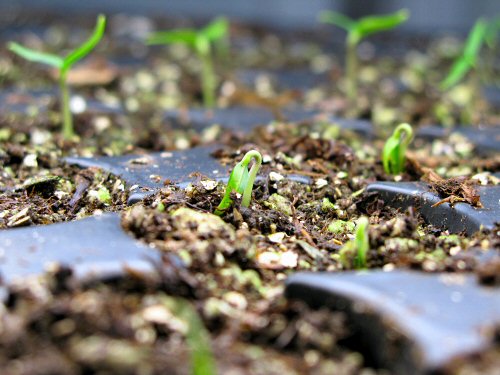
Another little new-season milestone: the first of the original veggie gang has appeared. These are Gypsy (hybrid) sweet peppers, seeded six days ago, along with other varieties of pepper and eggplant. They started to poke up in the last day or so, and by this morning, the first leaves had unfolded. Along with tomatoes (soon to be seeded), I think of these three—toms, eggplant, peppers—as my original crops. These are the veggies I started first (and way early) in Year 1: winter was storming along outside, while these brilliant little splashes of green were popping up in the warm, bright bubble of the first seedling room (a side room in the farmhouse). I was fascinated and kind of amazed. I used to come downstairs in the middle of the night to check ’em out, make sure they were still alive and growing… Actually, it’s not so different even now! :)
seed
Seed starting tools II
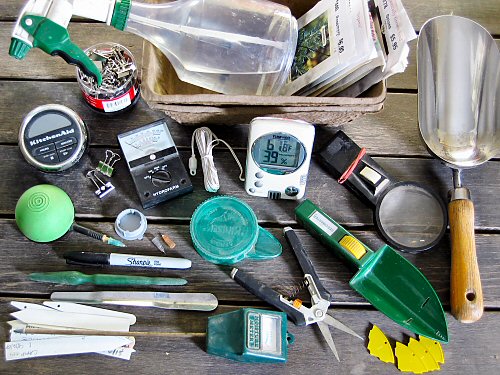
Here are ALL the indoor seed starting tools I have, most of them always-used, a couple not. Nothing special, and FINGERS I’ve found are handiest for most of the work at this scale. In any case, a few details (and there’s more on #1-5 in Seed starting tools, part 1): 1. The Seedmaster, a gadget for trickling out small seed as you rotate the wheel (the yellow pieces are click-in filters for different seed sizes); 2. assorted white plastic plant labels; 3. a dibbler or dibber or whatever, for poking little holes in soil; 4. a fine-point black waterproof marker (I like Sharpies) for labeling; 5. the mini-transplanter is essentially a tiny, stainless steel shoehorn for easy liberation of plugs from their cells; 6. a moisture meter, simply stick it in the soil; 7. plant snips for thinning seedlings; 8. Mini-Sim seeder: fill and shake out; 9. suction seeder with three tip sizes: squeeze the bulb, put the tip on a seed, release to hold, squeeze again to drop… ($25…what was I thinking?!); 10. digital timer for keeping track of repetitive tasks like bottom-watering trays one by one; 11. plant light meter, reads in footcandles, with settings for indoor and out; 12. digital indoor/outdoor min/max thermometer/hygrometer, mainly for keeping track of temperature; 13. magnifying glass with light, for examining seedlings (and GREEN MOSS) up close; 14. soil scoop for filling plug sheets and pots with seedling mix; 15. spray bottle with good quality spray head (more water per pull; I’ve used a wand mister like I have in the greenhouse, but the hose kept getting in the way, I may try one again for the seedling room this year); 16. small fibrepak flats, convenient for holding tools and seed packets on the potting table (left lying, the packets can so easily get wet…); 17. small bulldog clips, useful for all kinds of things, like organizing groups of seed packets. And the winners are…all of them, EXCEPT for: #9, which I found to be useless for my purposes; #8 which is great, but mostly for heavier hand seeding in the field, like for flowers; and #6, 11 & 13, which are more educational toys than essential tools, but still cool! (Wow, that was a lot of blogwork for pretty obvious stuff, but there you go! :)
Tomato seed
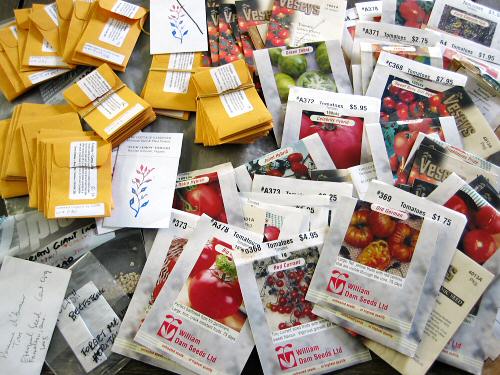
It’s sounds a little odd to call it that, but this is my tomato seed collection. A rough count says there are maybe 150 packets, with another 30 on the way with the just-completed all-heirloom tomato seed order. I’ll get a few more basics, like Juliet, in the last big general seed order, and that’ll be it for the season.
Most of these are different cultivars, there are only a few…doubles. The brown envelopes are heirlooms from a small seed company. The printed packets are mostly hybrids, from my two main seed suppliers. The plastic pouches and plainer white envelopes are various seed given to me to try (I’ll generally only accept seed from trusted sources, people who actually garden and seed-save, to avoid…disease).
Why so much, so many? I dunno. I don’t think of any other veggies in my seed supply as “collections” (like trading cards or tiny action figures). I do clearly remember looking closely at a fuzzy little tomato seed back in Year 1, about to start my first transplants, and thinking, “No way is this little thing is going to turn into a massive tomato plant with 20 lbs of big, fat tomatoes?!” (At that point, all I knew was what I’d read and seen in pictures.) It wasn’t so much disbelief in the powers of the seed, but in my ability to actually manage this obviously intense process—what a tiny seed!—to a reliable, predictable harvest.
Of course, once you’ve watched seeds grow into plants, it becomes…normal: clear the way a bit, and the plants do most of the work! Still, having imprinted themselves on my consciousness FIRST, right at my gardening start, I guess tomatoes have a mild hold on me, and I obsessively plant a few more different varieties every year.
This year, there may be a more manageable 40 varieties (down from over 60 a couple years back). I haven’t finished the starting line-up yet.
Ten-day leeks
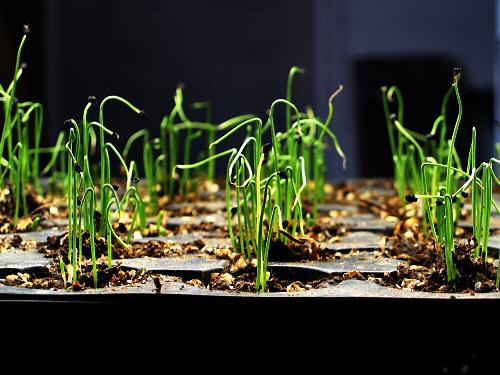
The leeks are thriving, all straight up and down. Ten days from seeding, and some of ’em are nearly 3″ (7.5cm) tall. Clearly, the seed was more viable than expected, looks like practically every one popped up. The first parsley just appeared, and a second set of arugula is already blowing in the wind. Things are slowly getting…busier.
Leeks appear
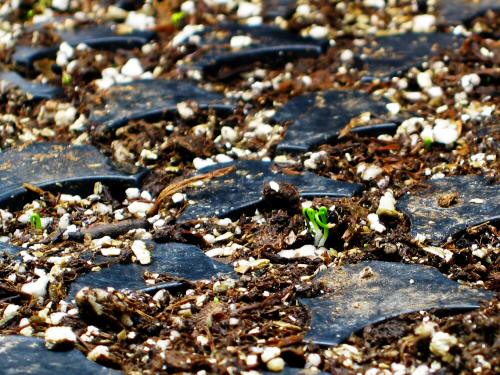
That was quick! After barely four days, the Jolant 75-day early leeks are poking up quite vigorously (there are early leeks and long season one’s that’re usually 100 days+ and more cold hardy). I used a mix of seed from last year and three years ago. Seed from the onion family has a short shelf life, it’s usually rated good for only a year, and I’ve noticed a pretty big drop in germination rate (I tested 2-year-old green onion seed, and it went from 88% germination to around 50%). Anyhow, because of that, I was pretty generous, dropping in maybe 6-8 seeds per, which will be thinned down to one or two. Anyhow, these guys are just raring to go…!
Books! Seed! Orders arrive…
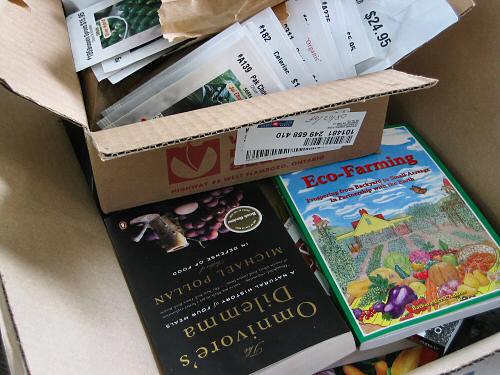
Better than Christmas! The first half of the first big seed order, and my first book order in months, both arrived today.
Seed every year comes almost entirely from three companies: William Dam, Veseys and Terra Edibles. The first two are both bigger, family run companies, one definitely slicker and more marketing-oriented, with a series of color catalogs through the year in addition to their main one, all kinds of enticing special offers involving free shipping, a call center with almost no waits, y’know, the works. The other is definitely more…”indie”, with a single annual catalog, a written commitment to untreated seed only, and a busy signal more likely than not right through the order season: keep calling till you get through. The third is a tiny company specializing in heirloom seed, grown in-house or directly sourced from small growers.
The cool thing about all three is that you’re actually dealing wtih the owners, right to the top. Even in the case of the slickest one, when a seed potato order was a WEEK late last year, the prez himself called to apologize. And I’ve had great, informative chats with various people from all. It’s another small satisfaction, knowing to a degree from where and whom your seed arrives.
The book situation is a little different: Amazon.com (Amazon.ca, in my case). It seems like a sprawling, faceless, digital megacorporation, and I long ago stopped keeping track of who bought out who, but as far as I know, it’s still…OK (like, not like Facebook). And it’s downright depressing/futile to browse a small-town bookstore if you’re looking for specific titles (of course, they can always order in, so I do it myself instead).
Anyhow, the few titles (selected from a long list of must-reads): The Complete Vegetable & Herb Gardener: A Guide to Growing Your Garden Organically (based on a recommendation), The Omnivore’s Dilemma: A Natural History of Four Meals (finally…eek! :), The Art of Simple Food: Notes, Lessons, and Recipes from a Delicious Revolution (hmm, high hopes for this one, based largely on a Charlie Rose PBS (US public TV) interview with author Alice Waters; I WILL cook more, but we’ll see if this helps…), Micro Eco-Farming: Prospering from Backyard to Small Acreage in Partnership with the Earth (I have NO IDEA how this came to the long list, I forget, but I did mark it with a bunch of stars…). And then there’s the Linux Pocket Guide, ’cause with blogs and web sites, like tiny farms, it’s usually best to know your way around the territory…
Off to start some rosemary really late, and read!
First cuts
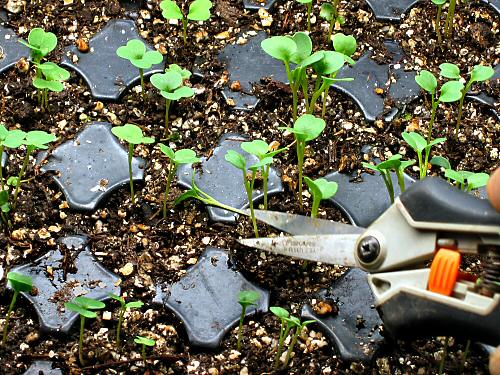
Time to thin out the lettuce and arugula. Between the seven varieties, some of the seed I used was up to four years old, so to be safe, I was quite generous, maybe 4-5 seeds per cell for the arugula, and a bit more for the lettuce (that tiny seed can get away from you, though with new seed, I try to go lighter). Germination was good, and the little seedlings are already shading out each other as they push for the light. I’m still getting used to timely, to-the-point thinning, both in the trays and in the field. I usually have the urge to leave ’em a while longer, but almost always, this ends up being not the best thing to’ve done. Give the best ones the biggest break as early on as possible, which means, kill off the rest. This also takes some timing experience, but in general, it’s hard to go wrong by not waiting around. Sounds brutal, but that’s about it! The lettuce will eventually be one per cell, although for now I’ll leave a couple per. Starting arugula indoors is a first for me, I usually direct-seed, so I’m figuring things out this time around. I’ll leave two per cell, and plant them out two together at 6″ (15cm) spacing and see how that works out. Here, I’m snipping arugula at the soil level with wickedly pointy little shears…