Seed ordering sanity

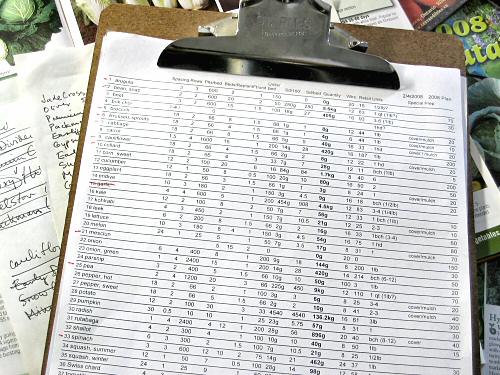
Seed ordering sheet

The first main seed order is finally done. There will be one more in a week or two, and then I’ll be set for the season. Working out the order was relatively painless, it does get easier every year, but without this handy Seed Quantity Calculator, my head would still be spinning. There are at least 65 different veggies, herbs, and flowers, and must be well over 200 varieties overall (wow, hard to believe when you add ’em up). It’s a lot to piece together.

Of course, I could REDUCE. That’s a whole other story (and then there’s the hybrids/seed-saving issue), but basically, I think variety is a great thing on all levels, so instead of reducing, I resist the urge to add more. For mainstay crops like green snap beans, I’ll try at least 2 or 3 similar varieties to see how they perform in this particular field (depending on conditions, the differences can be quite big). And you’ve gotta Try New Things, grow a little okra, some Jerusalem artichoke, LOVAGE, a row of tomatillos, and…lots more—even if a crop’s not exactly popular (self included), we can all learn! Crops, cultivars, there’s a lot of seed to choose from… And it gets more complicated.

On this tiny farm, where plantings are measured in multiples of 50 row feet, not in acres, the catalog price breaks are a maze of temptations and false economies. Seed for many crops becomes tantalizingly less expensive right after the first “bulk” quantity. For example, if 5g of something is $6, and 25g is $18, how can you pass up savings like that, especially when the difference is “only” 12 bucks? Freeze the extra and it’ll be good for years! But those extra 10 and 20 dollars add up real quick, and there are always lots more varieties to try.

So it goes, crop by crop, variety by variety, at ordering time. It could get real messy if I hadn’t long ago (Year 1!) worked out my seed quantity order sheet, which at least allows me to instantly check on how much space I really have, how much seed I really need, what the yield might be like… That helps!
Read more

Getting started

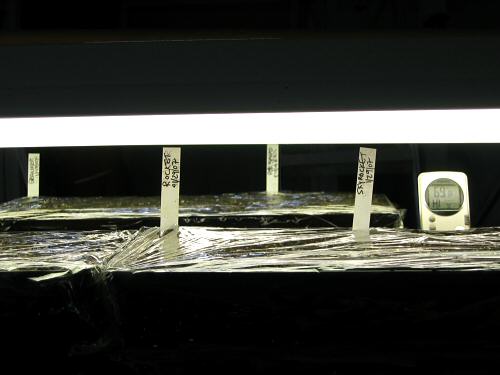
Started the first seeds of the year today: lettuce and arugula. At night, the grow racks remind me of a lab experiment, with the plugsheets in trays, carefully labelled and sheathed in plastic under the intense white light (fluorescents up close are pretty bright). And there’s the digital min/max thermometer, keeping score. The whole set-up looks like what it is. It’s great! In the beginning, I kind of obsessively (and largely unnecessarily) check every few hours to make sure the soil mix is sufficiently moist, the temperature is above 60°F, to see if anything’s emerged and it’s time to take off the plastic. Maybe after another five or 10 years, it will become simply routine, but for now, every single plant to emerge is still cool and exciting… For this, the earliest lettuce attempt yet, I’ve started five varieties, all with maturity dates of 50 days or less. There’s Simpson Elite (a really fast 40-day) and Two Stars, both green leaf, Granada and Red Salad Bowl, both red, and Sierra, which is red tinged. As a salad mix in any combination or all together, they’re a great blend of colors, textures and tastes. The arugula, Rocket and Skyrocket, intended for the mix, is faster growing than lettuce, but I felt like starting some now (I’ll start some more, later). If all goes well, these will hit the unheated greenhouse in the beginning of March, a good three weeks ahead of last year!

The seed…

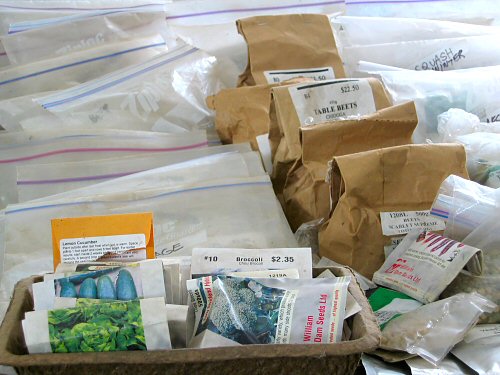
Keeping up with the early start, I got out the seed from its storage chest to take a look. With the tiny farm’s growing HISTORY (hey, Year 6, coming up!), keeping the seeds sorted for freshness is an ever more…serious consideration. Old seed won’t work, and there’s always lots of carryover from year to year. For this garden’s veggie selection, seed life in cool, dry storage conditions falls into three categories: nice and long (around 5 years, for brassicas, cucumber/squash family, lettuce, tomatoes,…), medium (around 3 years: beans, peas, carrots,…), and SHORT (1-2 years, for onions, corn, parsnip, parsley,…not too many here). Luckily, this is all book info, not gathered from painful personal experience! But I listen closely, ’cause one of my biggest garden nightmares is THINGS NOT GERMINATING… There are enough reasons why gazing happily on those newly seeded, semi-straight rows might be the greatest satisfaction they ever offer, and dead seed shouldn’t be one of ’em. My first germination test last year seemed to bear out the wisdom of others: normally-stored seed is not forever… So, it’s checking packs and taking dates!

Broccoli flowers (flashback!)

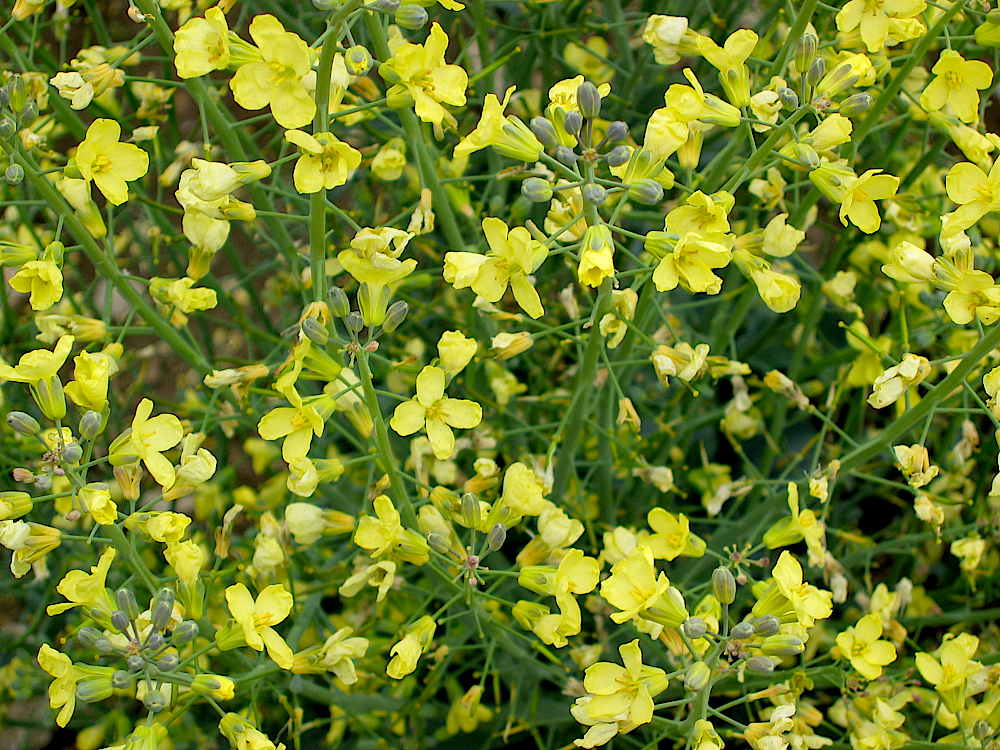
No real farming action today, but here’s an alternate entry from 2-Oct-2007—never let a perfectly serviceable post go to waste!: On my way to seed saving, I tend to let things go to seed! Here, the secondary shoots in a bed of Early Dividend broccoli have exploded, the tiny green beads turning into a gently rolling sea of miniature flowers on long thin stems. Unfortunately, the eventual seed from this hybrid variety wouldn’t be reliable…but it’s a step in the right direction! Also going to seed around the field: lettuce, radish, cauliflower… There’s some cleaning up to do. :)

Update: As mentioned in the comments below, these little guys are delicious as edible flowers, slightly sweet, tasting mildly of broccoli. We take them to market to offer as a free garnish for salad mix.

Catalog season

Seed catalogs

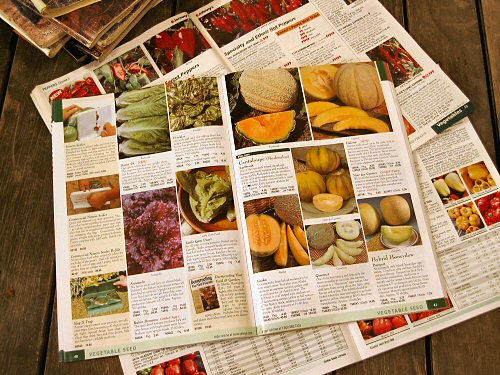
As pure, abstract small farming pleasure, for me so far, catalog season can’t be beat. This year’s catalogs started arriving two or three weeks ago. The first from one of my main seed suppliers has been here only a couple of days, and I’ve started flipping pages and poring over tiny type. What’s all the fun about? Simple. It’s the clean slate, the chance to START OVER, with the little edge of knowing what you know now, after another way less than PERFECT but oh so educational growing season. EVERYTHING is more than possible…next year! I’m picturing—visualizing!—a two-month continuous harvest of succulent MELONS, plump, super-early hybrids followed by exotic long-season heirlooms. Never mind that, between water issues, cucumber beetles and roller coaster temperatures, the melon crop here has never been too fine. That’ll change. Melons, and all manner of crisp, mild salad greens right through the summer heat, parsnip without endless hours of tedious, fingertip weeding while waiting for germination, plentiful red and orange and yellow and chocolaty brown peppers well before first frost (several varieties of eggplant, too!),… Wow, it’s almost unbelievable!! Especially with the pristine new CUT FLOWER GARDEN. And it all starts with the catalogs! I realize this is an odd sort of consumer world pleasure, and most of this is about hybrid seed that HAS to be bought every year. Still, I can imagine it as SIMPLE, and it’s great fun, until I get around to seed saving… ;)

The new year begins here!

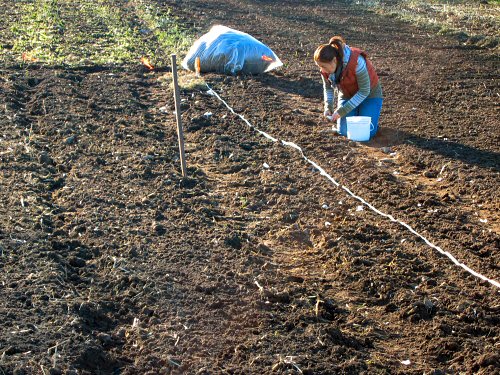
A perfect moment in tiny farming time as the first garlic goes in for next season’s harvest! It’s all Music (that’s the hardneck variety), and for the first time it’s 100% my own seed stock (last year, I had to buy some to add to what was set aside). The new garlic plot should be the best so far, with oats green manure and year old cow manure tilled in. Lynn and Conall dropped by to help. The row set-up is new. Previously, I’d done two double rows per 5′ (1.5m) bed, each double row spaced 6″ (15cm) in-row and between, with about 18″ (46cm) between the doubles. This year, a more intensive approach: five rows with 6″ spacing both ways, in a 4′ (1.2m) bed. What does all that mean? 500 garlic in 4’x50′ instead of 400 in 5’x50′. It should make mulching, watering and weeding that much easier! I tilled up the bed a couple of days ago to allow pushing in the cloves by hand (the moist, clayey soil gets pretty dense this time of year). The rows were marked out (you can just make out the lines in the soil), and we ran a measuring tape down the beds for quick checks on the in-row spacing, ’cause I’m a little concerned with crowding. They were planted about 4″ deep, from both sides, three and two rows, to avoid uncomfortable leaning (the greens machine was a little too narrow!). Afterwards, the beds were raked to fill in the holes. In the pic, there’s a bag of that new mulch, ready to go (although I ended up not spreading it today). The first 2,000 went in in three hours. I’ll add some more, another 500-1,000, a little later on!

Rye arrives!

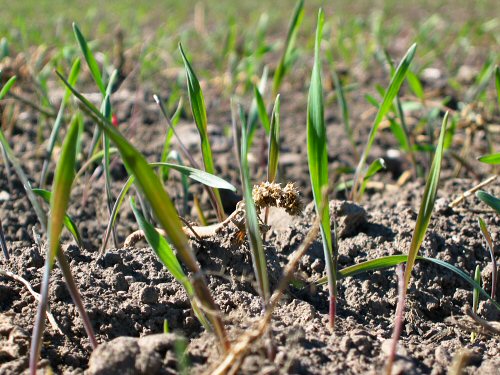
Where the oats arrived with a dramatic, iridescent splash of green, the fall rye made a much more sedate entrance, so much so that I didn’t notice it until today. It probably emerged a couple of days ago. It’s looking great! I dunno why I’m so extremely pleased by these green manure cover crops…but I am! The rye comes with a lot of promise. It probably won’t winterkill, instead, start up again in spring, making it good for sections that won’t be planted out till May. It thrives in cool weather, also making it great for fall and spring service. And it may have an allelopathic effect on PIGWEED, meaning that, on a plant-produced chemical level, future pigweed may suffer… That’s nice. On the caution side, if it gets too well-established, it could be a little tough to eradicate. No worries. I won’t seed it on sections that’ll be used for the earliest spring planting (there won’t be time to till it in), but otherwise, I’ll spread this around everywhere I can for the next month or so and see what happens!