Onions from seed!

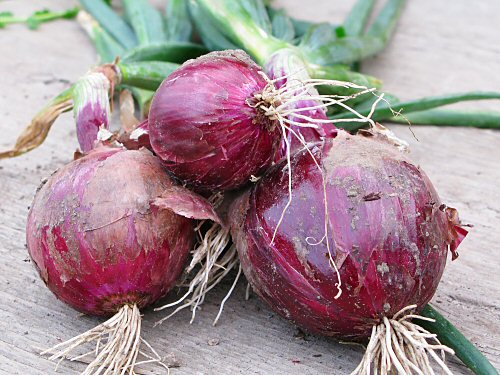
This is the first year I’ve tried growing onion from seed, and they’re doing fine. Today, I pulled up one multi-planting of Red Wing to check ’em out. Multi-planting onions was also a first-time experiment, with 3-4 seedlings transplanted in one spot, at 12″ (30cm) in-row spacing. They’ve done a good job of pushing themselves apart, they’ve stayed pretty round, not flattening out where they touched.

Another thing I was a little concerned about didn’t come to pass. For around a month, the onion seedlings had already been under the usual 14-16 hours a day of fluorescent light on the grow racks, when I read about the possibility of daylength sensitivity at the seedling stage. When the amount of sunlight reaches a certain threshold, over 12 hours or so for long-day varieties, the onions move from leaf growth to producing bulbs. A couple of sources said that premature bulbing can be triggered by too much light too early on, even at the beginning seedling stage, and you’d end up with tiny, marble-sized onions after a season in the field. Other sources disagreed, but in any case, that didn’t happen here! Still, in future, I’ll start long-day onions under reduced artificial light…to be safe.

As usual, the cracked surface of our clayey soil looks rougher than it is: it isn’t really hard, only a thin, dry layer with moist soil right underneath. Here, four out of five seedlings have pushed apart, rotating the stems outward, and grown into decent-sized…onions!
Last of the lettuce

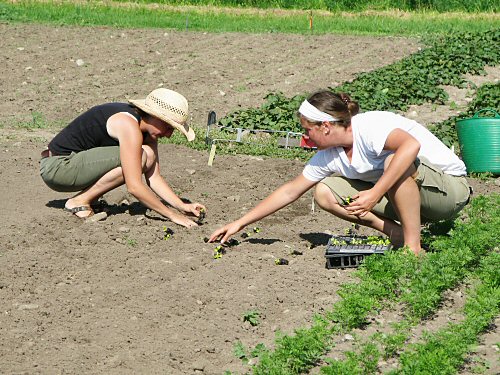
Can’t quite seem to stop planting! Lynn and Libby put in a last 200 or so lettuce seedlings to see how far they’ll go in fall growth. The soil is still moist an inch (2.5cm) or so down, but the surface is way DRY from a few days of sun and breeze, so we watered in these guys—the weather’s been great, sunny and warm this week…and it’s back to the hoses!

Last of the season’s brassicas

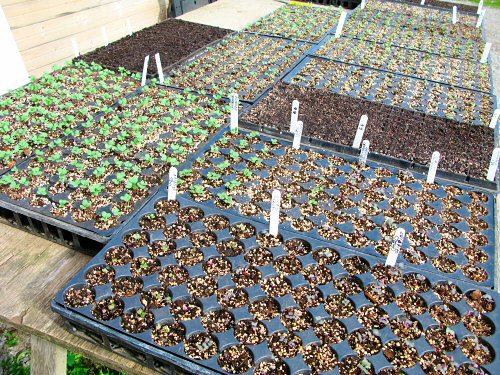
These brassica seedlings—broccoli, cauliflower, kale, early-maturing cabbage—were started a week ago, way late by any planting guide standard for our region, but I’m going by the reality of our recent crazy weather. Last year’s “late” cabbage family seedlings did just fine, so I’m gambling again! There are a couple of 200-cell trays of lettuce in there as well…

Shifting gears for summer…

The spring rush is over, and fieldwork is shifting into summer mode, from mainly planting to mainly weeding and watering, and then, HARVESTING. Seedlings for the most important crops and varieties are in, although there’s still quite a lot to transplant.

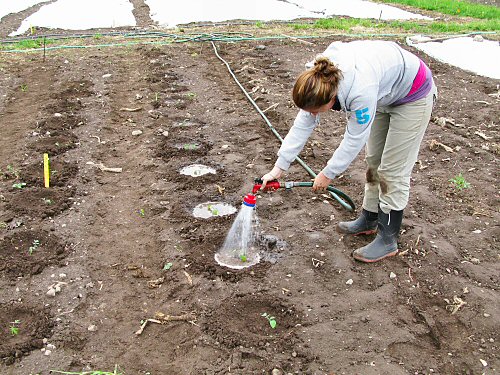
Here, we’ve just finishing another 100 or so tomatoes, with Lynn watering them in (the Redhead water breaker is GREAT, delivers as much water as you’ve got pressure, while softening the flow so that you’re not smashing or burying the seedlings). Creating a little basin around each seedling makes the most of hand watering in.

In my continuing experiment with shortening seedling production time, these are the youngest toms to go out ever, a third set started at the beginning of May, with their first true leaves now just coming in!

There are also more squash, melons, and a few more toms to transplant—in years past, I’d’ve been concerned about the date, but I’m learning to adapt the season’s resources (time, people, irrigation capacity,…) to the WEATHER.

Keep the workflow balanced is my new first mantra, so we also spent a few hours weeding today (Ryan dropped by to help for a few hours, he’s a new CSA-er this year who is also about to move his family to their own tiny farm at the end June!), instead of rushing on the last transplants.

It’s hard to measure, but for this type of small, diverse market gardening, in this time of extreme weather, things quite often don’t work out as they traditionally should. For example, the recent rain and cold, and now, more heat, have created a situation where the dominant weeds—pigweed, mallow, and lamb’s quarters—are seemingly slow, but are in fact about to explode. Weeding now will probably save way more time and deliver more harvest than putting off weeding just to transplant a few more beds a few days earlier.

I dunno, I’m figuring this out as I go, but I think traditonal garden rules and timing have to be increasingly bent as the weather gets crazier… I guess you could say: EXCITING TIMES! :)

Potting for market

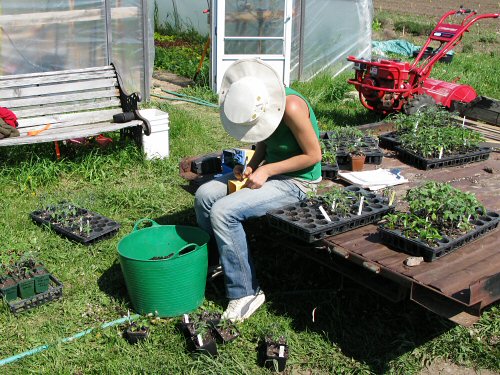
With the recently warming weather, field crops have started to grow more quickly, but nothing but radishes will be ready for this Saturday’s farmers’ market, and the early lettuce in the greenhouse has gotten pretty low after two weeks of harvesting. This is a first: by the end of May, mesclun and usually spinach have been ready in the field. Not this time. Sooo, we decided to fill out the week’s market stand offerings with seedlings. Selling my extra insurance seedlings at the market is something I’ve avoided until now: for the few dollars more, it didn’t seem worth the chance of complaints if anything goes wrong (I’ve heard people blame all kinds of things on the plants they buy)—usually, I’d sell or give only to people I know. There’s always a first time, so Shannon potted up and labeled a couple of dozen spares. We’ll take a walk on the wild side and see what happens… :)

Seedlings away!

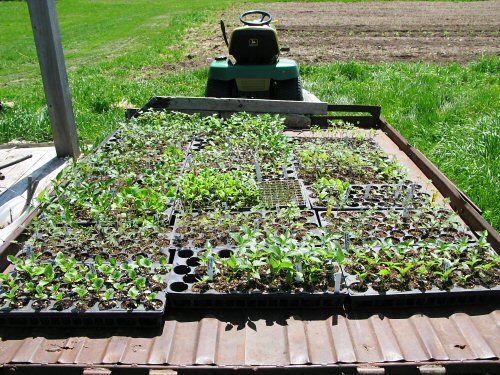
Things can change suddenly on the tiny farm. I picked today to move the majority of seedlings to the greenhouse. Although this was MUCH later than hoped for earlier this year, it’s all about the (recently COLD) weather, and I didn’t want to spend much on heat. But you can’t wait forever. There’ll probably be at least a couple of freezing nights in the next two weeks, but it IS getting to mid-May, and these guys will be out in the field, one way or another, before the end of the month. So, it’s out of the Milkhouse and onto the trailer behind the little John Deere riding mower for a little trip…

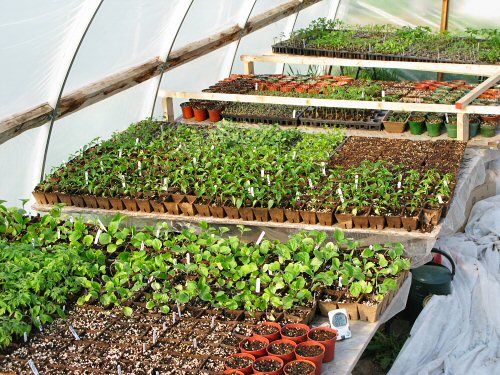
The greenhouse tables are now just about full, and that’s with a fourth one added a week or so ago. Plus, there are a few more trays of plug sheets on the ground off to the right. Lots more seedlings than ever before… On the closest table, there’s the (excellent) digital min-max thermometer/hygrometer, recording critical highs and lows, right after the fact! New this year are those red and green plastic pots (with cukes, squash, pumpkins, melons)—I decided to stop using the 3″ peat pots and try soil blocks, BUT, I didn’t feel like learning about block making right in the rush, so I used the last of the peat and then dipped into the collection of plastic pots I’ve been given over the years. (I’ll get the soil block maker in the summer, so I can play around with it first…)

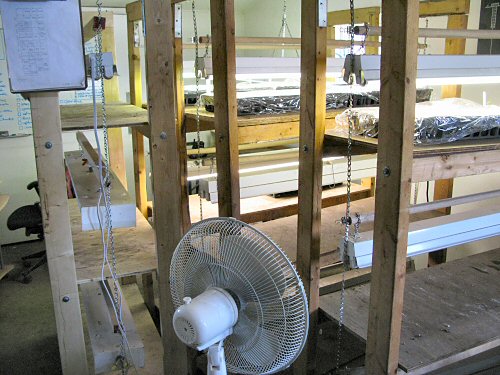
It’s always a little…sad when bright, cheerful gear goes dark and empty… There are still a few trays of really young tomatoes, brassicas, and a couple of other late-started things, but the grow rack days are just about over for the year. We’ll soon be stowing the lights and chains, and presto, instant rolling racks for harvest bins. Transplants for late spring and summer will get started in the greenhouse…

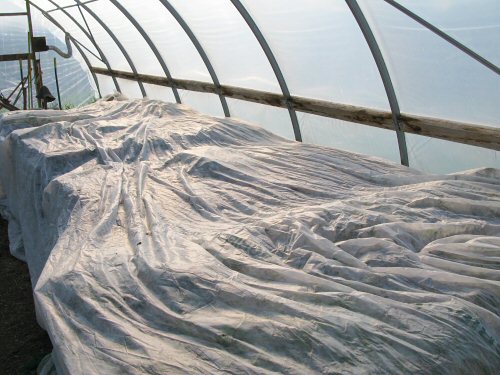
And so, the seedling greenhouse gets tucked in for its first full-house night of the season. Boy, imagine if something WENT WRONG in there… :)

Potting up

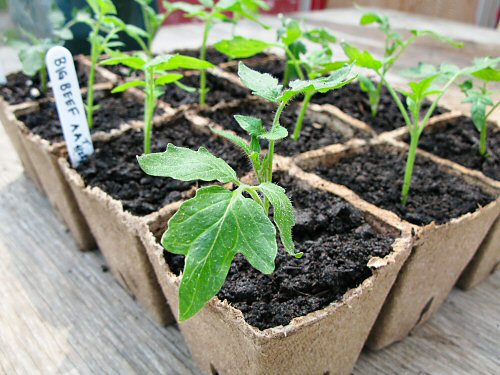
Many things are going on at once, and one of them is potting up seedlings and moving them out to the greenhouse. Already, onions, leek, parsley, lettuce, and the first trays of cauliflower and broccoli are out there, all of them hardy enough to take whatever cold comes along. What’s really going to use up space once they’re potted up are the tender tomatoes, peppers and eggplant. I’d like to’ve had them all done by now, BUT, there’s going to be a cold snap for 4-5 days starting early next week, a couple of nights may go down as low as -8°C (18°F), and I’m concerned that row cover and the kerosene heater may not be enough protection in the unheated greenhouse. So I’m waiting, potting up a few every day and finding room for them under the lights. I started with the Chosen 100, my earliest 100 tomato starts, 25 each of Big Beef (above), Juliet, Striped German and Stupice (in order, two hybrids and two open pollinated heirlooms). They’ve gone into 3″ peat pots, with a mix of peat, compost and soil, and I’m also hardening them off outside. The rest of the toms were started a couple of weeks later. They’ll move from 72- to 38-cell trays, all part of the spend-less-time-on-transplants experiments… Waiting on weather forecasts is a bit of a risky way to work, it’s really not a good idea to delay anything at this point in the year, I’ve found it’s generally better to get on with things and deal with problems as they come up, not try to second guess the future. But I have so much else to do, I’ll take the chance and wait a couple more days to finish them all…