
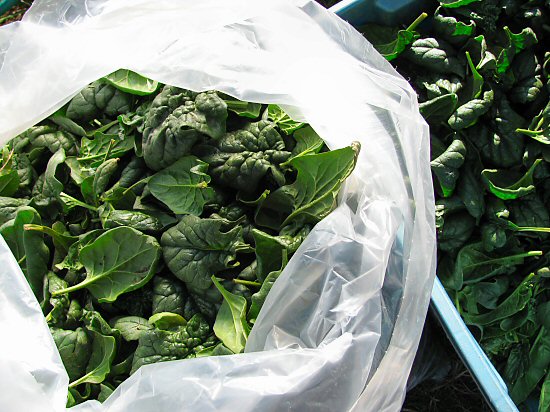
So this is it for the season’s spinach, a last 18lbs (8kg) of Spargo, unfazed by many subzero nights and all sorts of up-and-down weather antics. Spinach is one of the great ones for cold-climate tiny farming, easy-going once it gets started, tough under freezing conditions, and always in demand… The deer that’ve been lurking and circling the field all year have started to come in for an exploratory nibble here and there, working their way in from the edges. At this point, it’s slim pickings! They discovered one edge of this final, late-planted, slowly-growing spinach patch a couple of days ago, so we (Lynn, Steve, and I) grabbed the rest this morning. Between us and them (mostly us!), the spinach is done!
spinach
Garden in transition
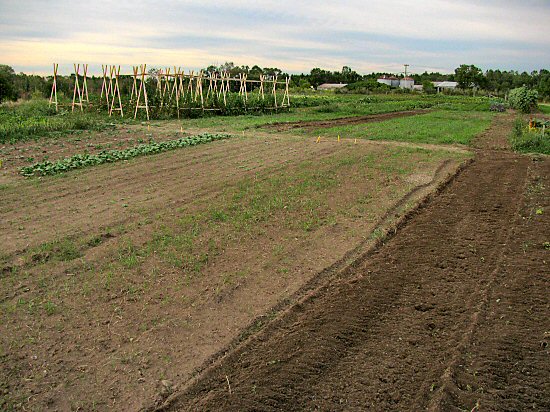
The weather is warm, the days still feel long (although, at 5:00 a.m. for Saturday market, I’m already waking up in the dark)—summer is in full effect, but you know the season’s soon changing because the field is clearing out. Today, I did some tilling, cleaning up before weeds get too established, and preparing for a last seeding of spinach for fall harvest (a gamble, for sure).
In the pic, a couple more passes to the left of the freshly turned strip and we’ll be at the edge of the previous spinach planting, barely visible, seeded about 3 weeks ago. To the left of that, a half-bed of bok choi, delicious and miraculously untouched by flea beetles, at tiny baby stage from seedlings transplanted at the beginning of the month. Beside the bok choi, beds of broccoli and cauliflower, also set out 4 weeks ago, and looking pretty good for harvest in October.
This section was planted out at the start of the season to snap peas, lettuce, and the first spinach. After adding in some of the handy pelletized alfalfa, it gets to go round again!
In the next section (top right of the photo, which is…east), I’ve started tilling in an overgrowth of grass and vetch, where more peas and the first plot of potatoes used to be. That section is done for the year, and may get a protective cover of fall rye, as a green manure to be turned under in spring.
In the market garden, it’s always one thing after another… :)
Another rainbow
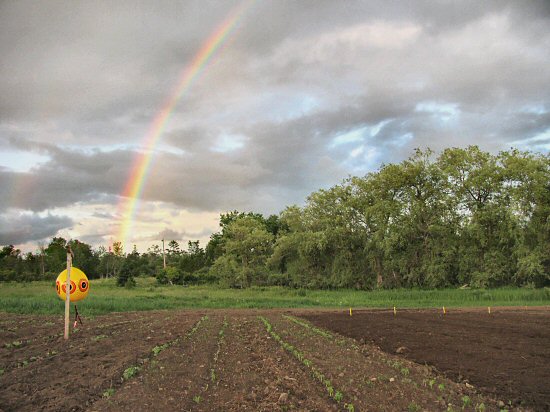
It’s almost “yet another rainbow,” but not quite. We’ve seen a good collection so far this season, including quite spectacular horizon-to-horizon double rainbows two nights in a row. Which means there’s been lots of rain, and all the cloudiness that goes with it. It’s nowhere near as miserably wet as last season, though—rainfall this year has actually been great, averaging around the golden inch-a-week (2.5cm-a-week)—but 4-5 mainly cloudy days out of 7 is slowing things down.
How slow? The first summer squash that should’ve popped in size in a few sunny days, has been slowly expanding for well over a week. Root crops like beets, carrots, potatoes, aren’t affected as much, and seem to love the rain. But toms, peppers, eggplant and the whole cucurbit family (squash, melons, cucumber) are in slow motion, maybe a week or two from where they’d be with lots of sun.
Still, all in all, everything is growing along well enough, and we’re bound to hit a sunny stretch. Right?
In the photo, a third planting of green and yellow snap beans, with scare ball in place to scare off birds (it seems to work). To the right, a freshly tilled section, waiting for a third planting of spinach… This weather’s great for summer spinach!
Early season harvest day
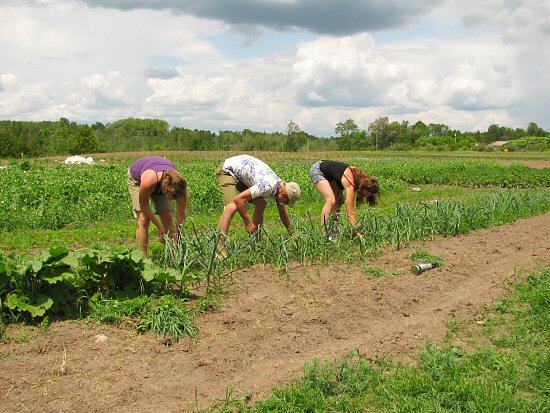
It’s a harvest Friday, second for the farmers’ market, and first for CSA, but the load is still light. After picking snap peas, we spent the day doing other field work. In the photo, Libby, Jordan and Michelle are hand-weeding the small strip of spring-planted garlic, and we spent some labor-intensive time thinning a 400′ (122m) of carrots, and several beds of beets (the thinnings were the beet greens harvest). In late afternoon, time to cut greens: spinach and mesclun. Plus a little parsley.
Checking back over the last four years, at this time, we had broccoli once, radishes usually, baby Swiss chard a couple of times. And, of course, garlic scapes. And, a couple of years, no peas yet. So, all in all, with the slightly slower planting schedule in this start-up this garden, and all the cloudy weather, we’re doing pretty well!
First veg at the new farmers’ market!
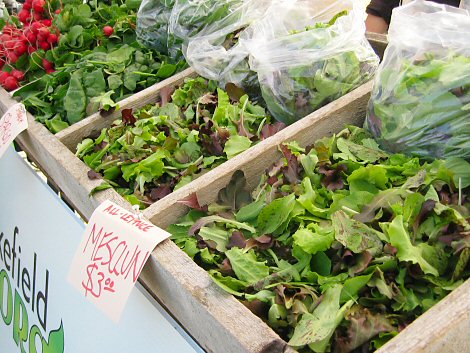
At last! Our first day at the new farmers’ market, with a large sign (we temporarily used our new roadside sign to make a…big entrance :), and a small but superfresh and tasty (and seasonal) selection: all-lettuce mesclun, spinach (Spargo) and radish (Rebel). Lynn was happy to be at market in her home town, and Tara made her new-tiny-farmer market debut! The flow of people was steady, and we sold out by 11 am. Pretty good!
Pricing at this market is quite a bit different from the old market: everything is more expensive! It’s not quite at urban market levels, but a lot closer in this bigger town. Basically, the same harvest as in previous seasons sells for almost twice as much.
This is for sure more realistic and fair. I think about the ridiculously low (though rapidly rising) cheap food supermarket pricing that sets the baseline for what small growers can charge at the market. I recall that in North America and Europe, we apparently spend less than 10% of income on food, when quality produce just can’t come that cheap. And these aren’t ridiculous, high-end, boutique veggie prices, simply a more realistic price—processed foods are still sooo much more expensive, while possibly (probably) killing you at the same time…
STILL, it kinda feels weird putting less into a bag than I’ve been used to for six market seasons. Oh, well, change is always a little strange, this one is good all around, and I’ll get used to it! :)
Happy signs of veggie life
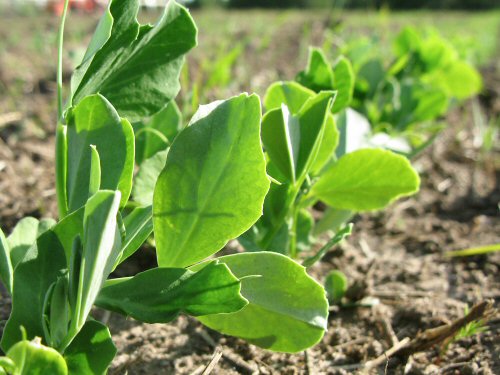
Snap peas (above) are still the crop to watch for pleasing signs of veggie life in the fields. Mild concern over the chopped sod content continues, so each new bit of healthy growth, while expected, is still a happy event! The soil itself is nice, I’m comfortable with the fair degree of clay content (water-holding is good!), I’m pretty sure we’re developing a good working relationship. And there is a lot of other stuff to see. Three successive seedings of Sugar Ann snap peas are doing well—the first two are below, and in the distance, two seedings of spinach, broccoli and cauliflower under cover, radish, beets,… And there’s lots more. With tiny farming and Mother Nature, trust is good, but seeing is believing!
A field day
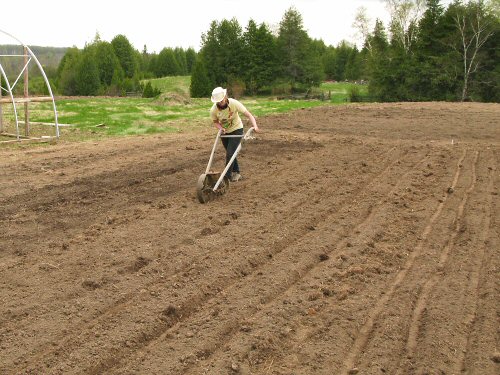
At this point in the season, EVERY day is a field day, unless it’s totally rained out. Today was no exception. Lynn brought a couple of friends, Julia and Tom, to check things out and lend a hand. They’re off to work in one of our fine parks this summer, but wanted to see what was going on on this tiny farm. No problem!
I seem to’ve gotten pretty good at tossing people into the tiny farming action, with little work-up or ceremony. A quick tour around (and here, there’s not much to see just yet), and it’s on to the hands-on. Neither Tom nor Julia had experience with market gardening, but in no time, they were seeding with the seeder of the day, the trusty and heavy Planet Jr. (above). We’re doing a second planting of spinach, and a third of peas…
The Planet Jr. can take a little getting used to, so there I am, explaining how it works as we go! Knowing exactly what a tool is doing and why really makes learning to use it so much more…satisfying. I think.
Just about EVERYTHING in tiny farming is quite simple and straightforward (there’s just a LOT of simple things to know!), still, some people have a natural talent for this or that. Like, Tom can clearly walk a very straight line as he measures off more beds for onions and peas. The current bed marking method: measure and stake the path centers at both ends of the bed, and walk ’em in! It’s pretty simple.
For getting your hands dirty, there’s nothing quite like crawling along in the dirt, pushing Stuttgarter-type yellow cooking onion sets into the ground, six inches (15cm) apart, by the hundreds. Once you get into the rhythm, you can sow and chat, and things get done in no time! All in all, relaxing and productive day in the field. Fun and useful, I hope, for all! (Photos 2, 3 by Lynn.)