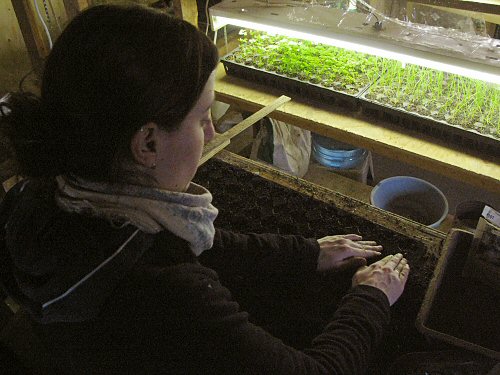
It’s spring! The ground is clear, hasn’t snowed in a while, but it’s still cold, and the tiny farming action remains mainly indoors. We’re steadily filling up the racks (here, Lynn populates a plug sheet with Red Russian kale; under the lights, parsley and onion). I’m spreading things out a lot more than usual, instead of starting a whole lot on one day. We’ll see what difference a few days or a couple of weeks make to the various veg… It likely won’t be much, but some interesting things could happen if we get really drastic week-to-week weather changes around transplant time, like we did last year. An experiment!
Spring
Pick your own CSA share pick-up
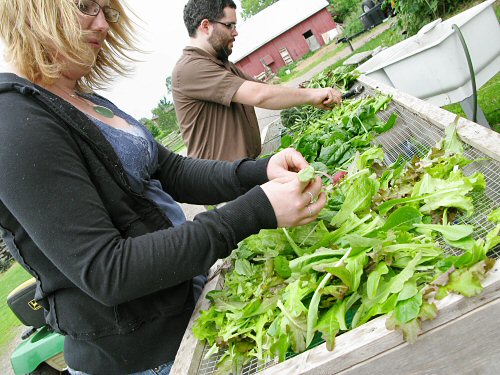
CSA shareholders coming to the farm this year are encouraged to harvest as much of their share as they feel like! Here, it’s sorting through mesclun and spinach on the screen table, removing bad leaves and the odd weed, before packing in their own bags. This approach is great fun all around, with me explaining what to do and helping out when needed. There are only a couple of on-farm pickups (most are at the farmers’ market), so this approach might be a little more personalized than if the number of shareholders was bigger. Regardless, this DIY approach is a tiny farm first that seems to work!
Chickens to the slaughter
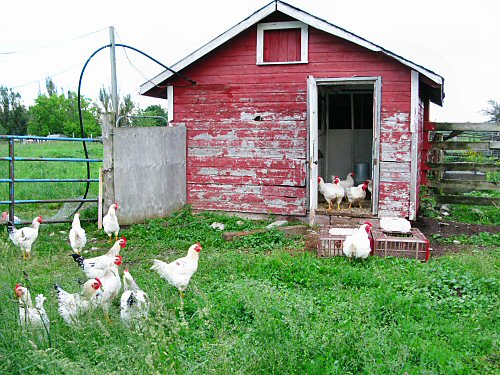
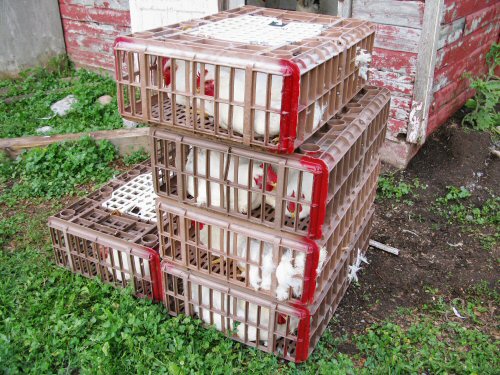
Raising your first chickens, killing them, and eating them has gotta rank up there with other Firsts worth a little attention. Now, I’m at least part of the way there: the killing this time was done behind closed doors, with me on the outside—chicken PROCESSING. Still, first enough to be worth a few photos… I’d been cutting it close with booking a processing day for the White Rocks, the local processor is known to get solidly booked for weeks. I finally called yesterday, looking for a date in two weeks, and was told there was also a cancellation for tomorrow (today!). I checked out the WRs, and, man, how could I imagine them getting any bigger (I think I was mesmerized, waiting for them to explode)? So I called back and booked. We drove over last night to pick up crates (20 minutes each way), then it was up at 5:30 this morning to load ’em. As soon as I opened the door, all of the Frey’s dual purpose darted out immediately, as usual, while the WRs, who mostly go nowhere, stayed in: it was kinda fitting that the Frey’s stood around in unfenced-in freedom, ready to run (and they would’ve!), while the WRs kinda dumbly looked out at their crates (above).
Five to a crate, 25 in all, 30 minutes or so to loaded…no need to chase down these lumbering beasts (while I was packing, most of the Frey’s figured out no good was afoot and entirely disappeared around the other side of the chickenhouse, something they’d never done before, while a couple stayed to watch).
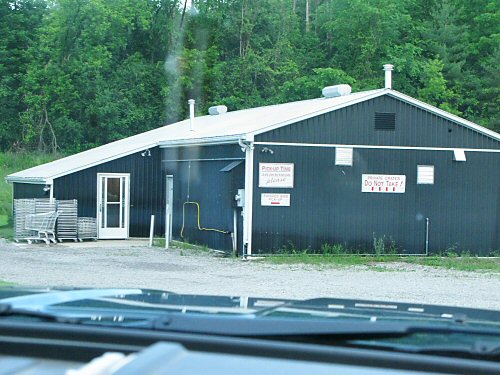
The processor is on a farm, a low building where birds go in live on one side, and come out the other, cleaned and chilled, weighed and government-inspected, ready to go…
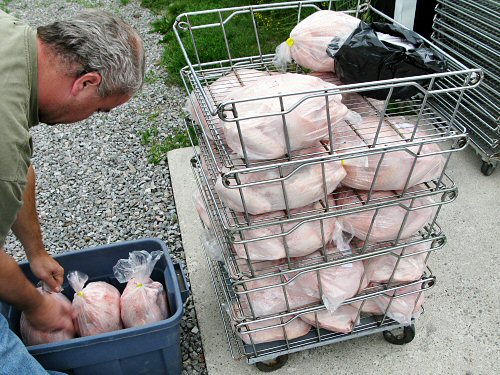
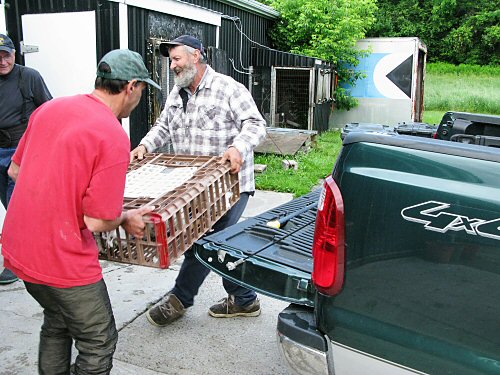
Bob and a processing guy unload. It’s 6:45am. The paperwork is quick and painless, I didn’t even have to write or sign anything. The only sign of bureaucracy in action is the required chicken purchase number, a serial number that’s on the form that you fill out when purchasing the chicks. And the on-premises government inspector popped out and did a little of his own paperwork. Other than that, just processing choices. For a few cents more (like 75-85), you can have the chickens halved and put in separate bags, or halved or quartered in the same bag. We got 10 halved and separated, for when cooking a whole fat chicken would be a little too much. Modern conveniences?! :) I also chose to get the organs back (in the black bag; below).
Eleven hours later, it’s 5:30pm and we’re back. Matthew helps pack the big birds for the trip home and into the freezer. Average weight is around 8lbs (3.6kg), where the Frey’s are maybe barely 3lbs. Hmmm… Not the most satisfying little adventure, with three 40-minute round trip drives, and the chickens disappearing through yet another middleman, reappearing neatly packaged for $3 more… With the processing fee tacked on for good measure, these are EXPENSIVE chickens, but I’ll do the math, and review the overall, somewhat unsettling White Rock Experience…later. On the other hand, you can’t beat the results: a lotta REALLY plump chickens! Next up in Meat Birds, Take 1: waiting for the free-ranging Frey’s to bulk up, and THEN it’ll be a fully DIY field-to-table chicken dinner!

Checking under row cover
Three weeks ago, it was floating row cover everywhere. So, what was it worth? Today, I checked things out. Overall, growth has been startlingly slow, due to the lack of sun. This is really noticeable in the summer squash (above), which could be huge at this point, but…aren’t. Under cover, these zucchini (I didn’t check the variety) are doing fine, no cucumber beetle damage, but of course, weeds are doing fine as well: unmolested under there, pigweed runs rampant. I’ll take the cover off here in another week or so, and then there’ll be a whole lotta weeding to do… I removed the cover from the first beds of cauliflower (Snow Crown) and broccoli (below), they’re big enough to take a little flea beetle munching. The leaves have shaded out much of the potential weed action in the beds, but you can see a nice collection in the path (top center, where the row cover ends). The plants look untouched, although the flea beetles managed to get under and at the kale and collards, (they’re out of sight just to the left)—I left them covered, back in a week. If there’s any doubt about what the FBs will do, just check the radishes, which grow MUCH faster than these guys and can survive the damage…
Back with the cucurbits, the cucumbers are the most noticeably slow: after a month, they’re hardly bigger than the transplants they started as (hope it’s all going into the roots!)… I’ve cleared away the weeds between a couple of the plants, beetle damage is minimal (they tend to get in at the ends of rows, where the cover can get blown up by the wind), but there are weeds everywhere. Cover goes back on here for a while. Weird stunting weather and floating row cover: not the most peaceful and inspiring natural garden combo, but it should all straighten out in a bit… ;)
Weeding day
A cool, gray, peaceful day of WEEDING. Lynn and Raechelle combine hoeing and basic hand weeding to pull up a nice mix of pigweed and lamb’s quarters, with a little mallow and orchard grass for variety. I did paths with the wheel hoe. At the same time, we checked for Colorado potato beetle eggs (orange clusters on the undersides of leaves)—they’ve been here for a week or more, but so far not in troublesome numbers. It’s slow work, but satisfying in the end. The potatoes are growing abundantly with all of the moisture (which isn’t a problem so far), so much of what’s weeded now won’t be coming back under the expanding leaf cover. That’s nice.
Measuring peak oil by the can
This tiny farm’s entire direct connection with the world of oil is simple: six red, 20-liter gas cans, three for gasoline, three for diesel. It’s a really stark way to watch spiralling gas prices and the so far bubbling-under peak oil panic, made more so for me because I don’t drive (never bothered to get a license), and I’ve lived 100% in big city cores until the farm—North America’s deep-set gas station culture had been a spectator thing for me. And now, gas is suddenly connected in a very straight-flowing line, from pump to a handful of tiny farming tools that perform clear and specific tasks. On the gas side, there’s the riding mower (mowing, mulch collecting, hauling stuff in trailer, used a lot), a walking rototiller (only moderately used since the wheel hoe last year), the pond irrigation pump (with so much RAIN, not used at all this year!), a weed eater (used only moderately), and another weed eater converted into a mini-cultivator (seldom used). On diesel: the Kubota compact tractor (rototilling, moving stuff with the front-end loader, quite used). That’s it! I filled three cans in mid-April, two diesel, one gas (above), today, two months later and all out, I filled two more, one of each. In my five years of tiny farm experience, cost has gone from $15 a can of gas (and quite a bit less for diesel), to about $30-35 a can (with diesel more expensive?!). It’s worrisome, but I don’t get too agitated, probably because the containers are so few and so relatively SMALL. But every time I’m tilling on the Kubota, or driving the length of the field loaded down with harvest and gear, I’m increasingly, acutely aware of the amount of work that comes out of a little gas, and what the manual labor alternative would be like. It’s like a little calculator program running in the back of my mind: how long would it take me to do this by hand? How about with help? What would it be like to do without? I feel great satisfaction when the six cans are filled and set in the drive shed all in a row: supplied for…a while! Of course, gas figures big in getting to the market and getting to town, and I pay my share there (I have an arrangement with Bob for the market season, and for the rest, I get lifts when others are going where I need to). And I also never forget how all those store shelves get filled. And how people get to market, pick up CSA shares, get to the farm. And I’ve started calculating highway mileage to reimburse everyone who volunteers here for their travel. Not to mention all the flying and driving it takes WWOOFers to get here from far and wide. And so on… Oil is everywhere, not easy to avoid or make sense of. At this point, for me, it still comes back to the cans: the color of oil is RED… :)
Weird weather day
This was one of the strangest single days for weather that I can remember. Transplanting more squash in the morning—Michelle is checking out working on the farm one day a week—it was beautifully sunny, with a nice breeze. Around mid-morning, suddenly, it shifted to humid and sticky. I headed in to change into shorts, but before I’d even walked out of the field, the humidity started fading again, so I didn’t bother. A bit later, covering the squash with row cover, a nice breeze from the north, enough to easily float the cover, casually shifted 180°, coming from the south, in the 20 minutes it took to lay down the cover and unfurl the next. Early afternoon, the wind picked up, and within half an hour what had been a largely clear sky had totally clouded over, then, pounding rain and HAIL (not too big, only some leaves got battered, no smashed plants, you can used the bottlecap below for scale). Then back to calm and clear for a couple of hours. Then heavy clouds again, and a massive wind storm that tore some branches off of trees. Then back to…sunny. As extreme as this day’s been, two or three quite drastic changes in a single day have been happening quite a lot recently. This is our new weather…?