
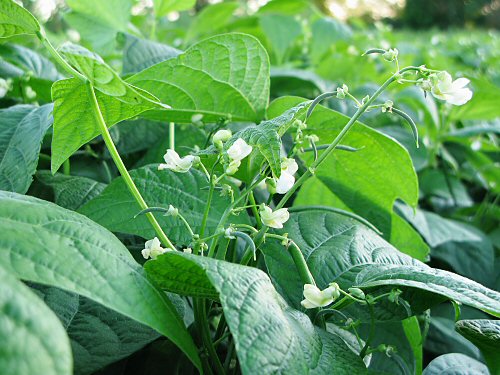
The second bean planting is setting and sizing up nicely, but we didn’t have beans at the farmers’ market today, after a good first and second picking of the first crop over the last two weeks. With succession planting, snap beans are usually a continuous harvest once they start, right through to a killing frost (usually in September, but with row cover, now extended into October in the last couple of years—more of that global warming, I guess). This year, cloudy weather slowed growth and the timing didn’t work out for continuity. There are a couple of ways to insure non-stop beans. Planting really frequently doesn’t work, because if the plantings are too close together, like, only a week or two apart, any two are likely to sync up, either by germinating at different speeds, or catching up during growth (both due to weather), and you’ll have too much one week, and not enough the next. Over-planting is the easiest way to go: if you have a lot ready at once, usually you can hold in the field a week past optimum harvest time and still have good quality, that is, nothing too oversize or woody. Of course, harvesting when ready, then storing in a cooler is the surest way: beans do quite well in cool storage, a good week in the most casual cooler conditions. But of course, there’s fresh and there’s FRESH!
timing
Shifting gears for summer…
The spring rush is over, and fieldwork is shifting into summer mode, from mainly planting to mainly weeding and watering, and then, HARVESTING. Seedlings for the most important crops and varieties are in, although there’s still quite a lot to transplant.
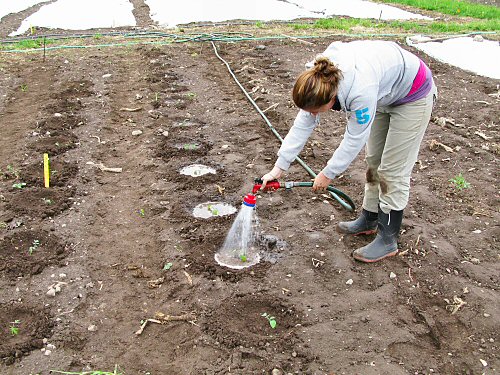
Here, we’ve just finishing another 100 or so tomatoes, with Lynn watering them in (the Redhead water breaker is GREAT, delivers as much water as you’ve got pressure, while softening the flow so that you’re not smashing or burying the seedlings). Creating a little basin around each seedling makes the most of hand watering in.
In my continuing experiment with shortening seedling production time, these are the youngest toms to go out ever, a third set started at the beginning of May, with their first true leaves now just coming in!
There are also more squash, melons, and a few more toms to transplant—in years past, I’d’ve been concerned about the date, but I’m learning to adapt the season’s resources (time, people, irrigation capacity,…) to the WEATHER.
Keep the workflow balanced is my new first mantra, so we also spent a few hours weeding today (Ryan dropped by to help for a few hours, he’s a new CSA-er this year who is also about to move his family to their own tiny farm at the end June!), instead of rushing on the last transplants.
It’s hard to measure, but for this type of small, diverse market gardening, in this time of extreme weather, things quite often don’t work out as they traditionally should. For example, the recent rain and cold, and now, more heat, have created a situation where the dominant weeds—pigweed, mallow, and lamb’s quarters—are seemingly slow, but are in fact about to explode. Weeding now will probably save way more time and deliver more harvest than putting off weeding just to transplant a few more beds a few days earlier.
I dunno, I’m figuring this out as I go, but I think traditonal garden rules and timing have to be increasingly bent as the weather gets crazier… I guess you could say: EXCITING TIMES! :)
The wild bunch
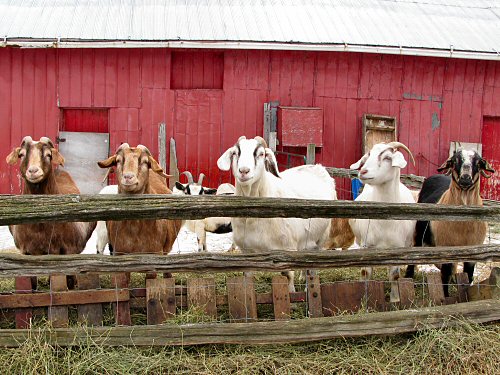
Mainly mucking about today. Visited with the goats. Around 15 of ’em. These girls upfront are the current kingpins of the goat yard. Goats have their pecking order (just like the chickens to come!), which mainly means a few get first crack at food, or crowding at the fence, or whatever else they all want to do, while the rest back away and wait or get butted. It’s mostly rank by size, but a vicious streak counts, too. The one in the middle is on top now (with her friend on the right), the brown pair on the left (the Evil Twins), used to be a vicious tag team running the yard, but they lost their edge. Not that they’re always fighting, a brief burst of deterrent action goes a long way. It’s like a soap opera if you watch ’em every day. Goats…
Every year, this little period in the first half of March is kinda like waiting for the starting gun. I’m full of energy and waiting on the weather. A little EDGY. All the early starts are now under lights: onions (first time from seed), celery (another first), more leek and parsley, plus the stuff started around the end of January (leek, parsley, rosemary, arugula, lettuce). It’s another week to the peppers and eggplant, and then the grow racks will start to get full, and I’m also holding off till then to transplant the early lettuce to the greenhouse. As soon as the snow clears and the temperature warms up a bit, there’s outdoor fix-it work, starting with an old ice fishing hut to turn into a home for the composting toilet (an outhouse for the field!) and the chickenhouse to renovate. There’s a list. Plus a lot of garden clean-up, crops left over winter, that should be pulled as soon as I can. MEANWHILE, I’m waiting…
Grow lights, on!
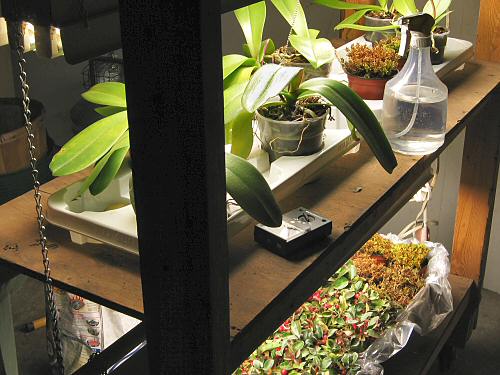
Grow rack lights went on today for the first time this season. They’re only for the rescued houseplants (orchids, wintergreen, heather)—I guess every plant deserves a place in the sun—but, I’ll be starting super-early lettuce soon, a month earlier than ever, for an experiment in planting them out to the greenhouse at the beginning of March. Getting the grow racks ready is another familiar routine. In early summer, I remove the fluorescent light fixtures and the chains and dowels they hang from and store ’em somewhere (last year, it was on the new Big Shelf). For spring, I dust them off, wipe them down, hang them, and a new seedling season begins!
Pounding stakes
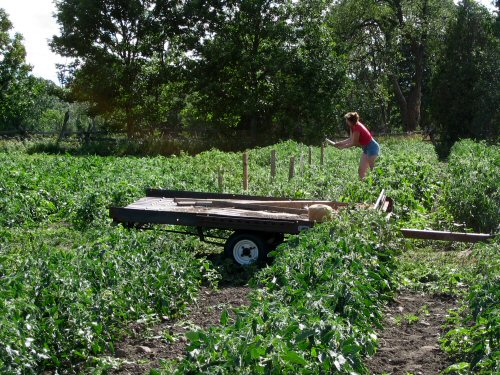
Jo pounds in wooden stakes for a somewhat catch-up version of tomato staking. I think of it as the Modified Sprawl. There are about 600 plants, with maybe 250 in home-style tomato cages. The rest are so far on their own. The cages work great, until a mighty wind comes along and blows a bunch over—they’re not really rugged field gear. It’s too late for proper basket weaving support, so it’s on to my previously tried and OK version, pulling the plants up with twine on both sides, to stakes set every three plants apart, with a bit of pruning and suckering as we go…
This is the point in the season where we start playing catch-up as a million different things need handling. It can get a little frantic, depending greatly on how it went earlier in the year. To add to the…decision-making puzzle, it’s last call, and even very iffy last call, for planting many crops (60 day maturity and under), with day length shortening and frost risk building to a significant consideration just 6-8 weeks down the road. So, thin here, or weed or seed there, or water elsewhere, you can’t do everything at once! It’s all in the timing, with much of the schedule in the hands of Ma Nature (where’s that RAIN!?!). Gambling, yes! Still and all, quite FUN.
More people in the field…
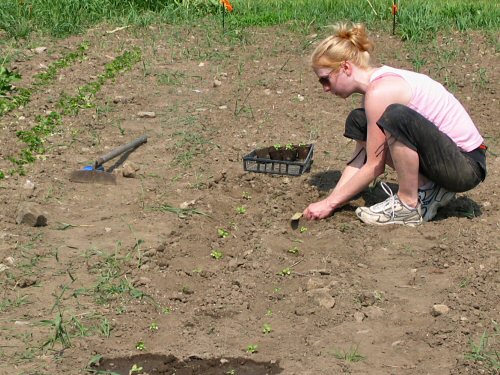
At work transplanting really tiny basil in the still-to-be-shaped-up herb patch, Andrea is doing her very first day of tiny farm gardening. It all worked out very well! After nearly a month of working with Conall, the all-new organic grower, almost every day, and having several other people out for a few part-time hours, it’s a different season for me compared to the previous four. Not less work (we’re planting way more than ever before), but the energy is different. Before, largely working alone, it was more of an against the odds thing as I faced the fairly massive task of each season’s start-up. I liked that solo mission adrenaline and challenge. Now, it’s more of a people puzzle, as this season’s small crew assembles. By the time it comes to more substantial harvests in three or four weeks, I’ll be totally reliant on teamwork to get it all done. No going back: it’s like, Tiny Farm II: People in the Field. :)
Set to explode
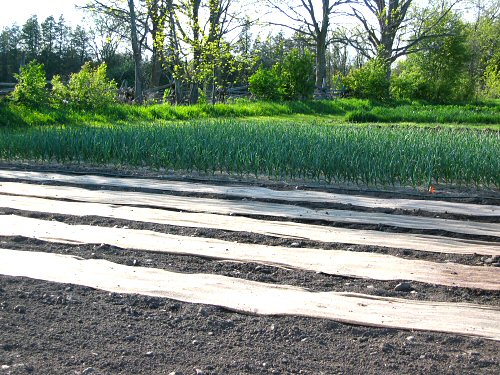
There are many particularly exciting points during the growing season, and this is one of ’em! We’re on the third plantings for some crops, things are emerging everywhere, and some plantings are just getting ready to put on serious growth towards maturity and harvest. In other words, the field is getting ready to explode with veggies. This happens several times during the year, in different sections, with different plantings and crops, but the first time is right across the field and always a thrill. For me, it still seems like kind of a miracle when all those tiny seeds and plans and energy actually turn into…the new Veggie Garden! Here, green onions (in the faint furrows) and carrots under burlap are recent second plantings (yesterday), and the garlic is starting to shoot up on the way to tasty garlic scapes in June…