
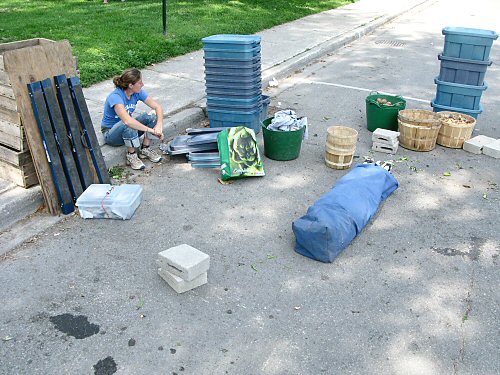
Somehow, I always forget to take enough pictures at the market, of things like setting up the stand. It’s really great, how a plain old small town street, in about an hour, turns into a…farmers’ market. For our stand, basic set-up and teardown—canopy, table, sales gear—is only a matter of maybe 20 minutes at each end. Because I don’t drive, our stand is different from most, where a truck or trailer is the usual veggie stand backdrop. Bob drops us off in the morning in a pick-up: a self-contained veggie sales outpost. When it’s all over, with empty containers nested and packing volume much reduced, we get picked up by truck or smaller mini-van. Here, Lynn and I wait for our ride. There are garlic and potatoes left in a basket and a trug, and the four bins contain mostly crop residue, a bit of miscellaneous garbage, and odds and ends of unsold produce. Neat!
Lynn
Last of the lettuce
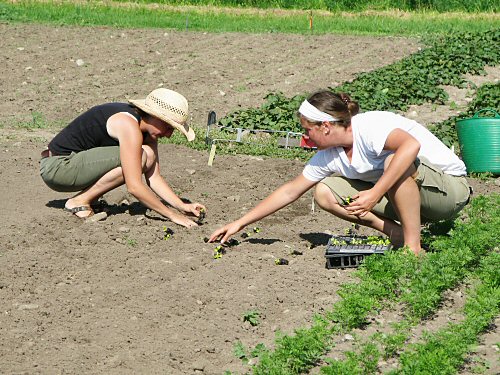
Can’t quite seem to stop planting! Lynn and Libby put in a last 200 or so lettuce seedlings to see how far they’ll go in fall growth. The soil is still moist an inch (2.5cm) or so down, but the surface is way DRY from a few days of sun and breeze, so we watered in these guys—the weather’s been great, sunny and warm this week…and it’s back to the hoses!
Supply run…
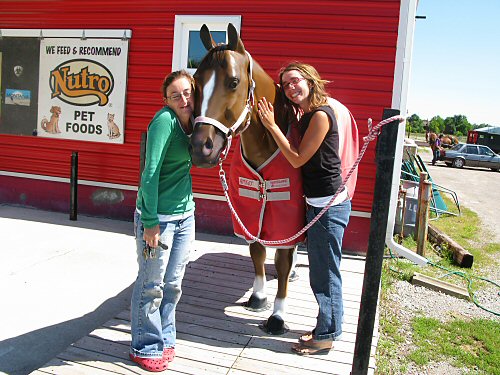
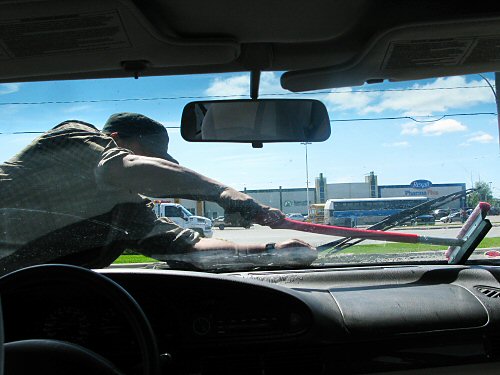
Not a typical farm day in the field, instead, a fairly extended supply run to town: chicken feed, groceries, diesel…ice cream… Moving through the last half of summer, the workload eases up a bit, and you can afford to get a little leisurely. So, three of us headed in…an UNTHINKABLE use of people power any time earlier in the season. Above, at the gas bar across from our local strip of box stores, I’m actually having fun squeegeeing the windshield, just like in the movies (I’m a non-driver, hardly used a gas pump, and maybe never washed a windshield before…). Below, Lynn and Raechelle pose with the wooden horse in front of the feed store. If you look closely down the side of the building, you can see a Mennonite horse and buggy loading up beside a car. Everybody needs feed! Curiously, today was one of those trips to town where I really felt the fine line between being a “new farmer” and…not. As long as you’re surrounded by the garden and a lot of WORK, it’s easy to see a clear course. But when you’re away from your field, you can see how precarious tiny farming really is (at least, for now, in North America). We’re still so reliant on the existing system, for gas, machinery, supplies, even a lot of our year-round food, on taken-for-granted “utilities” like electricity, phone, Internet, and, of course, on a reasonably functional economy that allows others to drive to the farmers’ market or farm to buy our produce. Hmmm… It makes me wonder, how much of my tiny farming simply comes from what I do every day, and how much is a fundamentally changed outlook from my city days, a new state of mind? What would I be now, if I stopped doing this? What a puzzle! ;) Anyhow, as for the weather, it was all beautiful sunshine for this laid-back day… (Windshield photo by Raechelle)
Garlic all in
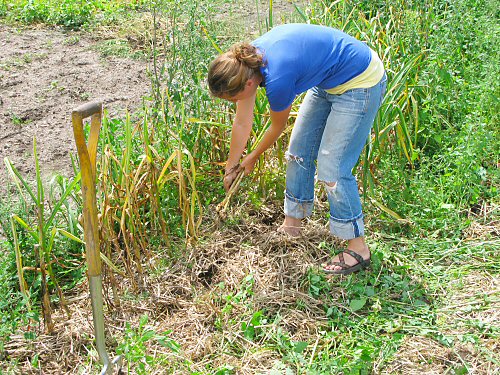
Harvested in three parts over the last week, the garlic is now all in! This crop seems to’ve done well once again (I LOVE growing garlic!). For the first time, there’s a small pile of damaged goods, water-logged from all the rain. But overall, things are looking good. The combination of oat straw (from last fall’s cover crop) and grass mulch worked great (below)—weeds were kept down, and although the paths weren’t as heavily mulched as around the plants, they weren’t bad. We’ve been having trouble starting the riding mower, which means no trailer, so the tractor bucket took its place for transport duties. The garlic is stacked on pallets in the barn. Lynn seems to’ve taken to garlic harvesting and went to town: fork and pull, fork and pull…around 3,000 garlic bulbs hit the local food chain!

People in the field update
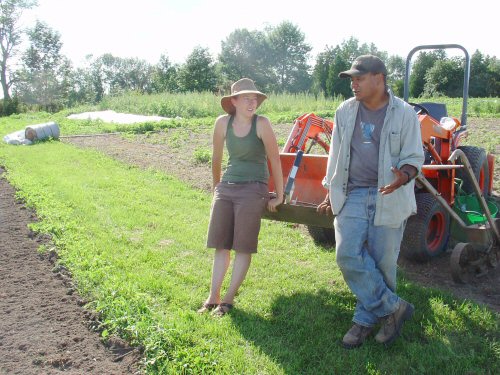
This has been an interesting summer for learning about tiny farming, people, and the ups and downs of growing largely without machines. I’ve had an ongoing debate with Bob over the years about the garden layout, using relatively short, 50′ beds, and hand cultivation, rather than planting long rows and doing most of the between-row weeding by tractor. The tractor approach lets one person, one machine, and some cans of diesel do most of the routine work alone. The hand-grown approach requires lots of labor, and you either settle in and do it yourself with many 10-12 hour days right through the weekfor a good part of the season (as I used to do), or…have help. I’ve found it’s definitely more fun to work with others, BUT, once there’s a bit of a regular crew, there’s the new matter of keeping the group dynamics smooth and making sure everyone’s HAPPY. Long days of often repetitious work, finishing one job only to launch directly into another, and working around the vagaries of the weather—this year is an exceptional case in point—aren’t what most people are used to. And when some of the people live on the farm, for a few days a week like Lynn (chatting with me in the pic), or 24/7 in the case of WWOOFers, things can get even more complicated, like, when is quitting time! At least in the start-up years, tiny farming can be pretty much an all-consuming focus during the growing season, and that’s not something most people really want or can handle, either—you’ve gotta love it! So finding the balance between going all out, and, well, providing a fun taste-of-tiny-farming experience for others, can be a bit of a puzzle. At least, that’s what I’ve found so far. All just another part of the ever-changing TFE…! (Guest photo by Maria)
More carrots
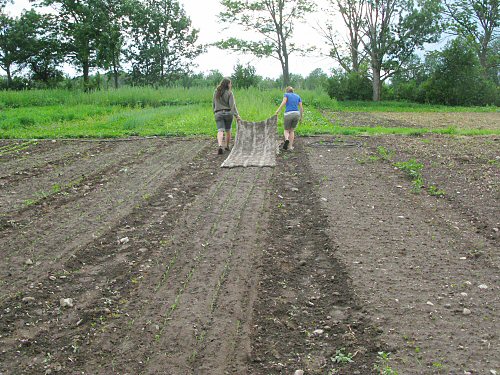
Wouldn’t DREAM of starting carrots without the burlap method now. Maria and Lynn remove burlap from the third planting of the season, using the fold and fold again approach rather than rolling it up…
View from the stand
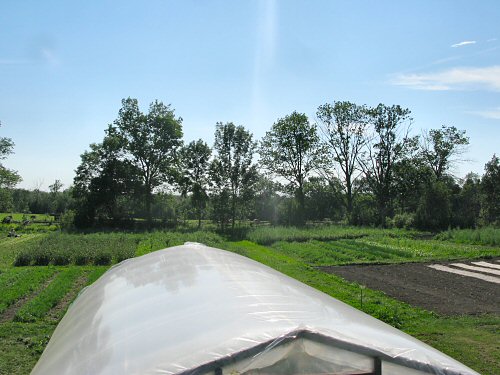
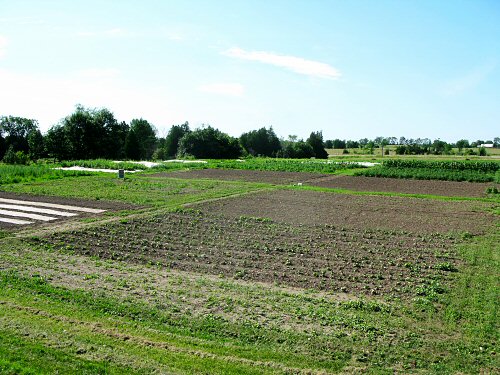
It’s mid-July, and on a (recently rare) sunshiney afternoon, things are looking OK. Better from a distance than up close, because a few sections, like the summer and winter squash, are quite severely in the weeds and in need of intensive hand pulling. And the ground remains almost constantly wet. Our moisture-retaining clay-loam soil, such an advantage in the usual near drought conditions we’ve had over the last three years, is now a bit of a hindrance. Sprawled tomatoes are particularly at risk if they don’t dry out against damp ground, and instead contract early blight (more about that another time!). Still, carpe diem, huh—seize the day! From atop the farm stand, the view is fine! We have the north end (above), with carrots under burlap (third planting), brassicas (newer transplants still under row cover), the cover in the far middle over squash, in front and more to the right, tomatoes, with a windbreak of giant sunflowers at the very right, and sweet potato bottom center. Open sections will include brassica transplants in a couple of weeks, and a fall cover crop. Out of sight to the north are onions…
In the middle, clockwise from the left, there’s a second planting of carrots, fifth mesclun right in the corner (with Maria weeding on the Greens Machine), garlic and parsnips, and potatoes in the distance (with more big WEEDS), the first planting of beets, carrots and green onions, and the edge of the third carrots under burlap from the first photo.
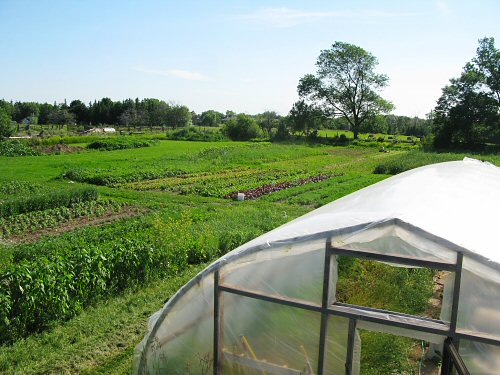
And then, the south end of the field, going left from the peak of the greenhouse, the garlic and Maia in the mesclun, the second planting of carrots and beets (that slash of of red is Bull’s Blood beets), the fourth mesclun , a weedy area with nasturtiums and tomatillos, and to the bottom left, herbs and flowers (fairly towering Jerusalem artichoke at the bottom left). (Guest photos by Lynn)