
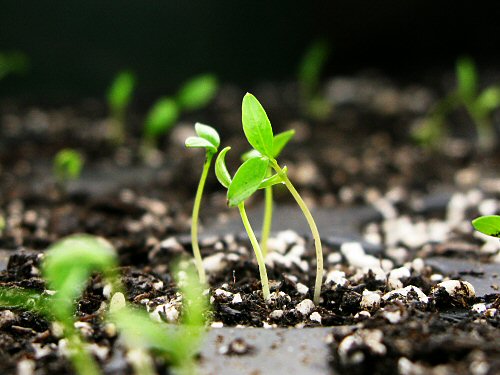
Parsley, seeded 11 days ago, began popping up over the last couple of days, so that’s the second crop of the season, underway. Four varieties this year, two each of flat-leaf (Plain Dark Green Italian, Hilmar) and curly (Forest Green, Green Pearl). They’re 18 cells per variety, in a 72-cell plug sheet, around 4-6 seeds per cell—I’ll eventually thin them down to two. They’ve already started to stretch because they’re sharing a light rack shelf where the lights are set higher to accommodate a tray of onions. Parsley is easy to start, I’ve had no problem with transplants, but my seedlings have always tended to stretch and tangle in the trays before transplant time. Last year, I snipped them back quite a bit so they wouldn’t tie themselves to each other. They seem to like their light strong. These are just early season details that I won’t be much concerned with a little later on, but I’ll see what I can do. I’m gonna hang lights on another shelf for them right now!
transplant
Fava beans test OK
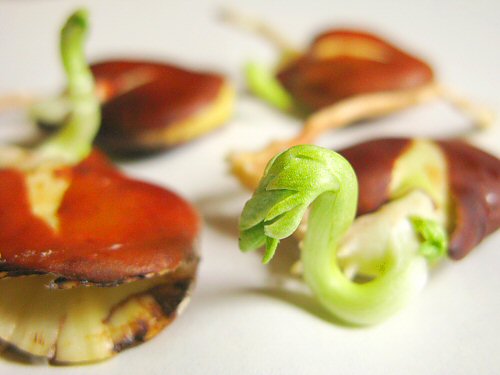
It’s that time of year again when obsession with seedlings somehow takes hold for a short while. I wonder if I’ll ever get over it, that almost overpowering early spring feeling that you don’t want to waste even a SINGLE seedling. Here, I germination tested a few Witkiem fava beans (broad beans) from an overlooked four-year-old supply. Bean seed viability is often rated at three years, but I didn’t doubt that these were fine, they looked and felt great. I tested some anyhow: wrapped them in a paper towel, misted them with water, popped them in a clear ziploc plastic bag, put them in a warm spot. That was about three weeks ago. Sure enough, a week later, the not-so-little white radicles were poking out of all of these big beans. Excellent! So I put them back in the bag and kinda forgot about them, moved them and all. Today, they were unpacked, and even without any light for at least a week, the seedlings were lustily struggling to break free. Now the kinda obsessive part is, I FEEL BAD ABOUT THROWING THEM OUT! This is pretty crazy. There is no good reason to pot them in February and have ’em hanging around for months until it’s warm and dried out enough to transplant. After two-three months in a pot, they’ll be useless as proper transplants, anyhow. Meanwhile, in a couple of weeks, there’ll start to be so many seedlings around here, and this keep-’em-all urge I’m having now will be gone without a trace. So I stuck ’em in some water, just for now… I thought this beginning of the season hang-on-to-every-seedling thing would wear off after a few years, but apparently not yet. Maybe I don’t take this business of tiny farming seriously enough! :)
After the row cover: weeding!
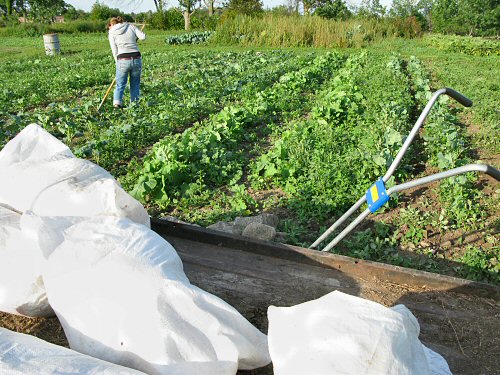
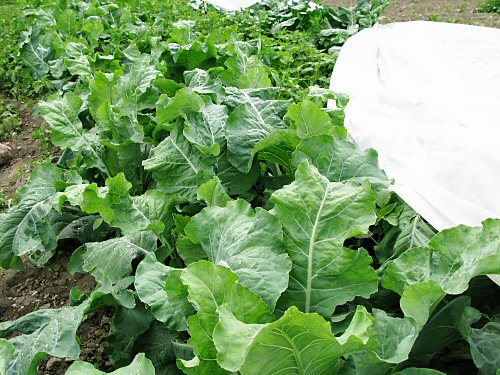
It’s been about six weeks, time to permanently remove the row cover from the last transplanting of fall brassicas! There are two sections, about 20 x 50′ beds in all, with broccoli, caulflower, cabbage, collards, kale. The cover protected against flea beetles, and at this point in the season, the FBs aren’t around much. Which leaves the post-cover weeding! I generally plan to remove the cover earlier, weed, and then replace it quickly, but this seldom seems to happen. Instead, it’s one big weed-a-thon at the end… Here, the mainly pigweed looks fairly big and dense, but it’s actually not much of a problem. The row cover has protected the ground from many days soil-packing rain, so the beds are nice and loose (it’s amazing how much rain can compact clayey soil). Weeds come out easy! With two people, it’s a relatively quick job, 2-3 hours for a pretty thorough clean-up. We worked with a combination of hoe and wheel hoe, me doing the paths and between-row clearing, and Lynn hand hoeing in-row, between the plants spaced at 18″ (45cm)…
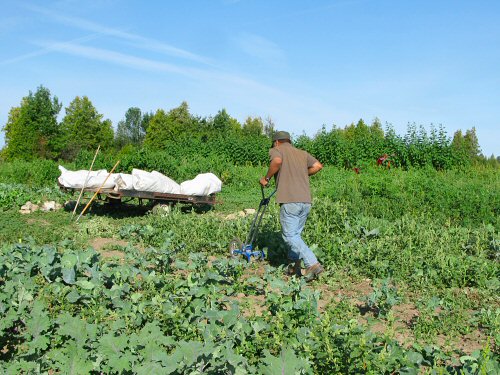
Each time I use the wheel hoe, I grow to love it that much more. So easy, so TIME-SAVING! It’s such a sophisticated yet simple tool, a perfect marriage of wheel, leverage and steel (you could say! :)… Today’s job is heavier work than it’s usually used for, the weeds aren’t just emerging, they’re pretty big. Rather than rolling the wheel hoe continuously down the rows, I’m cutting the weeds with a series of forward and backward strokes that either slice the plants below the surface, or pull them out, roots and all…
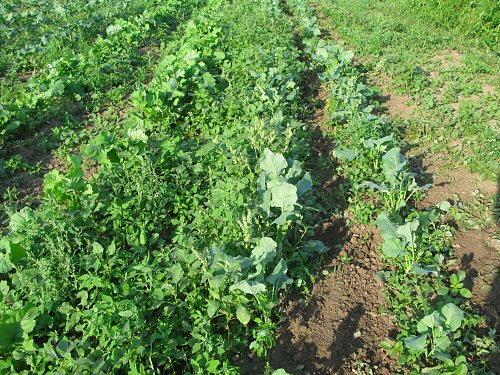
Clearing a path (before and after, above) in the loose soil takes maybe 3 minutes for 50′, many times faster than hoeing or hand pulling…
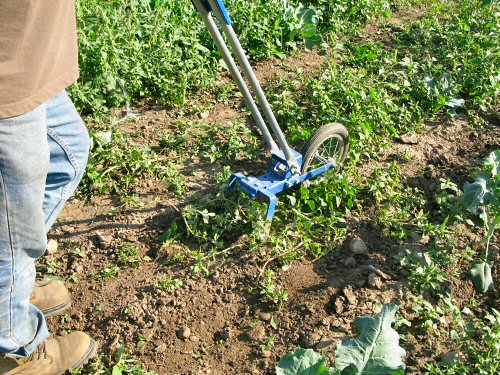
For this heavier weeding work, I use a fairly forceful forward stroke that travels about 1-1.5′ (30-45cm), then raise the blade to clear the felled weeds as I step forward to start the next bit…
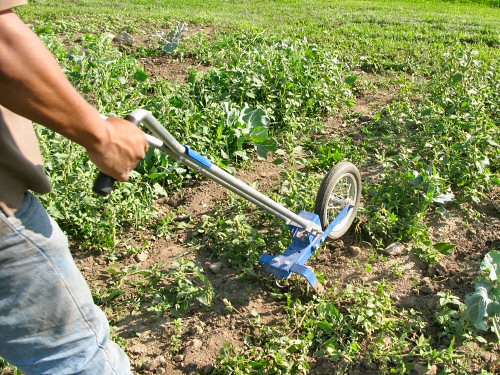
The wheel hoe is equally good at cutting on a backstroke, which comes in handy for dense areas and tough specimens… It’s not particularly strenuous work: the blade is sharp, the wheel and angle of the handles give lots of leverage and momentum, and some part of the hoe is always in contact with the ground, so you’re never completely lifting the whole tool. Like most things I do here in the field, I’ve figured out how to use the wheel hoe on my own, by reading instructions, looking at pictures and applying my version of common sense. Techniques no doubt vary. It’ll be interesting to eventually see how others do things! Meanwhile, everything seems to work out…especially, the wheel hoe! (Wheel hoe action photos by Lynn)
Onions from seed!
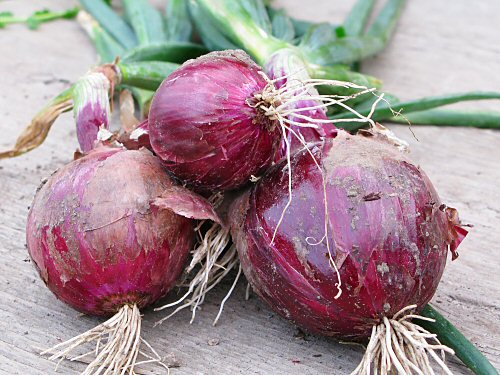
This is the first year I’ve tried growing onion from seed, and they’re doing fine. Today, I pulled up one multi-planting of Red Wing to check ’em out. Multi-planting onions was also a first-time experiment, with 3-4 seedlings transplanted in one spot, at 12″ (30cm) in-row spacing. They’ve done a good job of pushing themselves apart, they’ve stayed pretty round, not flattening out where they touched.
Another thing I was a little concerned about didn’t come to pass. For around a month, the onion seedlings had already been under the usual 14-16 hours a day of fluorescent light on the grow racks, when I read about the possibility of daylength sensitivity at the seedling stage. When the amount of sunlight reaches a certain threshold, over 12 hours or so for long-day varieties, the onions move from leaf growth to producing bulbs. A couple of sources said that premature bulbing can be triggered by too much light too early on, even at the beginning seedling stage, and you’d end up with tiny, marble-sized onions after a season in the field. Other sources disagreed, but in any case, that didn’t happen here! Still, in future, I’ll start long-day onions under reduced artificial light…to be safe.

As usual, the cracked surface of our clayey soil looks rougher than it is: it isn’t really hard, only a thin, dry layer with moist soil right underneath. Here, four out of five seedlings have pushed apart, rotating the stems outward, and grown into decent-sized…onions!
Last of the lettuce
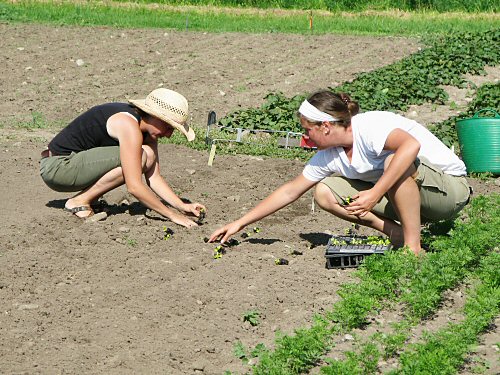
Can’t quite seem to stop planting! Lynn and Libby put in a last 200 or so lettuce seedlings to see how far they’ll go in fall growth. The soil is still moist an inch (2.5cm) or so down, but the surface is way DRY from a few days of sun and breeze, so we watered in these guys—the weather’s been great, sunny and warm this week…and it’s back to the hoses!
Sweet potato thrives
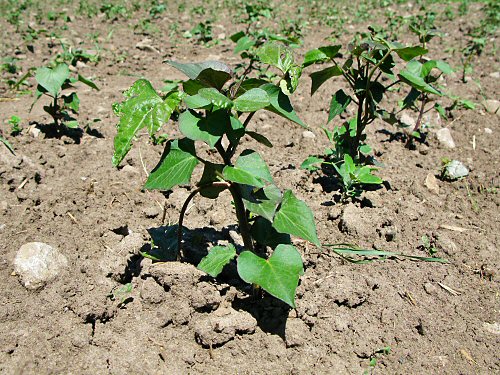
A month after transplanting the slips, the sweet potatoes are thriving! I’m still entirely unsure of the eventual harvest, but these plants are a low-maintenance pleasure so far. Almost every slip, even most of the ones that turned into tiny, leafless stubs for a while, managed to establish without any care at all, not even watering in after transplanting. Cool!
Checking under row cover
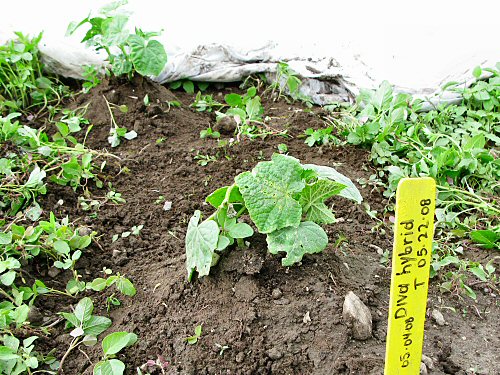
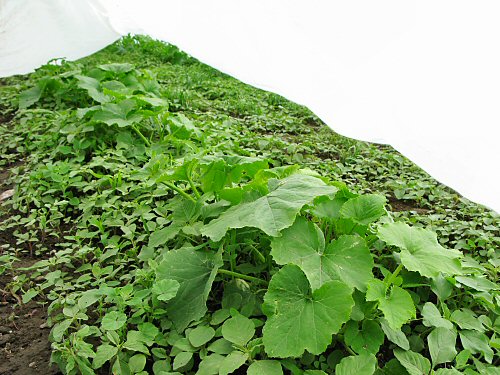
Three weeks ago, it was floating row cover everywhere. So, what was it worth? Today, I checked things out. Overall, growth has been startlingly slow, due to the lack of sun. This is really noticeable in the summer squash (above), which could be huge at this point, but…aren’t. Under cover, these zucchini (I didn’t check the variety) are doing fine, no cucumber beetle damage, but of course, weeds are doing fine as well: unmolested under there, pigweed runs rampant. I’ll take the cover off here in another week or so, and then there’ll be a whole lotta weeding to do… I removed the cover from the first beds of cauliflower (Snow Crown) and broccoli (below), they’re big enough to take a little flea beetle munching. The leaves have shaded out much of the potential weed action in the beds, but you can see a nice collection in the path (top center, where the row cover ends). The plants look untouched, although the flea beetles managed to get under and at the kale and collards, (they’re out of sight just to the left)—I left them covered, back in a week. If there’s any doubt about what the FBs will do, just check the radishes, which grow MUCH faster than these guys and can survive the damage…
Back with the cucurbits, the cucumbers are the most noticeably slow: after a month, they’re hardly bigger than the transplants they started as (hope it’s all going into the roots!)… I’ve cleared away the weeds between a couple of the plants, beetle damage is minimal (they tend to get in at the ends of rows, where the cover can get blown up by the wind), but there are weeds everywhere. Cover goes back on here for a while. Weird stunting weather and floating row cover: not the most peaceful and inspiring natural garden combo, but it should all straighten out in a bit… ;)
