The other sunflowers…

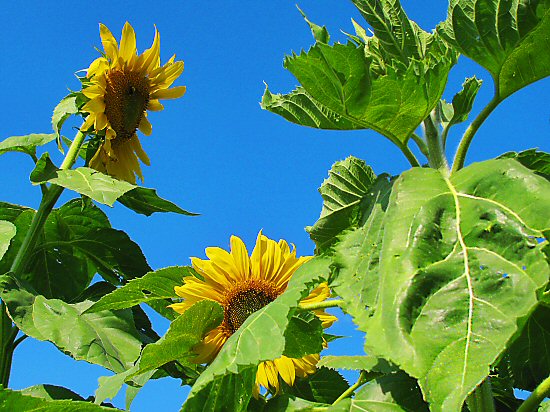
There are pretty ornamental cutting sunflowers, and then there are these monsters of the field, towering Early Russians, and their almost as imposing kin, the rugged Jerusalem artichoke (last photo). They’re the genus Helianthus, North American natives, supposedly dating back 8,000 years, and by the look of it, really not too disturbed by the crazy weather right now.

Both of these are experiments. This is the second season for the Russian giants, grown exclusively for their potential as a plant-protecting wall. It’s the third time around for the JAs, a crop that can do double duty as a living wall… Neither were strategically placed for action this year, but the idea is mainly to use them as shade during scorching summers. They get to a pretty good height by sometime in July, so the timing works. Even at 7-8′, they won’t protect too far out, a dense and high-value crop like all-lettuce mesclun would make it worthwhile. They could be good as windbreaks as well, but I haven’t considered for what…

The sunflowers are around 8′ tall now, it’s quite incredible (with a longer season, they can apparently get up to 14′). You’d think with them growing so fast and big, they’d always stand out, but with all that’s going on in the field, you can forget and then one day, turn around and BAM, there’s that wall o’ green, STARING at you…

The flowers are practically as big as my head, and so heavy, they eventually wind up completely face down.

The Jerusalem artichoke are a little more refined, but still big and resilient. They’re around 7′. Both sunflowers and JAs are planted in double rows, and held up to this year’s helping of storms and massive winds no problem. Reliable…
Garden in transition

Garden in transition

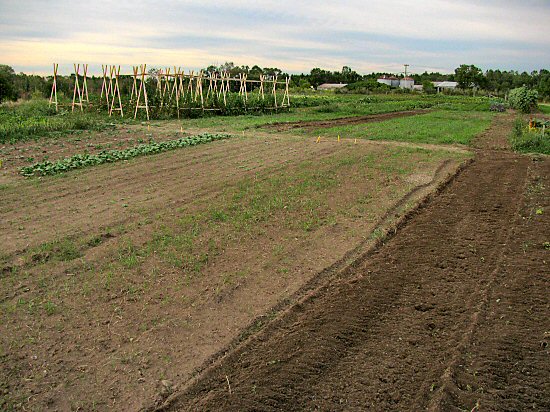
The weather is warm, the days still feel long (although, at 5:00 a.m. for Saturday market, I’m already waking up in the dark)—summer is in full effect, but you know the season’s soon changing because the field is clearing out. Today, I did some tilling, cleaning up before weeds get too established, and preparing for a last seeding of spinach for fall harvest (a gamble, for sure).

In the pic, a couple more passes to the left of the freshly turned strip and we’ll be at the edge of the previous spinach planting, barely visible, seeded about 3 weeks ago. To the left of that, a half-bed of bok choi, delicious and miraculously untouched by flea beetles, at tiny baby stage from seedlings transplanted at the beginning of the month. Beside the bok choi, beds of broccoli and cauliflower, also set out 4 weeks ago, and looking pretty good for harvest in October.

This section was planted out at the start of the season to snap peas, lettuce, and the first spinach. After adding in some of the handy pelletized alfalfa, it gets to go round again!

In the next section (top right of the photo, which is…east), I’ve started tilling in an overgrowth of grass and vetch, where more peas and the first plot of potatoes used to be. That section is done for the year, and may get a protective cover of fall rye, as a green manure to be turned under in spring.

In the market garden, it’s always one thing after another… :)

Perfect (market garden) squash!

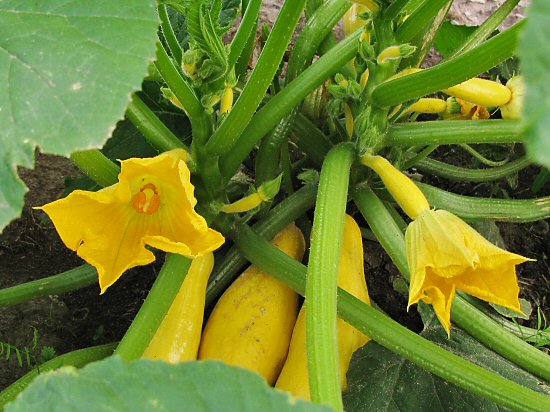
Early Crookneck summer squash

In the market garden, summer squash can’t get much better than this. These guys, part of the second planting for the season, have it all.

Leaves looking really healthy: green, uneaten, and so far free of the powdery mildew that inflicts itself on many squash varieties and eventually kills some off before their time.

Perfectly ready for picking: These Early Crooknecks are a nice size, there’s a few per plant, and they’re quite easy to get at. All the summer squash were multiplanted, 2-3 plants growing together, so things could get pretty overgrown and hidden. This second planting set fruit fast (unlike the first round!), and the plants are still nice and open for easy reaching in.

More to come: In the small-scale market garden, you’re always thinking quantity and COUNTING. How many pieces do we need for today’s CSA shares, how many bunches for tomorrow’s  farmers’ market, and so forth. You’re thinking for now, and also for Next Week, and then, more weeks ahead. In that order. Today, there are plenty of tiny squash that’ll size up in a week no problem!

Bonus specialty selection: Squash flowers! Lots of veggies have cool options, like broccoli flowers and side shoots, squash blossoms (aka zucchini blossoms), beet greens, pea leaves, and generally, harvesting very small and young (I tend to like things to grow to a nice, solid size). So if you dropped in looking for a few squash blossoms (as seen on Food Network :), we could hook you up!

So there it is, my idea of practically perfect market garden summer squash for the tiny farm harvest. There’s ALWAYS room to improve…but here, how?

Sunflowers

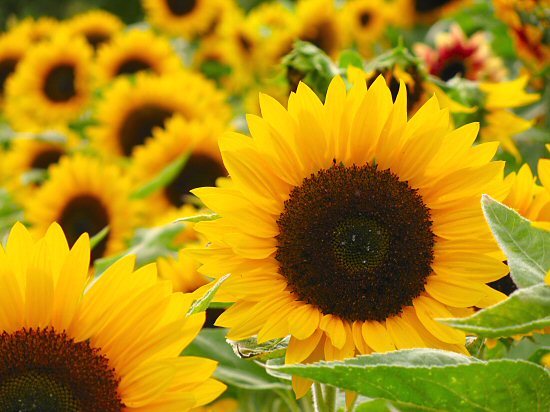
The sunflowers have been following the days for a little while now. I was not a sunflower fan until we started growing them a couple of years back, along with a bunch of other direct-seed cutting flowers—nothing like growing your own for attitude adjustment! Now, I love ’em (well, I really like them), especially when they’re standing tall in the field. These are Sunrich Orange, a one-to-a-stem “pro” cutting variety. There’s also a really rich, multi-color, multi-bloom variety called Go Bananas, you can see a couple tucked away in the corner of the pic… This season’s small flower garden is getting some use, as a few CSA shareholders take advantage of the there-for-the-taking standing offer. And I enjoy that they’re there for the seeing!

Potato digging party

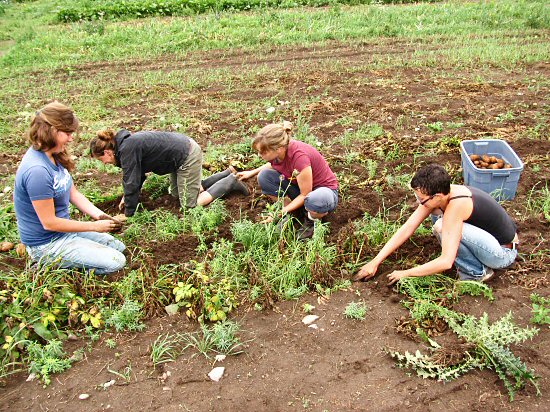
It’ll be hard to top THIS one for extremely labor-intensive tiny farming involving lots of peeps! Here, Libby, Lynn, Andie, and Mel hand-dig potatoes for tomorrow’s farmers’ market. The taters happen to be Gold Rush russets, and they’re in fine form, with a little wireworm damage (surface blemishes or tiny holes) to only a few. We’re right at the end of the first (of three) potato areas of this year, 600′ (183 m), evenly divided between Penta, Chieftan and Gold Rush.

So, what’s with all these people, digging together in a cluster, with just one bin? A little inefficient, pehaps? Well, not really. When there’s a lot of folks happy to mix it up with the dirt, tackling a single task all together can work out! We only needed about 70 lbs of each variety (that blue bin full). With the moist-but-not-mucky soil, pulling plants and scrabbling around was quick and easy. BIG POTATOES helped. Working close together wasn’t a problem because we had so little area to cover. Each bin got filled in maybe 15 minutes. Satisfying!

In the photo, you can also see how relatively good shape we’re in with weeds. The bit of grass growing back is in separate clumps, all the runners haven’t started to reach out and hook up. Further up is a section of more heavily overgrown onions. But that’s actually doing well as well: the onions were thoroughly weeded twice, and hoed a couple more times, so what you see is mainly grass from the last three weeks (without much shading out from the onion plants, everything else grows fast!).

Anyhow, when we tackle the main potato patch, around 2,000′ (609 m), methods will change. But we’ll still be digging in the dirt…!

Dog days of summer (a few)

The muggy wave continues, the sixth day or so of bright, swelteringly humid heat. Today was only 21°C (72°F), but the Humidex (or whatever exactly They call it) says it’s the equivalent to us humans of 40°C (110°F). It does feel that way. I can’t recall ever hearing a spread that big—quite weird, or maybe the Humidex got more accurate…

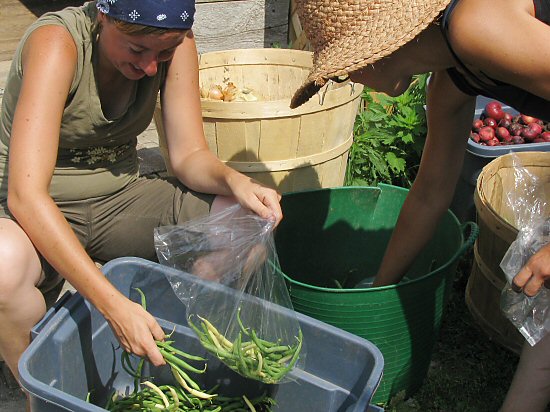
A smaller crew than usual this Monday morning as we harvested for CSA shares. Lynn and Mel (above) were out earlier, hitting the field at 7 am, partly to get a jump on the heat, partly because they both had to leave earlier as well. Michelle arrived around 8:30. Tara was tied up preparing for a short trip. Jordan, another Monday regular, is away for a couple of weeks, on various visits around the north-east.

People in the field. I still find it mildly unlikely and extremely cool each time one of our tiny field crews assembles for a day. Sometimes it’s a crew of two, other times, usually harvest Fridays and Mondays, the numbers swell (big for a tiny farm!).

We all head to the field for different reasons and different returns. The work is never endlessly tedious, we don’t go out and, say, pick beans for 8 hours, but we do get a lot done, and everyone does a bit of everything. You can find a little instant closure, where the start and end of a thing are all right at hand. You can learn to small-scale farm. You can chill out, take time to think—garden meditation while breathing some relatively fresh, country air and dabbling in the dirt. Chatting while veggie gardening can be great. It’s whatever you want it to be…

Today, it was hot. The shares were done by noon as planned. It’s all good! :)

First peppers

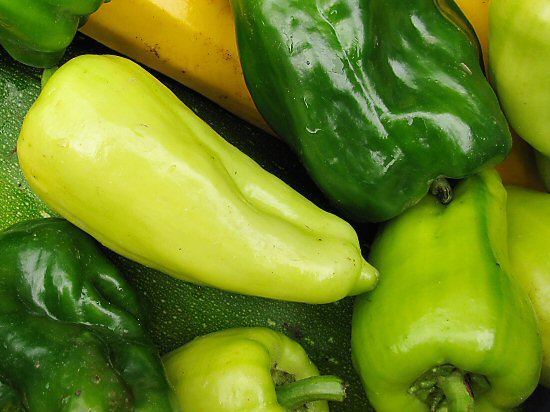
Harvested the season’s first sweet peppers, for the Monday CSA shares. They’re small…but tasty (that description has popped up a few times this year, as we pick early against the slow-growing weather and the flying by of time). The lime-yellow, tapering Gypsy (yellow-to-orange-to-red) are performing well once again, early and prolific, and the always-early, dark green bell peppers are Ace (green-to-red). Both varieties are F-1 hybrids (no seed saving), which isn’t great, but these guys are super-reliable in crazy weather, so I still plant ’em first… Peeking out from underneath, Ambassador (green) and Golden Dawn III (yellow) zucchini (also hybrids; GDIII is a mad producer, yellow zukes everywhere, on and on—another reliable standby that I’d love to replace with an open-pollinated variety)—after finally starting to take off a couple of weeks ago, the first planting of summer squash hasn’t looked back. So that’s something!

1 53 54 55 56 57 168