
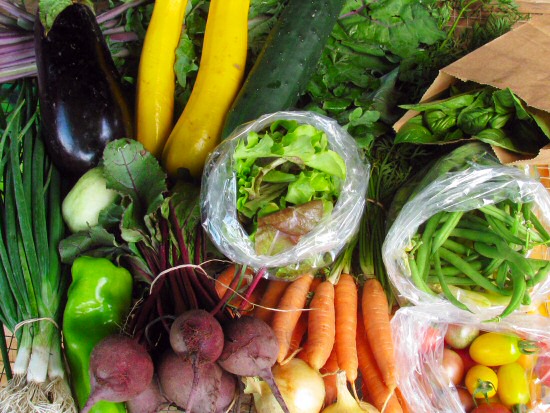
A pretty satisfying second installment of our “experimental” Weekly Harvest Share: “Like CSA, but one week at a time…”! Satisfying because, for the first time this season, harvest day felt kinda normal, with around 20 items harvested, enough variety to have to pick what went into the shares. And the winners, the veggies that made it through thick and thin: kale (Red Russian—no worries about running out of RR…), beets (Kestrel), carrots (Nelson), zucchini (Golden Dawn III, always there in numbers), cukes (Fanfare, Lemon), baby leaf lettuce (house blend, and a nice first cut!), beans (Jade, Indy Gold, first picking of this planting), assorted cherry tomatoes, green onion (Ramrod), sweet pepper (Cubanelle, picked young and green), onion (yellow cooking, from sets, kinda…compact), peppermint & spearmint (bagged, for tea!), and eggplant (old reliable Dusky). So, better late than never!
kale
In the cold garden
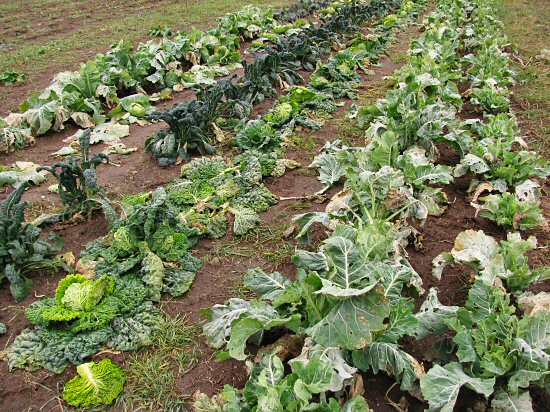
The star by far of the last planting of brassicas, that mostly didn’t size up in time for market or CSA, is without at doubt this unusual Nero Di Toscana strap kale. This Italian heirloom, apparently from Tuscany, is hardly better looking than the cold-beaten rest of the motley-looking crew: tiny cauliflower, mini savoy cabbage, some collards and this kale. But it’s growing back—been picked twice since October—and it’s amazingly, distinctively tasty. In the post-freeze veggie garden, looks aren’t everything! I’ve had the seed for a while, but grew it for the first time this season. It’ll definitely be back.
Kale in survival mode
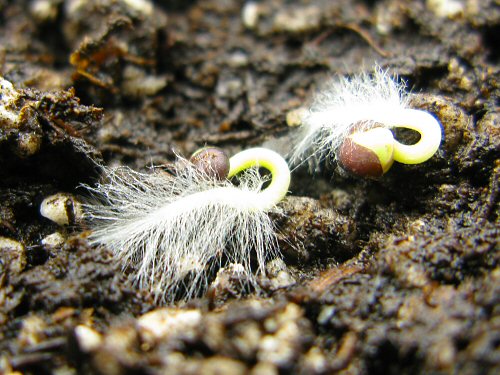
At first, it looks like some sort of horrible, fuzzy mold, about to devour your newly germinated seeds. But when you get really up close, it turns out to be superfine, hairlike extensions growing from the radicle. These kale sprouts pushed themselves right out of the seedling mix, probably because they weren’t pressed in and covered deeply enough.
Kale, broccoli, cauliflower and other brassicas do this in a very visible way during a surface emergency, sending out a mass of fine root hairs in search of water. Root hairs are normal below ground, but I’ve only really noticed them growing exposed on brassicas, other newly emerged seedlings with bared roots usually seem to just dry up. An unusual glimpse of what plants are up to with their vast root systems down below.
Given half a chance—a little surface moisture—these guys can actually manage to burrow down and root themselves. Pretty cool trick.
Seeding as we go…
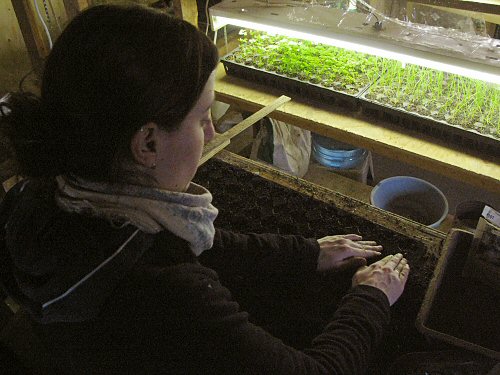
It’s spring! The ground is clear, hasn’t snowed in a while, but it’s still cold, and the tiny farming action remains mainly indoors. We’re steadily filling up the racks (here, Lynn populates a plug sheet with Red Russian kale; under the lights, parsley and onion). I’m spreading things out a lot more than usual, instead of starting a whole lot on one day. We’ll see what difference a few days or a couple of weeks make to the various veg… It likely won’t be much, but some interesting things could happen if we get really drastic week-to-week weather changes around transplant time, like we did last year. An experiment!
Veggies in snow
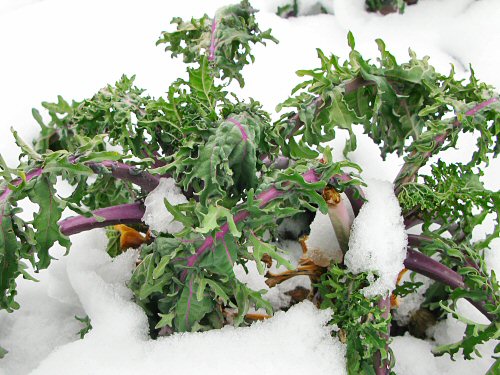
Every season there’ve been hardy veggies left to the cold and snow, and this season, it’s a record quantity, with nearly 2,000′ (610m) of broccoli, cauliflower, cabbage, and kale that mostly started sizing up just as the farmers’ market finished at the end of October. It seems like a waste, but it’s only a typical garden gamble on the weather (I was trying for an extra, really late crop). The risk was clear back in August, and we didn’t get enough sun to push things along a tiny bit quicker. We did harvest a lot of the Red Russian flat-leaf kale (above), for a good four weeks, and one round of 1-2 lb (450-900g) cabbage (a nice size for a meal for one or two). And there’s been a lot of personal-use picking in November. The rest is a giant farm lab experiment, more exploration of the snow-on-veggies effect…
More than the snow, the many nights of extreme cold (-15°C/5°F) that came with it this year really blasted these guys, wilting them and burning leaves and buds. So, none of the crops are too firm or pretty, BUT, they’re still alive: for the most part, there’s good color and texture. The kale, always super-hardy, did the best from a let’s eat some perspective, with good texture and great taste. The broccoli, while a little wilty on the stems and burned on the buds, also tasted great, fresh and flavorful. The cauliflower did the worst, the heads really damaged by the freezing and thawing, too mushy for me to bother with a taste. (Eating raw was fine, but how would this all cook up? We may see…) We’d already reaped most of the filled-out cabbage, so the rest aren’t going to go anywhere from here…
What’s all this odd information worth? Not much, I guess, I’m not planning on deliberately planting for snow harvests. But checking things out is always fun, no experience goes to waste, and there is at least one advantage to knowing there’s still good eating out there: the laying hens will be feasting on a fabulous greens buffet for a while!
Middle of the day at the market
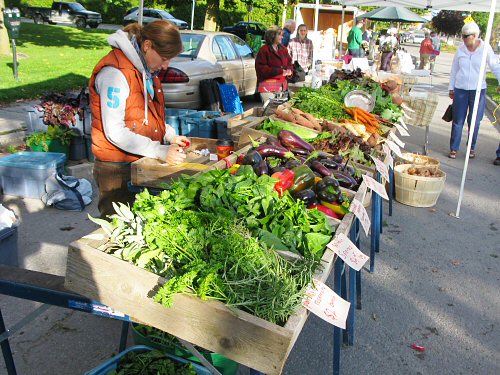
Here’s another slice of the action at the Saturday farmers’ market: recent market posts covered the beginning and the end, this is…the middle. In the first two pics, it’s about 9am—the market’s been open for two hours, but in colder weather like today, most people start showing up about now. This is the first time we’ve extended the stand by adding a new section with four more bins, quite an occasion, since I’ve been using the same 7-tray set-up for five seasons, almost since the beginning. It’s also the last day of tender crops, with a final harvest of eggplant and peppers. Lynn, vested against the chill, in the first pic looks like she’s making up more signs: red market on light brown card stock…
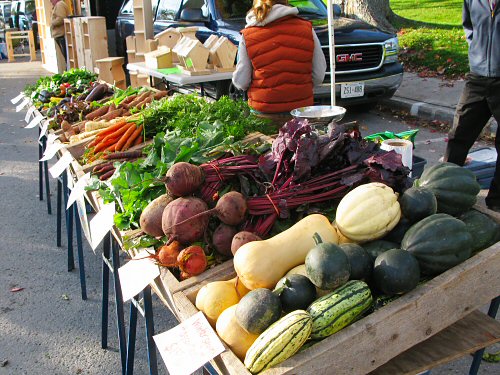
The shallow trays are easy to fill, it doesn’t take much to create a nice display. As things are sold, the display is refreshed from bins kept in the shade. The trays aren’t ideal for all veggies. Winter squash are harder to sort through, but there’s also a full assortment in bushel baskets that people can look through, with the trays more for display…
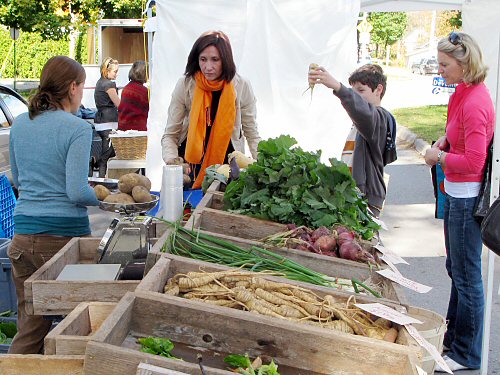
Jump ahead to about 11:30. It’s warmed up considerably, into a beautiful, summer-like day. This is Canadian Thanksgiving weekend, and the traffic has been pretty good. Traffic has died down in the last half hour, some crops are sold out, but people come by till the end…
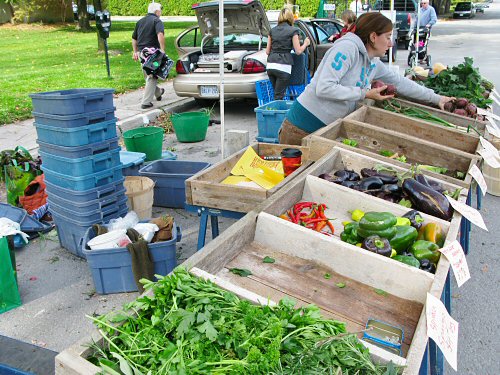
It’s now about 12:40. The market ends at 1, and we have until 1:30 before the street is opened up again. Most vendors start packing up early, around 12:30, but we always wait till the official end. Today, we’re pretty well sold out: the only veggies left in a bit of quantity compared to what we started with are some mostly very tiny eggplant, curly and flat-leaf parsley, Red Russian flat-leaf kale, and some winter squash. With things like kale, not exactly a universally popular green, sales are inexplicably random: usually low, but on some days, you can’t have enough. So, you always bring as much as you can (within reason!). Anyhow, a really satisfying and fun market day is almost done…
Fall crop watch
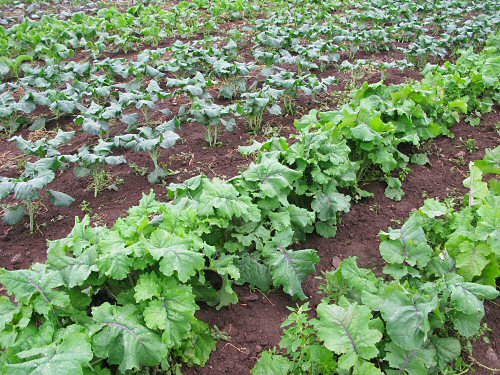
After a good weeding and another round of rainy days, the fall brassicas are pretty well on their own. It’s amazing how quickly growth slows down in September—what a difference the sun pulling away makes! The kale and collards are doing fine—we’ll be harvesting some Red Russian kale tomorrow. Broccoli and cauliflower will come through. Whether cabbage, planted this late for harvesting at baby size, will make it by mid-October is up in the air. More gambling and waiting to see…!