Potato digging party

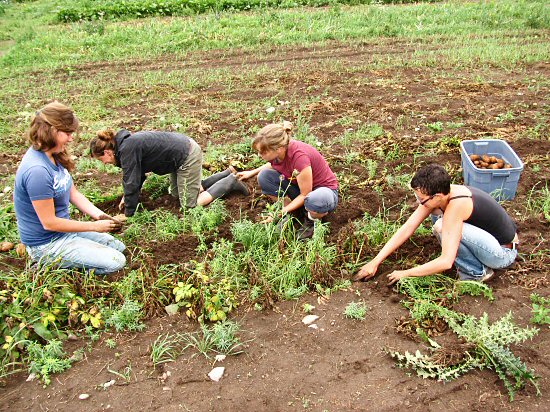
It’ll be hard to top THIS one for extremely labor-intensive tiny farming involving lots of peeps! Here, Libby, Lynn, Andie, and Mel hand-dig potatoes for tomorrow’s farmers’ market. The taters happen to be Gold Rush russets, and they’re in fine form, with a little wireworm damage (surface blemishes or tiny holes) to only a few. We’re right at the end of the first (of three) potato areas of this year, 600′ (183 m), evenly divided between Penta, Chieftan and Gold Rush.

So, what’s with all these people, digging together in a cluster, with just one bin? A little inefficient, pehaps? Well, not really. When there’s a lot of folks happy to mix it up with the dirt, tackling a single task all together can work out! We only needed about 70 lbs of each variety (that blue bin full). With the moist-but-not-mucky soil, pulling plants and scrabbling around was quick and easy. BIG POTATOES helped. Working close together wasn’t a problem because we had so little area to cover. Each bin got filled in maybe 15 minutes. Satisfying!

In the photo, you can also see how relatively good shape we’re in with weeds. The bit of grass growing back is in separate clumps, all the runners haven’t started to reach out and hook up. Further up is a section of more heavily overgrown onions. But that’s actually doing well as well: the onions were thoroughly weeded twice, and hoed a couple more times, so what you see is mainly grass from the last three weeks (without much shading out from the onion plants, everything else grows fast!).

Anyhow, when we tackle the main potato patch, around 2,000′ (609 m), methods will change. But we’ll still be digging in the dirt…!
Drizzly days

It’s been cloudy a lot this season, but the rain has kept pretty much to a reasonable number of rainy days and single downpours—it hasn’t been too WET. So, not that much fieldwork called for rain. Today was an exception, with a steady on-and-off drizzle from early morning that kept things watered down.

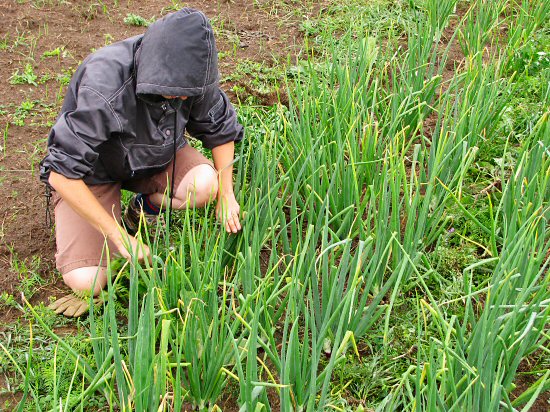
Lynn came out around 8:30 am to weed. Since it didn’t look like the sun would be showing up to dry things out, she finished a bed of onions (these are the last-planted onion seedlings, a fair bit behind the rest) and we called it a day for weeding.

In general, we try not to handle plants when they’re wet so as not to spread any sort of disease. This is a common caution for, for example, beans, and I’m not sure how it applies across the board to all garden veggies.  Still, since wet work in the field is seldom fun anyway, it seems like a good rule in general: No weeding when wet!

Another hand-watering method

Hand-watering onions

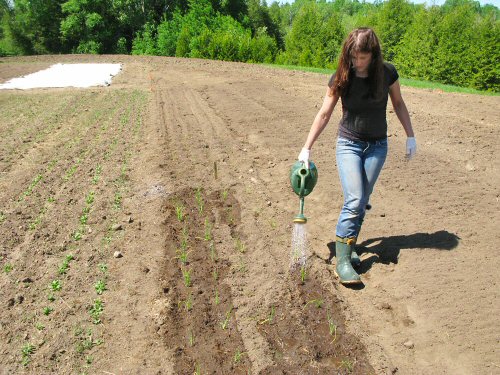
Another fine temporary measure this spring (and another of the many things the trusty Kubota compact tractor can do) is our new spot-watering method. Michelle waters in a last, experimentally late tray of onions with a slightly modified, inexpensive ($5) plastic watering can that holds about 2 gallons (8 l), and has big holes for fast, high-volume output. These cans we usually plunge into a rain barrel (or snow barrel) for filling, and to speed that up, I cut a squarish opening in the top (I always forget to cut the opening to the back, so water doesn’t escape from the top when pouring when full). The trick here is that the water comes from the Kubota’s bucket, maybe 30-40 gallons (110-150 l) of it, depending on how carefully the drive.  You fill up, then head over to exactly where you want, like a movable rain barrel! The whole thing is quick and  easy, good for watering in new seedings and transplants, until I hook up the field-long irrigation pipe. Quite the luxury, in a way, but the tractor’s already there, and we gotta keep things moving along! :)

More onions

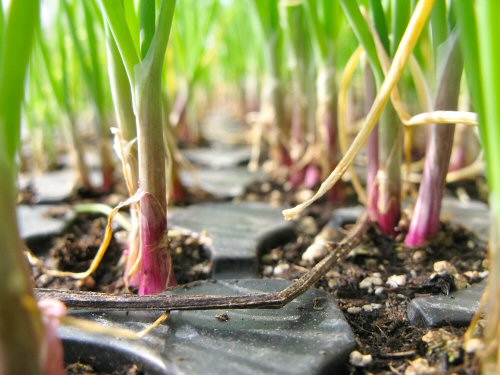
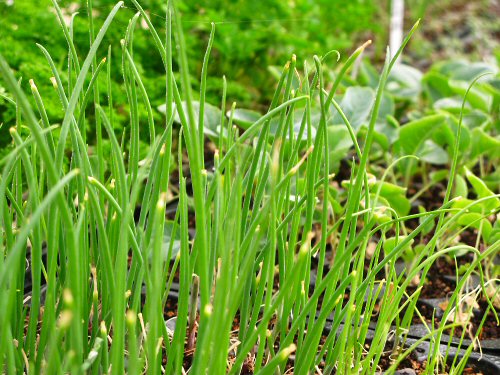
Red Wing onion seedlings

A last tray of onions—Red Wing hybrid red onions that did well last year—is hanging around the seedling room. What are they doing still not in the ground? Well, most of our onions—Stuttgarter-type yellow cooking, yellow Spanish, Red Wing, around 3,o00 in all—are already planted, in two sections, far apart. As I jigsawed together this season’s garden layout (now with the garden MAP), these guys just didn’t fit in the first two onion plots. So, they’ll get a bed of their own, somewhere, real soon, and we’ll see how they do compared to the others. Timing!

Seedlings queue up

Rototilling on the Kubota

It’s a jumble of seedlings around the seedling room, inside and out. Actually, it looks like a good part of the entire market garden, neatly in miniature, lined up in trays… Due to a pile of one-thing-waiting-on-another (for example, we have to run electricity for the fan that inflates the two layers of covering), the greenhouse is STILL not refit with its plastic, so the fallback plan is ferrying the seedlings out to tables—4×8 plywood on sawhorses—in the morning, and back in at night (when it’s still as often as not hovering around freezing).

Hardening off! All that daily moving is a bit of a pain, but they have to come in at night. In the hoophouse, without wind, it’d be a lot easier to row cover, and we could apply a minimum of overnight heat with the kerosene heater (or propane space heater). Outside is too much of a risk, particularly for the tomatoes, peppers, eggplant, squash,… Moving takes a total of maybe an hour a day, around 60 trays in all. (And the upside: it’s always cool to see backup plans work! :)

In the pic, the last of the onions from seed, plus cauliflower, parsley, and summer squash just germinating in the distance. Waiting to go…!

A field day

Seeding with the Planet Jr.

At this point in the season, EVERY day is a field day, unless it’s totally rained out. Today was no exception. Lynn brought a couple of friends, Julia and Tom, to check things out and lend a hand. They’re off to work in one of our fine parks this summer, but wanted to see what was going on on this tiny farm. No problem!

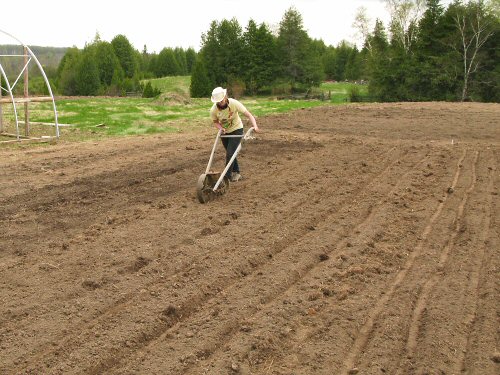
I seem to’ve gotten pretty good at tossing people into the tiny farming action, with little work-up or ceremony. A quick tour around (and here, there’s not much to see just yet), and it’s on to the hands-on. Neither Tom nor Julia had experience with market gardening, but in no time, they were seeding with the seeder of the day, the trusty and heavy Planet Jr. (above). We’re doing a second planting of spinach, and a third of peas…

The Planet Jr. can take a little getting used to, so there I am, explaining how it works as we go! Knowing exactly what a tool is doing and why really makes learning to use it so much more…satisfying. I think.

Just about EVERYTHING in tiny farming is quite simple and straightforward (there’s just a LOT of simple things to know!), still, some people have a natural talent for this or that. Like, Tom can clearly walk a very straight line as he measures off more beds for onions and peas. The current bed marking method: measure and stake the path centers at both ends of the bed, and walk ’em in! It’s pretty simple.

For getting your hands dirty, there’s nothing quite like crawling along in the dirt, pushing Stuttgarter-type yellow cooking onion sets into the ground, six inches (15cm) apart, by the hundreds. Once you get into the rhythm, you can sow and chat, and things get done in no time! All in all, relaxing and productive day in the field. Fun and useful, I hope, for all! (Photos 2, 3 by Lynn.)

Onions in the sun

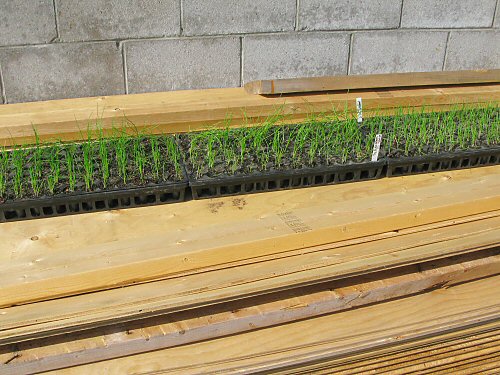
Beautiful day: 50°F+ (10°C) in the shade, over 60 (15°C) in the glorious sun! Couldn’t resist putting SOMETHING outside, so out went the first three trays of Red Wing red onions. Set them out around 10 am for a couple of hours, on a stack of lumber (the plywood is for re-flooring the upper barn), just outside the seedling room door, facing east.

This isn’t regular hardening off, just a kinda day trip, because I’m not sure when the greenhouse will be up. Normally, the plan is to get the hardy seedlings ready for moving out there sometime in April, but depending on the weather, they may stay indoors longer than usual. So, I dunno if back and forth between full-on SUN and WIND, and then the pale, fan-stirred world of the fluorescents, will freak ’em out a bit, but I don’t think so. It hasn’t done in the past! And I’ll keep putting them out every nice day from here on in…

This is the inquisitive, kinda impatient gardener at work, more than any sort of pro market grower on a rigorous production schedule (dunno if I even really have one of those anymore)—I like seeing indoor-started seedlings get outdoors, meet the real world, even for a minute, even if it’s arugula in the snow… Fun with tiny farming!