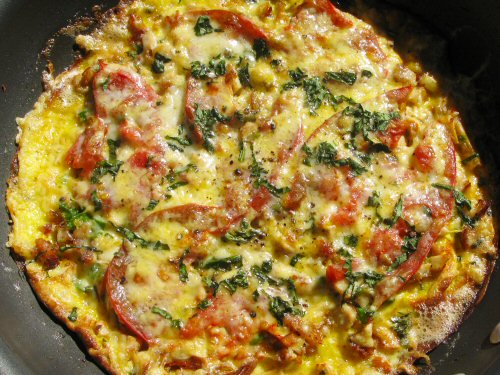
Odds-and-ends omelet

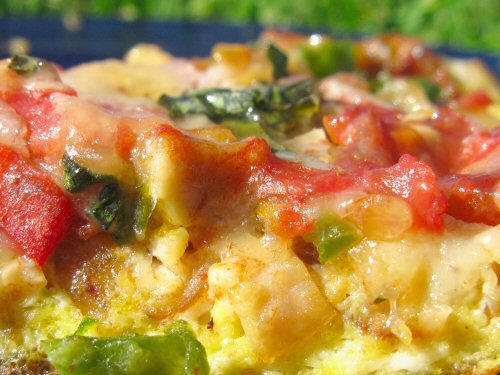
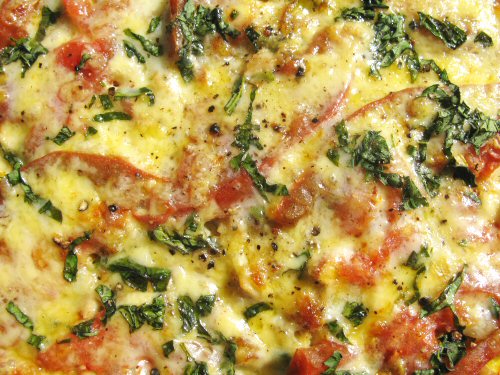
Preparing and gazing at food can bring as much enjoyment as growing, sharing and eating it! I’m really not a cook, but with fresh, quality ingredients, whipping up something appetizing is…simple. For our field lunch today, an omelet made from stuff at hand: eggs, cooked chicken with a little store-bought prosciutto, a black tomato (from Raechelle’s home garden), garlic, onions, basil and 4-year-old cheddar cheese. Chopped garlic and onions were sauteed in extra virgin olive oil, then the chicken and prosciutto were added to warm up. Out with the filling, in with eggs, lightly beaten with salt, pepper and a little powdered cayenne pepper. As the omelet started to set, the meat was sprinkled on, and the whole thing topped with thin slices of tomato, grated cheese, and basil. Quick, easy…

…and pretty tasty. Everything except the ham, salt, pepper, cayenne and oil came from the farm, or nearby. We ate in the field… :)

This year’s BBQ

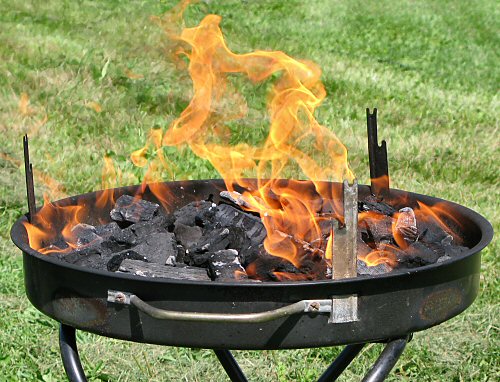
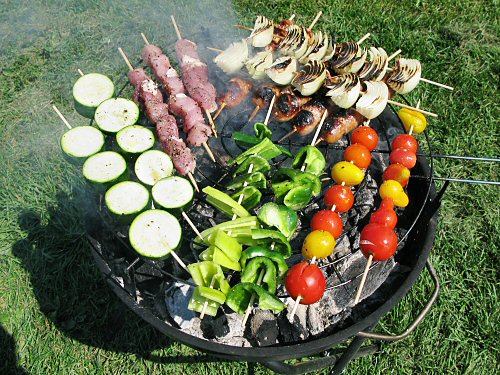
It took a while, but I finally dragged out the classic no-frills barbecue and continued the simpler BBQ approach started last season. This time around, I stumbled onto lump charcoal, which is pure wood carbon, and a step back from additive-rich preformed briquettes (I’m not all that serious about this, I just grabbed a bag and…discovered lump!). And so, on to the basic, quick-lunch-in-the-field experience, with garden veggies plus meat that the local independent butcher declares to be “local” (at least, from around us here in the province of Ontario). Chicken, pork, and several types of pork sausage, plus zucchini, onion, sweet and hot peppers, and cherry tomatoes from the garden. Also tossed rosemary branches right onto the coals for some aromatic smoke—between the breeze and the open grill, it didn’t do much flavoring, but it smelled nice! Cooking time is made easy by putting only one type of meat or veg per skewer—just slide off what you want and combine in your mouth! Simple and…tasty!!

Farmers’ market cruises along…

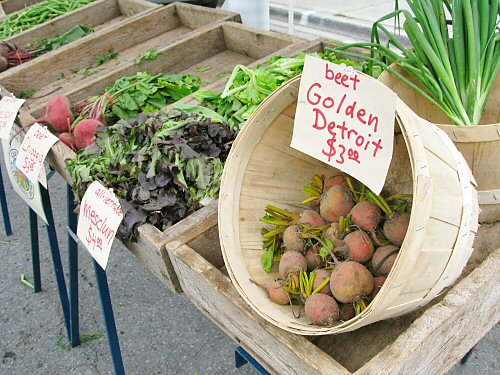
It’s 11 am and most of our harvest is sold. This is good, because the quantities of what we’ve been bringing have been fine. Still, with no early tomatoes, late green beans, not much summer squash, a wiped out first planting of cucumbers, and hail-killed first round of much of the peppers and eggplant, the pickings feel a little slim. It’s funny how variety seems to work at the market (and probably in the CSA shares as well): the greater the selection, the happier people seem to be, even though they don’t really buy more, or still buy mostly the same things. Maybe it’s because, as consumers (here in North America, at least), we’re so accustomed to being wooed by apparent choice, a regular parade of the “new” and the “improved” and cleverly repackaged, that having the same staple crops for a couple of weeks in a row makes the stand seem a bit stale. It’ll be…amusing to see outlooks change if (when) fresh food starts to get scarce. Well, all in all, a good day at the farmers’ market!

Eggs everywhere!

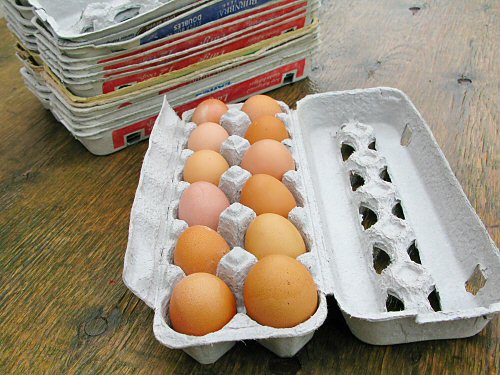
Barely a week after the arrival of the laying hens, egg production is in full swing, with about 20-21 eggs a day from 25 birds. From the start, all of the hens took to laying in one particular nest, I only occasionally find the stray egg elsewhere. They’re averaging about medium size, getting closer to large by the day (that’s the extent of my egg size terminology so far). Donated stacks of egg cartons are coming in from all directions. We’re surrounded by tasty little brown eggs…!

A simple (chicken!) sandwich

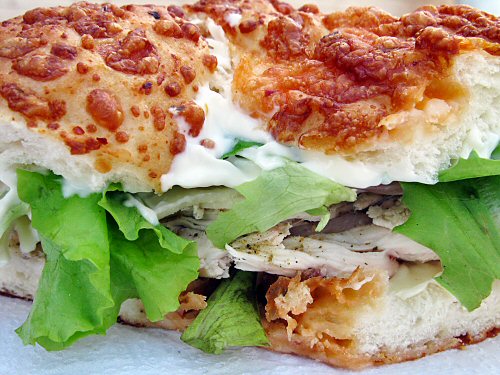
Roasted a White Rock chicken last night, today, got a Spicy Cheese Loaf from Fran, the baker beside me at the farmers’ market. (The market day went well, it was the first day of CSA shares: mesclun, spinach, radishes, garlic scapes, beet greens—it’s still early.) The chicken and the bread naturally organized themselves into a late afternoon simple sandwich…

Looking at it before the first bite, I realized that I’ve been thinking about FOOD a lot more recently. Not exactly my own diet, but on a more personal level than as a local veggie grower, probably something to do with the Endless Salad, more communal cooking and eating lately…

Part of the running stream of thought has to do with nutrition, what I know about it, how much I want to and need to explore further. I mean, do I really have any sort of basic IDEA of what to eat, beyond “lots of veggies, little meat, drink lots of water,” vague general guidelines like that? Do I NEED a plan? Should I RESEARCH? Consult with a nutritionist or a naturopathic doctor (I’ve been considering visiting an ND for an initial workup)? Sheesh, more RULES! All that is really clear is that most people around here (a “developed nation”) don’t know much practical stuff about the food they eat, me included.

The other part is about food quality, and local food. The one thing I’m quite sure of is that it feels way better to eat fresh food that you’ve grown, and to know where the rest comes from and what’s in it, and that wasn’t at all painful to discover. So, I examined this pretty local sandwich. The cheese bread listed the ingredients: flour, water, cheese, sugar, milk, vegetable oil, butter, yeast, dried chili peppers, salt. The chicken was raised here on the farm from two weeks old, fed mainly Purina (Cargill) starter and grower feed (nutritional content in percentages, contact the manufacturer for the actual INGREDIENTS), with some greens from the garden. The lettuce is from the garden. I poured on home-made vinaigrette dressing: extra virgin olive oil from Italy, pink salt from the Himalayas, fresh-ground black pepper, vinegar, Tabasco pepper sauce from…the store. The mayonnaise is from Kraft, it was in the fridge, the bottle says it’s “real.” It’s all ingredients within ingredients… I’m planning to make my own mayo, with eggs from the farm and oil from…Italy. Should I care where the flour in the bread came from? The cheese? The chili peppers? And what about the “vegetable oil,” what’s up with that? Should I make my own cheese and bake my own bread? When do I start looking around for organic chicken feed, how IMPORTANT is that, what’s the priority, how much can I afford to PAY?

I don’t have any neat point to sum up with here, I’m just being a literalist and looking at what I eat. When you start to question your basic eating habits in a very primitive way, they may not hold up to much scrutiny, and that’s unsettling. I’m curious. The story unfolds…

Chickens to the slaughter

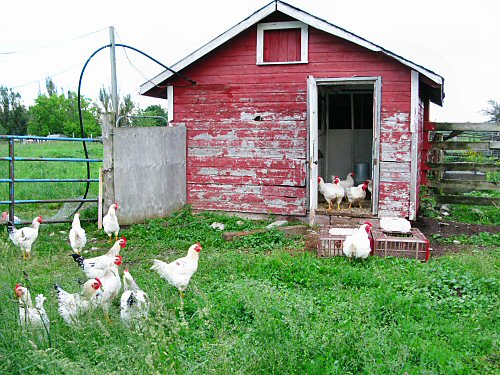
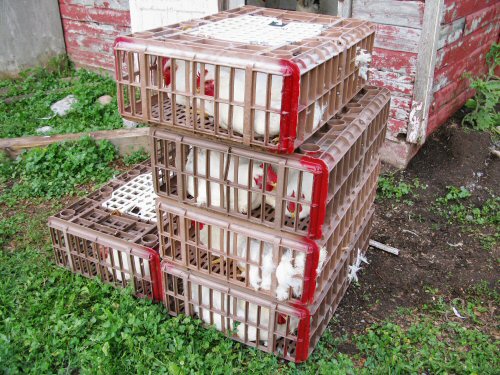
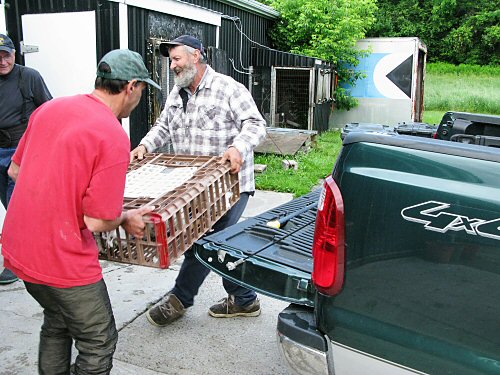
Raising your first chickens, killing them, and eating them has gotta rank up there with other Firsts worth a little attention. Now, I’m at least part of the way there: the killing this time was done behind closed doors, with me on the outside—chicken PROCESSING. Still, first enough to be worth a few photos… I’d been cutting it close with booking a processing day for the White Rocks, the local processor is known to get solidly booked for weeks. I finally called yesterday, looking for a date in two weeks, and was told there was also a cancellation for tomorrow (today!). I checked out the WRs, and, man, how could I imagine them getting any bigger (I think I was mesmerized, waiting for them to explode)? So I called back and booked. We drove over last night to pick up crates (20 minutes each way), then it was up at 5:30 this morning to load ’em. As soon as I opened the door, all of the Frey’s dual purpose darted out immediately, as usual, while the WRs, who mostly go nowhere, stayed in: it was kinda fitting that the Frey’s stood around in unfenced-in freedom, ready to run (and they would’ve!), while the WRs kinda dumbly looked out at their crates (above).

Five to a crate, 25 in all, 30 minutes or so to loaded…no need to chase down these lumbering beasts (while I was packing, most of the Frey’s figured out no good was afoot and entirely disappeared around the other side of the chickenhouse, something they’d never done before, while a couple stayed to watch).

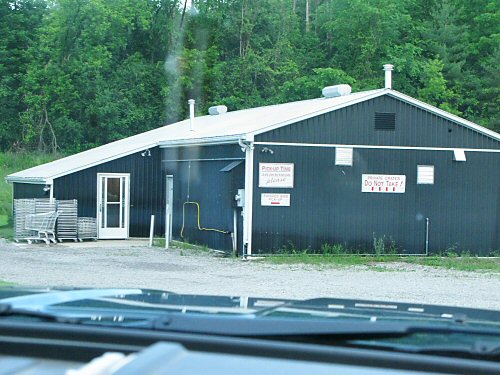
The processor is on a farm, a low building where birds go in live on one side, and come out the other, cleaned and chilled, weighed and government-inspected, ready to go…

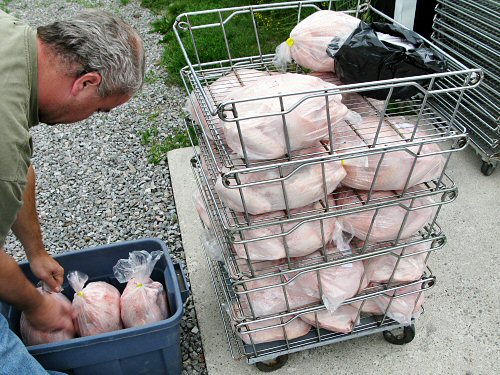
Bob and a processing guy unload. It’s 6:45am. The paperwork is quick and painless, I didn’t even have to write or sign anything. The only sign of bureaucracy in action is the required chicken purchase number, a serial number that’s on the form that you fill out when purchasing the chicks. And the on-premises government inspector popped out and did a little of his own paperwork. Other than that, just processing choices. For a few cents more (like 75-85), you can have the chickens halved and put in separate bags, or halved or quartered in the same bag. We got 10 halved and separated, for when cooking a whole fat chicken would be a little too much. Modern conveniences?! :) I also chose to get the organs back (in the black bag; below).

Eleven hours later, it’s 5:30pm and we’re back. Matthew helps pack the big birds for the trip home and into the freezer. Average weight is around 8lbs (3.6kg), where the Frey’s are maybe barely 3lbs. Hmmm… Not the most satisfying little adventure, with three 40-minute round trip drives, and the chickens disappearing through yet another middleman, reappearing neatly packaged for $3 more… With the processing fee tacked on for good measure, these are EXPENSIVE chickens, but I’ll do the math, and review the overall, somewhat unsettling White Rock Experience…later. On the other hand, you can’t beat the results: a lotta REALLY plump chickens! Next up in Meat Birds, Take 1: waiting for the free-ranging Frey’s to bulk up, and THEN it’ll be a fully DIY field-to-table chicken dinner!

Plastic…fantastic?

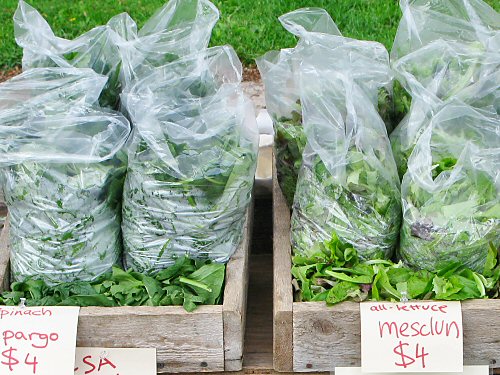
At the market today, greens were finally in great supply, with loads of mesclun and spinach: two giant, clear leaf bags full of each. I went home with quite a bit—no sold out sign this week!—which was great, ’cause I was selling right up to the end. And, as usual, I noticed all of the disposable plastic involved…

Greens, and market/CSA share harvests in general, usually involve lots of PLASTIC BAGS. In the beginning, this didn’t overly concern me on any level, other than that buying bags by the hundreds and thousands was kinda costly. But being on the dispensing side of this steady stream of plastic gradually made me realize how much of it is continuously being tossed out there FOR NO LASTING PURPOSE.

What got to me first wasn’t the environmental issue, but the fact that people were profiting off of this useless mass consumer habit of taking tons of “free” bags at every stop… Don’t like being fooled again and again… This culminated in one way for me about two years ago, when I stopped taking shopping bags for, like, 98% of my store shopping. Last year, I started cutting down on the way I offer shopping bags at the market: instead of automatically grabbing a bag for a customer as I asked if they needed one, I ask in a  leading way, kinda eying what they’re carrying already—not surprisingly, with all of the anti-plastic bag attention lately, the majority of people so far this year bring a basket or cart, or fit their purchases into a bag they already have.

I mean, to grow greens, it takes 40-60 days of watching, watering, weeding…and suddenly, in less than 24 hours, they’re harvested, bagged, distributed, and, hopefully, within another 2-3 days, EATEN. And the really useful life of the plastic in a bag of fresh-market greens is more like a very few hours, because once you’ve gotten your greens home, there are many more efficient ways to refrigerate them (like in a nice cotton bag, in a salad spinner, in a big bin,…). But there’s nothing that easily replaces the convenience of plastic for that last little trip between stand and home (a couple of people have asked that everything, greens and all, be tossed loose into their own shopping tote, which is kinda cool and should work no problem, but doesn’t sound too easy to encourage amongst ALL…).

So what am I getting at exactly, besides the OBVIOUS? Well, I guess it’s that plastic is curiously useful stuff, I’m not about to outright REJECT it in all its many handy shapes and forms, but I should learn more about it for a start… More as it unfolds! ;)