
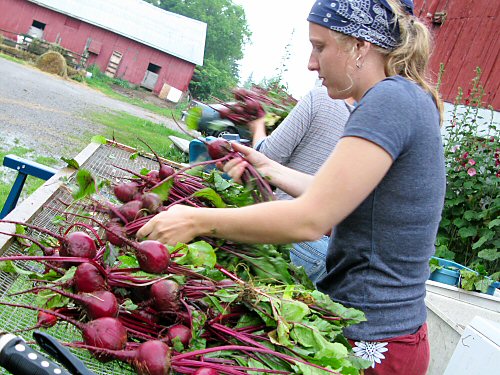
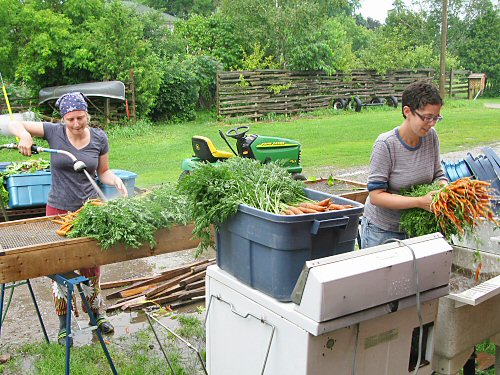
Yet another in this summer’s series of wet and gray afternoons, the weather blending perfectly with the wet work of rinsing and sorting muddy root crops. Instant efficient team chemistry between Rachel and Mel, both doing post-harvest here for the first time. (Above, carrots, below, beets.) The process is very small scale and manual. Crops are first dumped from harvest bins onto the screen table, clinging earth is quickly blasted off with the jet setting on the water wand. Next, double handful bunches are dunked for a final rinsing. Then it’s back into the bins… Simple and quick for a few bushels. Get wet!
beet
View from the stand
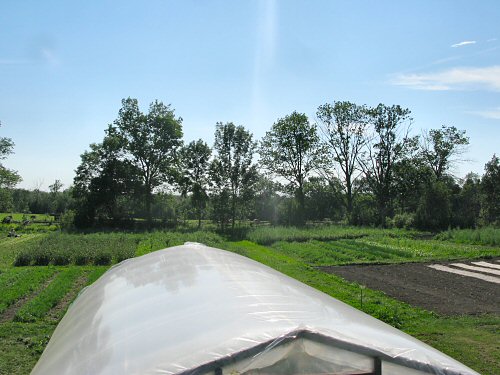
It’s mid-July, and on a (recently rare) sunshiney afternoon, things are looking OK. Better from a distance than up close, because a few sections, like the summer and winter squash, are quite severely in the weeds and in need of intensive hand pulling. And the ground remains almost constantly wet. Our moisture-retaining clay-loam soil, such an advantage in the usual near drought conditions we’ve had over the last three years, is now a bit of a hindrance. Sprawled tomatoes are particularly at risk if they don’t dry out against damp ground, and instead contract early blight (more about that another time!). Still, carpe diem, huh—seize the day! From atop the farm stand, the view is fine! We have the north end (above), with carrots under burlap (third planting), brassicas (newer transplants still under row cover), the cover in the far middle over squash, in front and more to the right, tomatoes, with a windbreak of giant sunflowers at the very right, and sweet potato bottom center. Open sections will include brassica transplants in a couple of weeks, and a fall cover crop. Out of sight to the north are onions…
In the middle, clockwise from the left, there’s a second planting of carrots, fifth mesclun right in the corner (with Maria weeding on the Greens Machine), garlic and parsnips, and potatoes in the distance (with more big WEEDS), the first planting of beets, carrots and green onions, and the edge of the third carrots under burlap from the first photo.
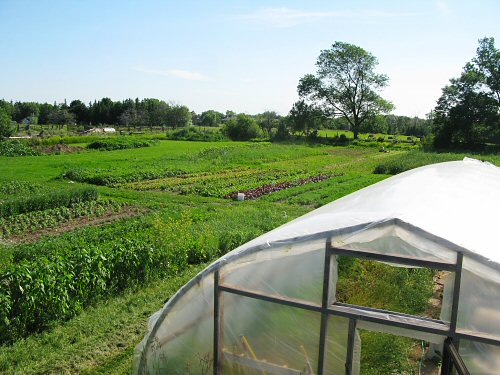
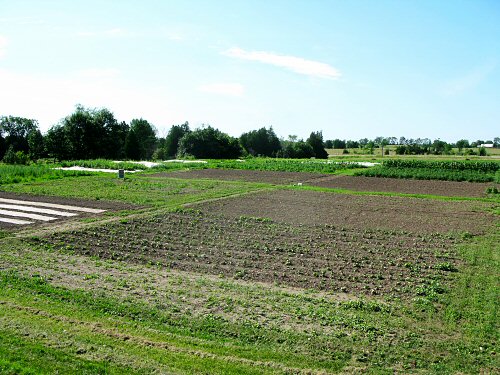
And then, the south end of the field, going left from the peak of the greenhouse, the garlic and Maia in the mesclun, the second planting of carrots and beets (that slash of of red is Bull’s Blood beets), the fourth mesclun , a weedy area with nasturtiums and tomatillos, and to the bottom left, herbs and flowers (fairly towering Jerusalem artichoke at the bottom left). (Guest photos by Lynn)
Still a lot of greens…
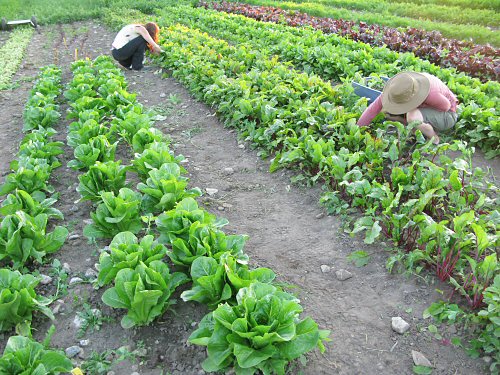
The Friday harvest is still greens-heavy, with beet greens in several varieties leading the way. Here, as the afternoon winds down and the temperature cools, Michelle and Lynn thin the second beets planting of Scarlet Supreme, with Chioggia and Bull’s Blood off to the right. There’s also the fourth planting of all-lettuce mesclun, just cut on the far left, and in the center, Panther romaine, miraculously spared by the earwigs and in excellent shape and taste, to be cut next… Elsewhere, cauliflower, parsley, the last of the spring spinach and peas,…
Tiny harvest!
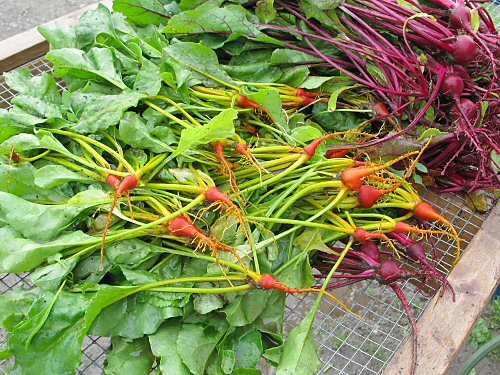
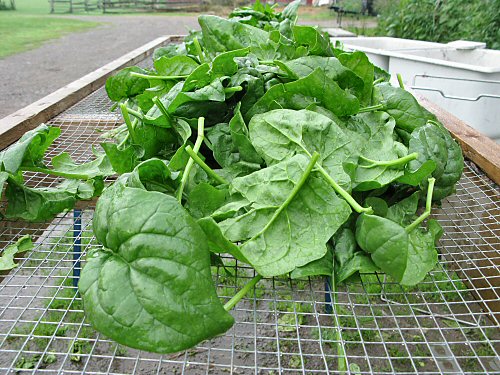
Spent the early morning harvesting a few CSA shares for a Monday drop-off. This is the first week of shares, and they’re still small, mainly greens… There are many tiny farming routines, things you’d probably never do in a bigger operation, that I find extremely relaxing and fun: the final rinsing and putting together of a handful of shares is one of them (it’s not really economical to separately harvest and drop off less than 10 shares or so, this is an…exception). There’s something deeply satisfying about this final post-harvest step, with the veggies together at their finest, the memory of the different quick individual harvests—picking, cutting, pulling—still fresh, that’s…cool! The spinach (above) was quickly dunked in cold well water to rinse off dirt splashed up from recent rain, then allowed to drip dry for a bit on the screen table.
Picked two types of beet greens, Golden Detroit and Scarlet Supreme. The stems are a little long on these—it all depends on the density of the rows, the weather, the harvest timing, leaf size is the luck of the draw since these are really thinnings, they’re not being grown just for the greens. Still young and tender, the baby beets and all can be cooked up, or the leaves used raw in salad (or as a salad!). Really tasty…
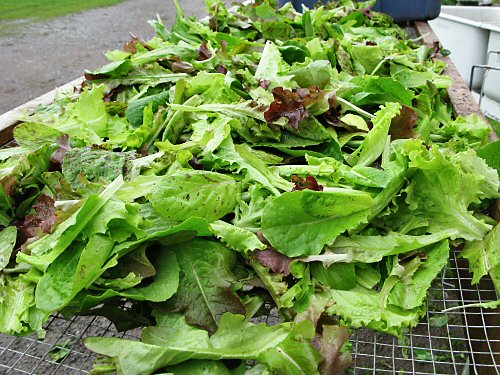
And mesclun, of course. This all-lettuce salad mix is a staple crop this year as usual, always on my mind! This cut’s nice and clean! Unrinsed—I let the morning dew dry off a bit on the screen table… More simple pleasures for the simple of mind! ;)
Thinning and weeding
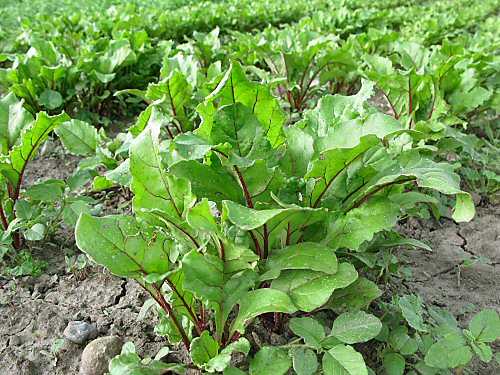
The first beet greens have sized up: lush and looking delicious, they’re ready to harvest. I love beet greens, both raw in salad, and lightly sauteed in olive oil and/or butter (a kind of deluxe spinach). I’ve never grown them as a separate crop, instead, they’re a happy byproduct of thinning the beets—removing the extra plants so that the remaining beets have room to grow. So the greens are both a harvest crop…and a weed. (I guess this is a continuation of yesterday’s post about WEEDS!) As you can see below, with the exception of a few gaps where nothing germinated, the first-planted beets are growing quite solid in their rows, which means a lot of plants have to be removed, maybe as much as 6-8 out for every one left behind (did you know, beet “seed” is actually tiny dried beet fruit containing several seeds?). There’ll be so much from four or five 3-row beds of beets, I won’t be able sell, eat, store or give away all of the greens that’ll pile up, but I can’t leave them in to stunt each other, so at at some point, the thinning becomes…weeding. Funny how that works! :)
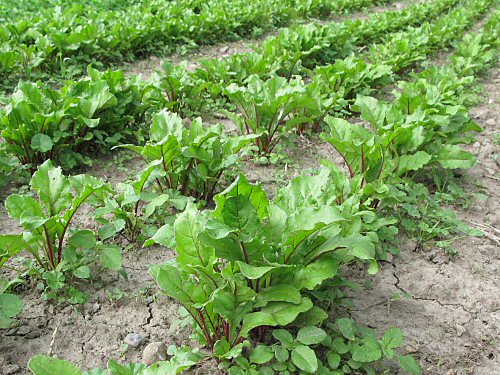
Meanwhile, after a quite intensive weeding by hand and hoe a few days ago, the beet beds and paths are in fine shape, with only some growth near the plants that’ll come out during the thinning. (The cracks in the ground are what happens with our heavyish clay-loam soil: it’s not at all concrete-solid, it’s nicely moist, but as the surface dries out, it tends to…crack.) As far as overall weeding, with some quick touch-up hoeing along the way, these beds should be fine till harvest in 3-4 weeks (maybe earlier for some). The increasing leaf cover will keep down weeds near the plants, and the increasingly narrow paths and between-row strips can be quickly walked down with the weed hoe. It should be…sweet! On the other hand, in the potato patch…
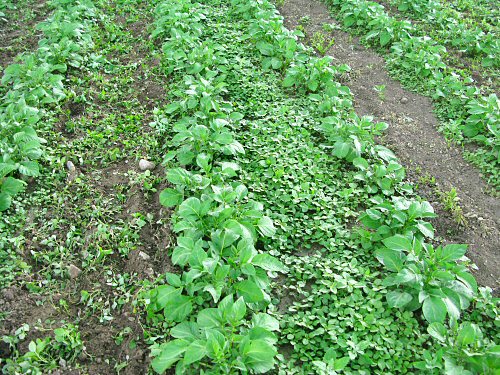
…things have gotten a little crazier. A dense and vigorous mix of mostly pigweed and some lamb’s quarters has carpeted one of the two potato sections. Here, you can see the difference a pass with the wheel hoe makes. On the left, a just-hoed path still looks pretty green. In the middle, it’s untouched and looking a little scary. I’d call this…Stage 2: leave these little guys just a few days longer, and it’ll be a fight to hoe as the pigweed stems in particular will start to get tougher. On the right, a path weed-hoed a couple of days ago (I was on the way through while walking back from hoeing another area)—after a day of sunshine, the cut and uprooted weeds dry up, and you can see how much weeding you’ve really done. There’s still a lot of close work around the plants, but the potatoes are really shooting up now, so once that final weeding is done, the plants will shade out and prevent germination of whatever weed seed’s still near the surface. On the other potato section, the weeds aren’t nearly so…dense. On this one, some of last year’s weeds obviously went to seed, which really increases this year’s population. It almost fee;s like a closed system: what work you get away with not doing now, you eventually pay for later, usually with a little interest…
Slow…
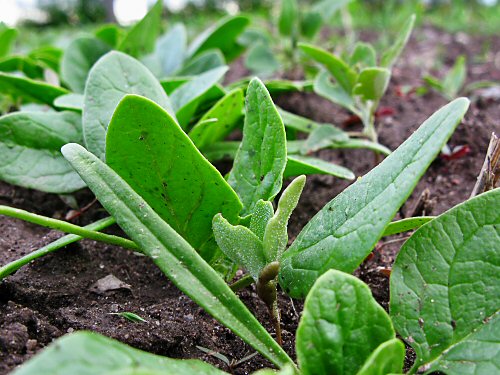
When you look back at last May on this tiny farm, overall, the state of the field isn’t all that different, BUT, the really cool nights for much of the month have slowed growth noticeably. Compare the first planting of spinach today, to the near ready crop of a week earlier last season. It’s the same for mesclun, beets, and chard. Snap beans are taking forever to germinate. And so forth. We’ll definitely be going to market at least a week later with the first field spinach and lettuce. Oh well, with all of the different crops going, bad weather for some benefiting others, it’ll overall catch up and more or less even out, I’m sure. It just about always does…
Frost is pretty when…
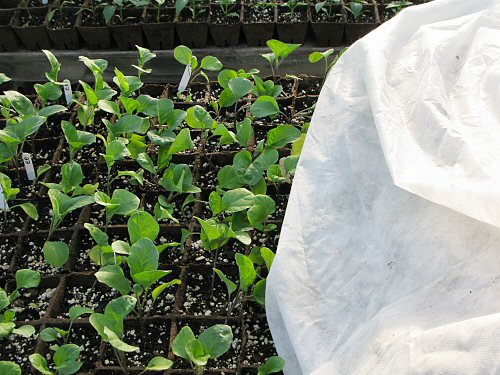
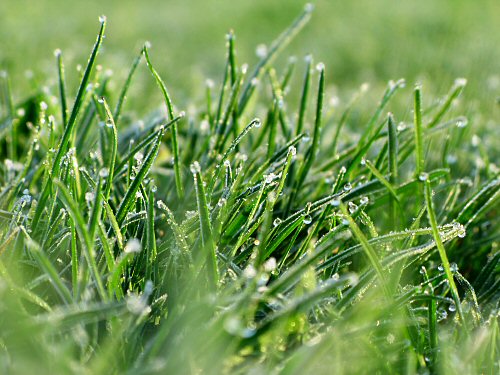
The days have warmed up now, mostly around 60-70°F (15-20°C), but the nights are unusually cold, dropping sometimes to freezing or a few degrees above. Frost burning off in the early morning sun is pretty when you don’t have anything in the field for it to kill, which I don’t… Let’s see: broccoli, cauliflower, radish, carrots, spinach, chard, beets, peas, parsnips, all-lettuce mesclun, tatsoi-mustard-arugula-bok choi mix… Nope, no worries there. (Funny thing, while pea plants are hardy, I believe the pods aren’t… I’ve never seen that in action, fall peas haven’t worked for me so far, and I don’t think there’ll be frost 40 days from now when this year’s first peas come in…). Meanwhile in the unheated greenhouse, although I’ve only fired up the kerosene heater once, just to be safe, row cover goes on all the tender stuff (toms, eggplant, peppers, and now, cukes, pumpkin, melons and squash, just about to poke up): on in the evening, off in the morning, better safe than toasted!
