First day at the new farmers’ market

Our space at the farmers' market

Here’s our so-far-unoccupied space at the new farmers’ market… This photo was accidental, clicked while checking some camera setting or the other. But when I saw it on the computer, it reminded me of the totally transient nature of farmers’ markets (and tiny farming in general!). Here we are, standing in a rectangle of asphalt marked out by some yellow lines, a PARKING SPACE, that transforms for a few hours into our little veggie emporium. All of the intention and energy of the tiny farm, concentrated…RIGHT HERE?! In a giant parking lot. Kinda weird… Life is what you make it, I guess! And I do love going to market! :)

Showed up at the 7am start of summer market opening day, to make an appearance, check things out (like, our new spot!), meet some of the other vendors, buy some food. Tara will also be here every Saturday, plus others when they can, but for the next couple of weeks at least, we won’t be setting up, and some veggie vendors won’t be here till June.

This market is at least 4-5 times bigger than the one we attended at the old farm. It’ll be a big change, with more small-scale organic growers offering similar veggie selections, and also way more people, but none of the familiar faces I’ve gotten to know, in many cases over 5-6 years. That last part is sad, but overall, it’s exciting.

Our stall is in a central spot—the empty space beside the round, yellow “honey” sign (below)—which seems good. Upfront in the photo is an array of unseasonably available produce—nice sweet peppers for early May!—from one of the several larger vendors who presumably buy at least part of their menu where the supermarkets do: a local food issue that’s concerning, but doesn’t upset or anger me the way it does some—everything tends to shake out…

We’re located beside another tiny farm, and I chatted with neighbor Anna about whether that might be a plus or not, if people have to choose from similar things on both stands. We’ll see, but it sounds to me like more choice, MORE FUN, and from what I’ve heard so far, all the small growers usually sell out by the end of the morning anyway. I bought some wild leek from our neighbors, a bag of great mixed baby greens from another aisle, an excellent bag of mixed sprouts…there’s lots to buy at the market when you’re not tied to your own veggie stand!

So, in its own exploratory way, our new season at the new farmers’ market begins…!!

Mixing and repotting

Filling peat pots

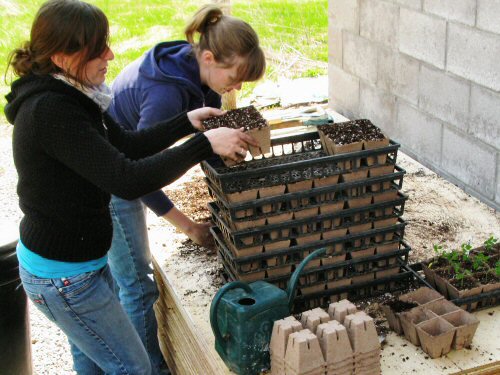
Today’s featured task: potting up tomatoes from plug sheets to 3″ peat pots. As with many things here this season, this is a little later than usual, by a week or so, as the new farm set-up gets squared away. (It should all even out sometime in June.)

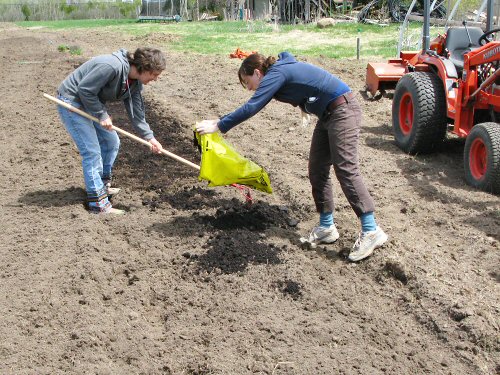
This batch of seedling mix is about 50% compost, 25% peat and 25% perlite. Lynn and Andie did the blending on top of a stack of 4×8 plywood, using a shovel, and hand-crumbling clumps of peat and compost. With a little experience, it’s easy to judge a mix by squeezing it (or you can just follow a recipe exactly), but a fairly foolproof test, when using compost or soil, is to water-in a loosely packed pot: if the mix collapses into a muddy muck, you need (lots) more perlite/vermiculite/peat. Water should flow through leaving things still kinda fluffy.

Between tomatoes, peppers and eggplant, we’ll end up with maybe 900 potted-up transplants, aimed for the field in about three weeks. I’d decided to stop using peat pots this year because you have to keep buying them (they’re planted with the seedling). BUT: it’s so busy, there was no time for soil blocks, hadn’t had a chance to find a supplier for reasonably priced, small bulk quantity (reusable!) plastic pots, and we found an inexpensive peat pot supplier in town (they’re usually ordered and delivered), so it’s peat once again this year…

Spring garlic?

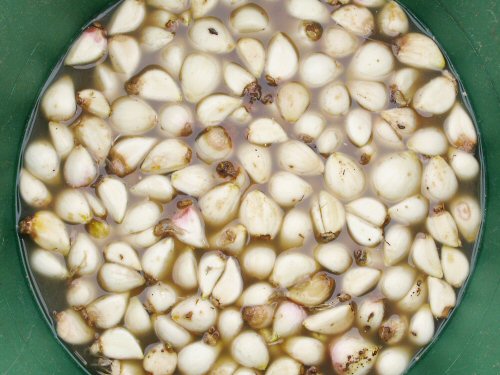
Garlic cloves prepped for planting

With the timing of the move to the new farm, there was no fall garlic planting for this year. Very sad—over the last three seasons, we’ve grown 2,000-3,000 bulbs a year, it’s a much-loved crop all around (starting with me!), and it’s been the very first sign of new veggie life as the fields wake up every spring. Oh, well, we should be back to full-on garlic this fall!

Meanwhile, what we have INSTEAD is about 200 of the toughest, most I-will-survive garlic cloves ever, going in today for a really late start, late even for spring planting! After long months of storage, and an accidental total freezing, the loss of garlic I’d been saving was pretty huge, these 200 out of maybe a thousand.

The guys who made it got an overnight cleansing and rejuvenating bath in a mild solution of baking soda (anti-fungal) and kelp extract (boost), and they’ll be quickly rinsed in alcohol just before going in. Especially for this small, late planting, all this prep probably doesn’t matter much, but they deserve it (personify and pamper your seeds and plants when you can, it’s friendly, until you harvest and eat ’em!).

So, it’ll be a first-hand test of whether it’s worth planting spring garlic at all. From what I’ve heard, chances are we’ll get at best smaller, later bulbs, some misfires with no bulbs forming, and the same great garden-grown garlic taste! We shall see…!

Direct seeding

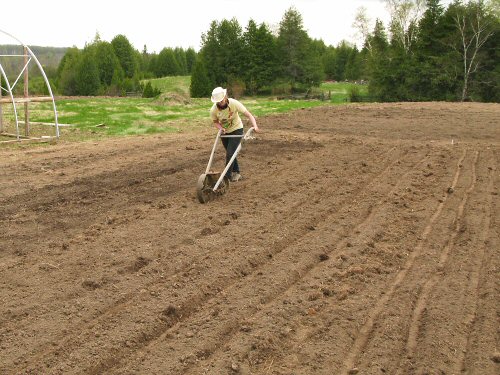
Direct seeding is going ahead at a careful pace. There’s a fair amount of broken up sod in the mix, and it would be nice for it to have more time to settle in and decompose, also for any bits of live grass to start poking up so they can be disrupted again with a light tilling… But we can’t just wait around. Spinach, beets, and radish went in a few days ago, just after the first peas. More peas went in yesterday (Connor for the first time wrestles with the kinda heavy and unwieldy Planet Jr., above, and ends up doing fine on a trial row). Now, the watching and waiting is on for the first plants to emerge in the field…

Potatoes delivered

Seed potatoes arrived today, all the way from tiny PEI (Canada’s potato province!). It’s still difficult to find certified organic potato stock, especially in more-than-home-garden-less-than-big-farm quantities, so it’s back to Veseys for another 300 super-expensive pounds, from 1,000 miles (1,600 km) away. Not too local, but that’s part of the certified organic game, finding seed… This year, the delivery charge upped the price by 60%—it’s expensive to truck stuff.

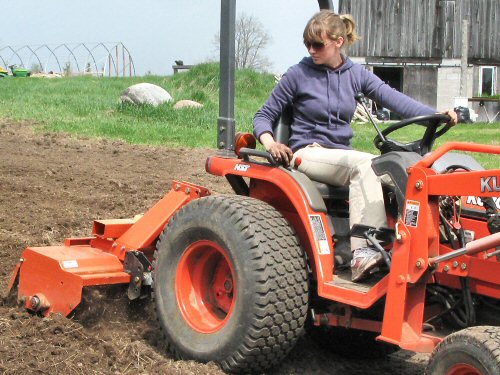
Unloading. The lane to the barn is narrow, has an obstructive tree right beside a slight but critical bend, slopes upwards, and falls off on one side—big trucks don’t even try to get in. We have to unload at the side of the not-too-busy 2-lane secondary road. Once again, the Kubota compact tractor makes up the difference, this time standing in as a forklift replacement.

Transport trucks it seems often don’t have elevating tailgates that can handle weight, they’re set up for forklift loading, so if you don’t have a handy farm forklift, you have to unstrap the pallet and hand-bomb everything off by the piece. The truck drivers are usually really helpful. This was just six 50lb sacks, two each of Penta (like Yukon Gold), Chieftain (red), and Gold Rush (russet-type), so we’re done in no time!

Machines can communicate: See ya!

Red cabbage

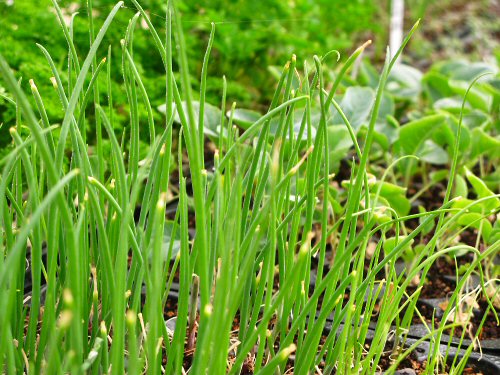
Besides the older seedlings, clamoring to get out, we’ve been starting new guys as well, for later planting. Here, a few days after emerging, a baby Cairo (hybrid) red cabbage, for crowded growing (12″ spacing), to produce “baby,” “gourmet” cabbages—basically, small ones! Elsewhere, Brussels sprouts, savoy cabbage, bok choi, and more. And it’s time for a second set of broccoli and cauliflower, to follow up the first wave. In our short May-September main growing season, now’s the time… Tick-tock!