
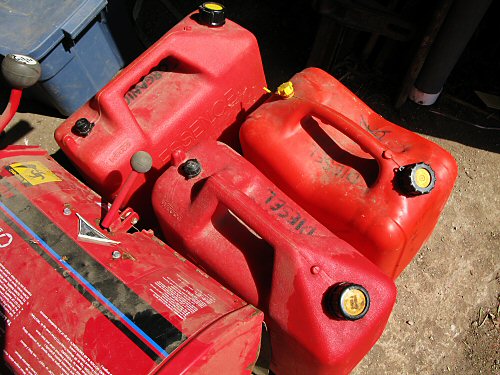
This tiny farm’s entire direct connection with the world of oil is simple: six red, 20-liter gas cans, three for gasoline, three for diesel. It’s a really stark way to watch spiralling gas prices and the so far bubbling-under peak oil panic, made more so for me because I don’t drive (never bothered to get a license), and I’ve lived 100% in big city cores until the farm—North America’s deep-set gas station culture had been a spectator thing for me. And now, gas is suddenly connected in a very straight-flowing line, from pump to a handful of tiny farming tools that perform clear and specific tasks. On the gas side, there’s the riding mower (mowing, mulch collecting, hauling stuff in trailer, used a lot), a walking rototiller (only moderately used since the wheel hoe last year), the pond irrigation pump (with so much RAIN, not used at all this year!), a weed eater (used only moderately), and another weed eater converted into a mini-cultivator (seldom used). On diesel: the Kubota compact tractor (rototilling, moving stuff with the front-end loader, quite used). That’s it! I filled three cans in mid-April, two diesel, one gas (above), today, two months later and all out, I filled two more, one of each. In my five years of tiny farm experience, cost has gone from $15 a can of gas (and quite a bit less for diesel), to about $30-35 a can (with diesel more expensive?!). It’s worrisome, but I don’t get too agitated, probably because the containers are so few and so relatively SMALL. But every time I’m tilling on the Kubota, or driving the length of the field loaded down with harvest and gear, I’m increasingly, acutely aware of the amount of work that comes out of a little gas, and what the manual labor alternative would be like. It’s like a little calculator program running in the back of my mind: how long would it take me to do this by hand? How about with help? What would it be like to do without? I feel great satisfaction when the six cans are filled and set in the drive shed all in a row: supplied for…a while! Of course, gas figures big in getting to the market and getting to town, and I pay my share there (I have an arrangement with Bob for the market season, and for the rest, I get lifts when others are going where I need to). And I also never forget how all those store shelves get filled. And how people get to market, pick up CSA shares, get to the farm. And I’ve started calculating highway mileage to reimburse everyone who volunteers here for their travel. Not to mention all the flying and driving it takes WWOOFers to get here from far and wide. And so on… Oil is everywhere, not easy to avoid or make sense of. At this point, for me, it still comes back to the cans: the color of oil is RED… :)
storage
Not turkey, beets!
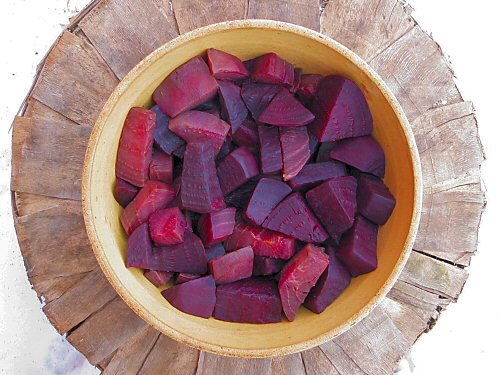
While a bit of a tradition of leftover-turkey crepes were being cooked up for brunch this morning, I was eying the leftover boiled beets. It was something about shapes and the muted, earthy shades of purple, and maybe the bowl helped along the effect. Soothing. Mesmerizing. I couldn’t stop staring. Guess I’ve got veggies on my mind… These were beets from the basement, roughly cut up as you can see, a mix of red (probably Scarlet Supreme) and white-with-red-stripes Chioggia, which were colored by the red beet juice. Boiling this time round was easier, though baking is the favored way to cook ’em. Anyhow, possessed by the beets, I brought them out into the light to take a picture, grabbed the first suitable surface to stick in the snow (a wooden bushel basket, upended), and took a pic. The color is sort of as I saw it, but you really had to be there for the full effect. Stare into the beets… Like I said, veggies on my mind! :)
Local food luxury
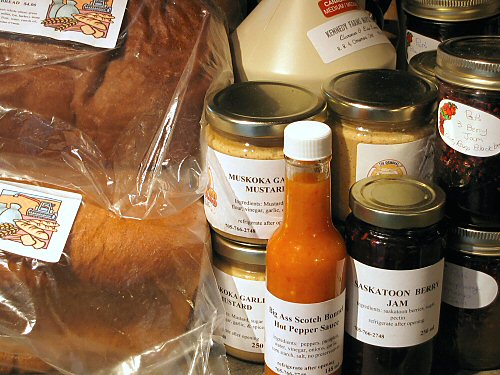
Today was the farmers’ market’s annual winter market, held indoors in town. It’s supposed to be local produce and locally made crafts, no reselling of manufactured stuff, and for the most part it is. I go to hand out CSA flyers. On the food side, there are storage veggies, like potatoes and carrots, and lots of baking, condiments and preserves. So I did some shopping.
Every Saturday during the market season, I buy from other vendors, but winters I’ve trailed off. This year, with the small but purposeful start on the way to a CSA root cellar, my mind’s more on personal, year-round “eating local”, and I’m doing something about it. One way is to stock up when you can. I bought half a dozen bottles of a really fine maple garlic mustard that I’d tried before, and a variety of preserves (we’ve been eating local jams and jellies almost exclusively for a while). I’m also trying a Scotch bonnet hot pepper sauce (it has a slow, steady burn, gonna get a six-pack!). There’s two liters of pure maple syrup (I’ll check out the farm it comes from, down the road, when the sap is running this spring). I also picked up several loaves of whole wheat, multigrain and Ezekiel bread, which I’ll slice and freeze (and I can order a minimum of four or five loaves from Barb, custom baked, for pick-up when I’m in town). With the stored veggies in the basement and in the freezer (like the simple, tastes-like-summer tomato sauce), it’s a pretty good start.
And local food feels excellent. I absolutely look forward to the taste of everything or I wouldn’t be eating it! From reading and from watching the garden grow, I really do believe in the superior nutritional quality of non-industrially raised food, even if it’s something you mightn’t SEE on the day-to-day. And the satisfaction of knowing my food right to the people who make it and the raw ingredients they make it from is deep and really fun. This to me feels like luxury, and it’s only getting started!
Root cellar check-in
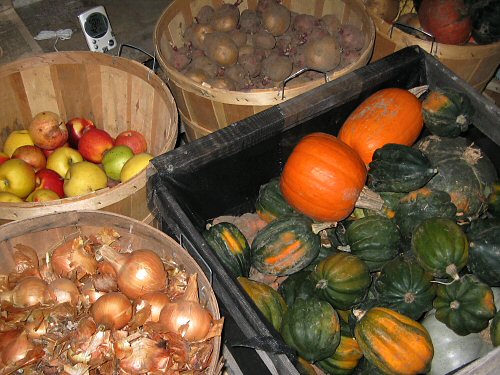
This is going quite well! Mainly, the idea is to do the regular tending, and see how things hold up. Although I’m calling it root cellaring, it’s really quite a limited experiment this first time round. The veggies weren’t too carefully sorted for long-term storage to start with, and I’d pay more attention to getting everything into cool conditions quickly. And really, I’d make sure the space was proper root cellar material! Here, the temperature didn’t drop from 60°F until the last week or so, and it’s only at 50°F now and around 45% humidity. Not exactly ideal. Still, not bad so far. I’ve culled about half a dozen onions from a bushel, lots of the smallest squash (there’s LOTS left), a couple of apples. The pic shows about half of what’s there. If I were holed up in the wilderness and this was my food cache for the next four months, I’d be worried. But I’m not, and we’ll be eating storage veggies for a while… It’ll be interesting to see what’s up in another month. I wonder, how many ways are there to prepare winter squash?!
The seed…
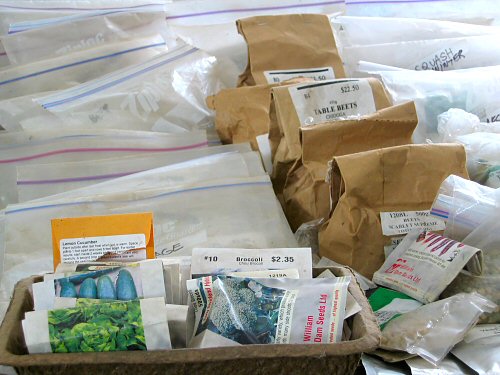
Keeping up with the early start, I got out the seed from its storage chest to take a look. With the tiny farm’s growing HISTORY (hey, Year 6, coming up!), keeping the seeds sorted for freshness is an ever more…serious consideration. Old seed won’t work, and there’s always lots of carryover from year to year. For this garden’s veggie selection, seed life in cool, dry storage conditions falls into three categories: nice and long (around 5 years, for brassicas, cucumber/squash family, lettuce, tomatoes,…), medium (around 3 years: beans, peas, carrots,…), and SHORT (1-2 years, for onions, corn, parsnip, parsley,…not too many here). Luckily, this is all book info, not gathered from painful personal experience! But I listen closely, ’cause one of my biggest garden nightmares is THINGS NOT GERMINATING… There are enough reasons why gazing happily on those newly seeded, semi-straight rows might be the greatest satisfaction they ever offer, and dead seed shouldn’t be one of ’em. My first germination test last year seemed to bear out the wisdom of others: normally-stored seed is not forever… So, it’s checking packs and taking dates!
Heat!
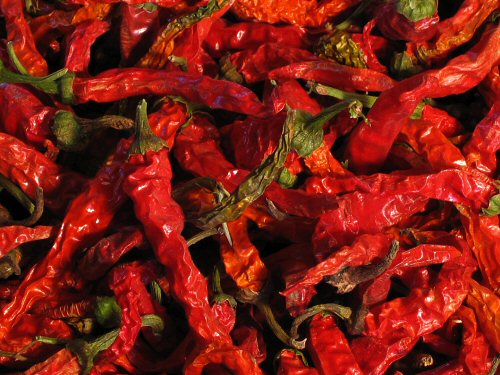
Finally finished a bit of hot pepper harvest, now there’s a convenient pile of dried heat! A few weeks ago, wondering whether to cover for frost, I decided to also pull up some hot pepper plants, roots and all, instead. An experiment! We loaded about 20 of the Cayenne Long Slim on the cart and dumped them in the Milkhouse, heaped on the grow racks that we’d been using, with the lights removed, as summer storage shelves. And there they sat, blending into the decor, drying, the peppers that were still green maturing to red. Until today… (This is the kind of thing you can do in a Milkhouse, not so acceptably in a real house…) They’re satisfyingly high on the heat scale, delivering a little pain if you don’t sample carefully. Great!
Outpost returns
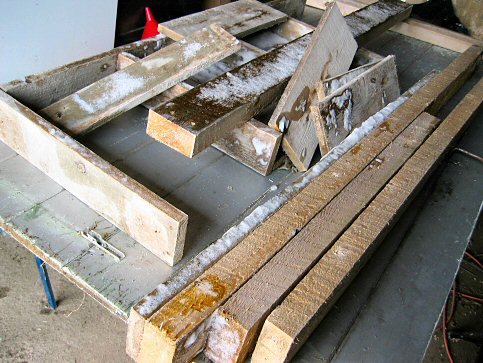
The mildly ambitious veggie outpost experiment of earlier this year has returned in pieces. The stand came back today, courtesy of Conall, who took it apart and dropped it off (you can’t help but notice, he’s pretty thorough when it comes to taking things apart…). In any case, a nearby coffee shop wanted to sell a small, choice selection of organic veggies. They were buying upfront at normal prices and marking them up a bit. Our part was to harvest once or twice a week, and deliver (only 12 miles)—building the stand was basically a last-minute favor… Why it didn’t work came down to that simple consideration that supermarkets are built on: SHELF LIFE. The coffee shop couldn’t get a handle on how to keep the veggies perky and fresh. I heard about an attempt to revive baby eggplants, shriveling after a day in the sun, by misting them like salad greens. Yikes. I would’ve helped if I could’ve, but I have zero experience with storage in a store-type situation. I’d kinda assumed that, since they prepare and sell food, they were equipped to figure it out. Not so. At the farmers’ market, I start in the cool early morning, it’s only six hours, and the veggies move quickly, so it’s all fine, without refrigeration or cooling, even on the hottest summer days. But keeping displayed veggies perfectly presentable for even a couple of days is a whole other specialized thing. Anyhow, after six weeks or so, we stopped. There was no ill will or anything, and we continued to supply mesclun for their salads for the rest of the season. The bottom line is a lesson I learned long ago, but failed to act on in this case: when you’re involved in something NEW, if there’s no plan that clearly deals with the DETAILS, chances are there will be…TROUBLE. I look forward to tackling this particular puzzle—how to handle daily fresh veggie sales—next year, when we FINALLY open the farm stand. ;)