
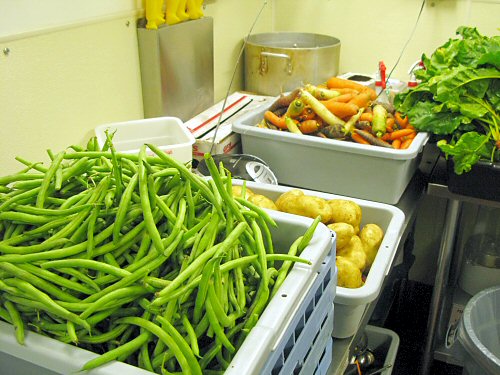
A phone call on the weekend lead to this, our first real restaurant sale. It was cool! A chef called looking for local, organic veggies for a special menu this week. They’d joined at the last minute a regional food festival, featuring local food in restaurants in several towns. I ran down what we had available and followed up with an emailed price and available quantity list. Today, we harvested and delivered: green beans (Jade), potatoes (Kennebec), beets (Golden Detroit, Scarlet Supreme), carrots (Nelson, Purple Haze, White Satin), and onions (Stuttgarter-type yellow cooking, yellow Spanish), in the 25lb (11kg) range for each. Pricing was the normal market unit price, no “wholesale” discount. It was great pulling up to the back of the building, delivering into the kitchen, checking out and describing each veg with the chef. The dinner plans: a “hearty fall soup” and a “steamed vegetable pasta with olive oil and herbs.” Market gardens and progressive local restaurants are a natural and quite common direct fit…as seen on TV (I’ve been known to watch the Food Channel)! I’ve had some minor dealings with restaurants in seasons past, but we’d never got round to a classic chef’s order and kitchen delivery. so it was interesting to go through the whole routine. We had lunch there afterwards, and the food was refreshingly good: bruchetta, flatbread pizza, sweet potato fries, salt and pepper rib tips, an asparagus sandwich (yeah, the asparagus aren’t exactly in season around here, but their special local food menu is a step in a cool direction…). Fun! Oh, and no frost last night.
onion
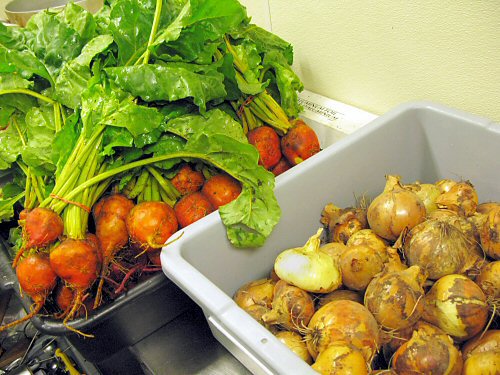
Onions from seed!
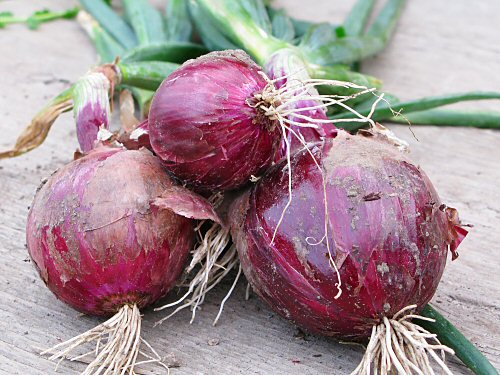
This is the first year I’ve tried growing onion from seed, and they’re doing fine. Today, I pulled up one multi-planting of Red Wing to check ’em out. Multi-planting onions was also a first-time experiment, with 3-4 seedlings transplanted in one spot, at 12″ (30cm) in-row spacing. They’ve done a good job of pushing themselves apart, they’ve stayed pretty round, not flattening out where they touched.
Another thing I was a little concerned about didn’t come to pass. For around a month, the onion seedlings had already been under the usual 14-16 hours a day of fluorescent light on the grow racks, when I read about the possibility of daylength sensitivity at the seedling stage. When the amount of sunlight reaches a certain threshold, over 12 hours or so for long-day varieties, the onions move from leaf growth to producing bulbs. A couple of sources said that premature bulbing can be triggered by too much light too early on, even at the beginning seedling stage, and you’d end up with tiny, marble-sized onions after a season in the field. Other sources disagreed, but in any case, that didn’t happen here! Still, in future, I’ll start long-day onions under reduced artificial light…to be safe.

As usual, the cracked surface of our clayey soil looks rougher than it is: it isn’t really hard, only a thin, dry layer with moist soil right underneath. Here, four out of five seedlings have pushed apart, rotating the stems outward, and grown into decent-sized…onions!
Odds-and-ends omelet
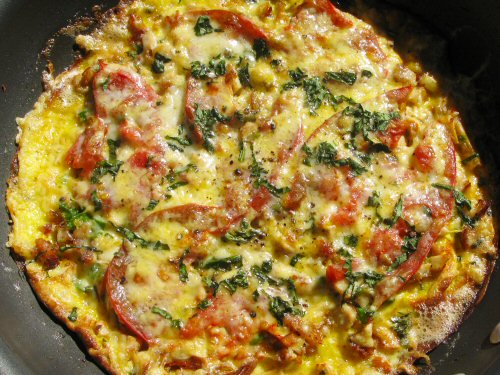
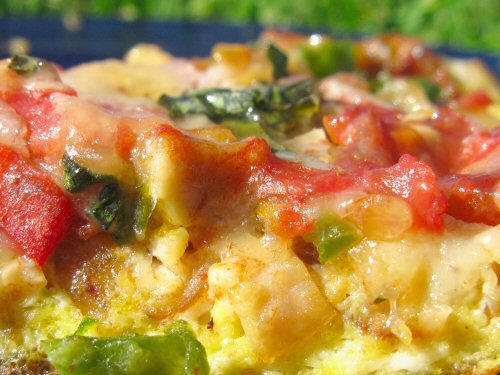
Preparing and gazing at food can bring as much enjoyment as growing, sharing and eating it! I’m really not a cook, but with fresh, quality ingredients, whipping up something appetizing is…simple. For our field lunch today, an omelet made from stuff at hand: eggs, cooked chicken with a little store-bought prosciutto, a black tomato (from Raechelle’s home garden), garlic, onions, basil and 4-year-old cheddar cheese. Chopped garlic and onions were sauteed in extra virgin olive oil, then the chicken and prosciutto were added to warm up. Out with the filling, in with eggs, lightly beaten with salt, pepper and a little powdered cayenne pepper. As the omelet started to set, the meat was sprinkled on, and the whole thing topped with thin slices of tomato, grated cheese, and basil. Quick, easy…
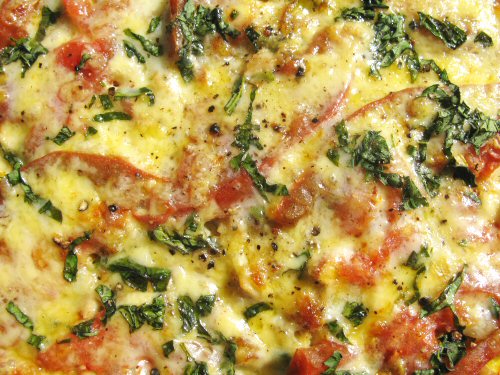
…and pretty tasty. Everything except the ham, salt, pepper, cayenne and oil came from the farm, or nearby. We ate in the field… :)
This year’s BBQ
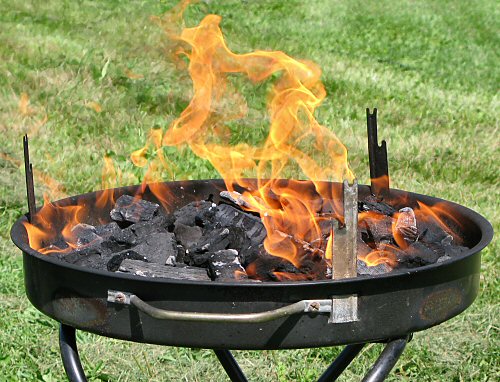
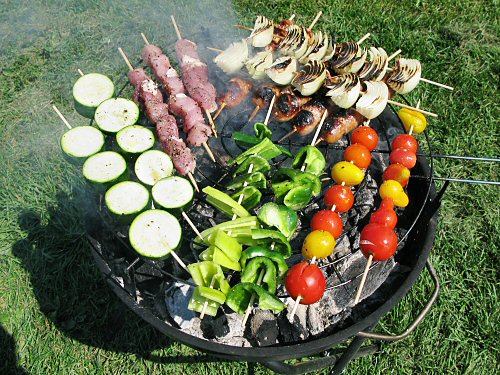
It took a while, but I finally dragged out the classic no-frills barbecue and continued the simpler BBQ approach started last season. This time around, I stumbled onto lump charcoal, which is pure wood carbon, and a step back from additive-rich preformed briquettes (I’m not all that serious about this, I just grabbed a bag and…discovered lump!). And so, on to the basic, quick-lunch-in-the-field experience, with garden veggies plus meat that the local independent butcher declares to be “local” (at least, from around us here in the province of Ontario). Chicken, pork, and several types of pork sausage, plus zucchini, onion, sweet and hot peppers, and cherry tomatoes from the garden. Also tossed rosemary branches right onto the coals for some aromatic smoke—between the breeze and the open grill, it didn’t do much flavoring, but it smelled nice! Cooking time is made easy by putting only one type of meat or veg per skewer—just slide off what you want and combine in your mouth! Simple and…tasty!!
View from the stand
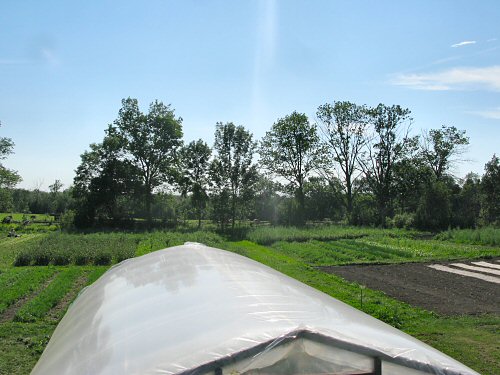
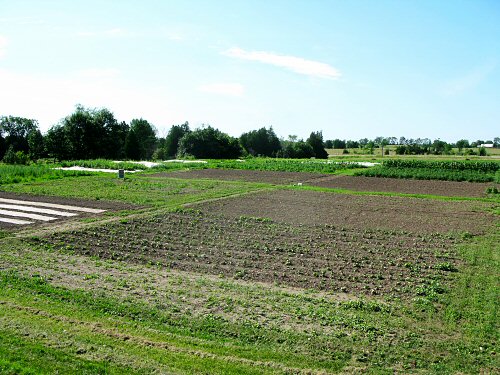
It’s mid-July, and on a (recently rare) sunshiney afternoon, things are looking OK. Better from a distance than up close, because a few sections, like the summer and winter squash, are quite severely in the weeds and in need of intensive hand pulling. And the ground remains almost constantly wet. Our moisture-retaining clay-loam soil, such an advantage in the usual near drought conditions we’ve had over the last three years, is now a bit of a hindrance. Sprawled tomatoes are particularly at risk if they don’t dry out against damp ground, and instead contract early blight (more about that another time!). Still, carpe diem, huh—seize the day! From atop the farm stand, the view is fine! We have the north end (above), with carrots under burlap (third planting), brassicas (newer transplants still under row cover), the cover in the far middle over squash, in front and more to the right, tomatoes, with a windbreak of giant sunflowers at the very right, and sweet potato bottom center. Open sections will include brassica transplants in a couple of weeks, and a fall cover crop. Out of sight to the north are onions…
In the middle, clockwise from the left, there’s a second planting of carrots, fifth mesclun right in the corner (with Maria weeding on the Greens Machine), garlic and parsnips, and potatoes in the distance (with more big WEEDS), the first planting of beets, carrots and green onions, and the edge of the third carrots under burlap from the first photo.
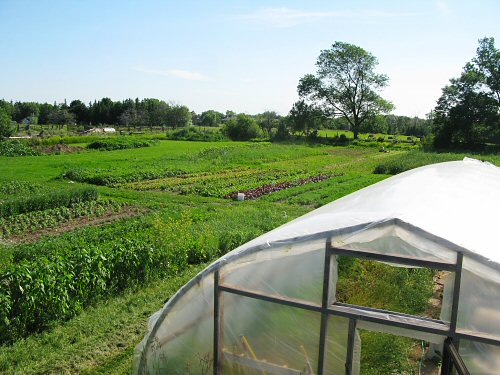
And then, the south end of the field, going left from the peak of the greenhouse, the garlic and Maia in the mesclun, the second planting of carrots and beets (that slash of of red is Bull’s Blood beets), the fourth mesclun , a weedy area with nasturtiums and tomatillos, and to the bottom left, herbs and flowers (fairly towering Jerusalem artichoke at the bottom left). (Guest photos by Lynn)
“I love intense!”
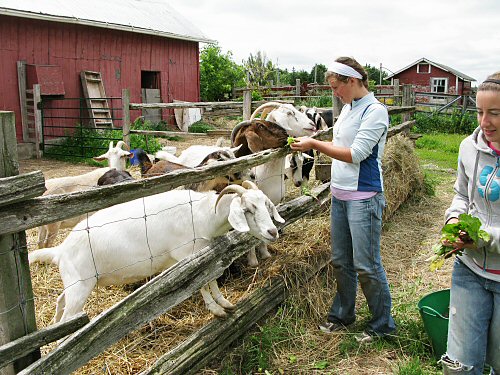
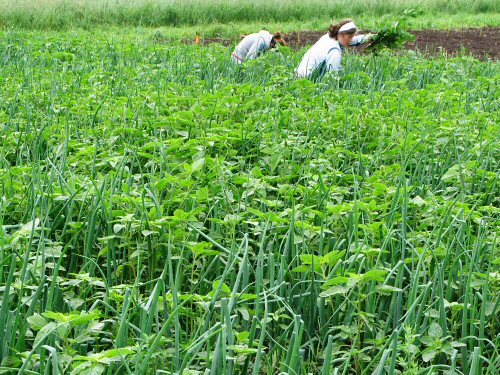
If you’re not on top of weeds by mid-June, things are gonna get ugly. Here, I’ve yet to come close to not having…problem spots, like this year’s onion section, where a perfect combination of heat and rain made relatively tiny pigweed JUMP in just a couple of days. At this size, and with the weeds growing right close to the onions, careful hand-weeding is the only option, other than tilling under the crop. Today. Lynn, Libby and I tackled the job…

Hours of weeding and a complete weather change later, the deed was done. As much as you think about the intense amount of labor, what that adds to the true cost of one of these onions, how things could’ve been done more efficiently, and so forth, you can’t help but be satisfied by such a complete…makeover. I asked Libby, after her very first crazy weeding spree, how she felt. With a big grin, she said: “I love intense!” You can’t help but love that attitude! :)
And there was still time for other fieldwork, an unhurried lunch break, and time out to play with the goats… Is this an economically viable way to farm? Well, it’s kinda working out so far, things are slowly, steadily improving, and we seem to be having ever more fun as it goes along!
Crops among the weeds
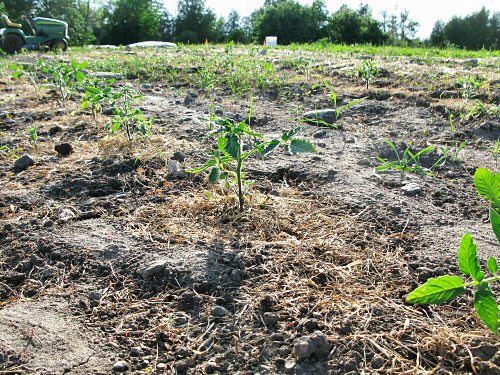
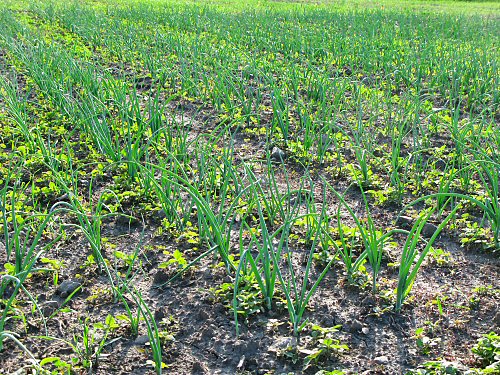
Weeded with the wheel hoe and hoop hoe, the onions looked impressively clear just six days ago, but after a few days of heat and moisture, the tiny weeds that were left shot up to the point where it’s time to do it all over again. Pigweed and lamb’s quarters, along with outbreaks of grass, are working to take over. It may look like a lot was missed. but weeding intensity depends on the crop. With onions, weeds tend to cluster close to the stems, so it usually seems easier to work more quickly and come back again, than spend double or triple the initial time, getting painstakingly close all around each plant (that’s how it seems, maybe not!). With the first section of tomatoes (below), things aren’t so advanced on the weed front, but there’s more grass in this area, and it’s still hard to see the crops in the general green haze of unwanted stuff growing. Hopefully, there will be enough grass mulch ready soon so we can extend the coverage between plants, and then onto the paths. This battle against weeds is the big one. All across the garden, both the veggies and what’s growing with them are at different stages, and require different weeding approaches. Typically, if you’re not using herbicides, tractor cultivation is the quickest way to keep the majority of the weed population down by working between rows. Even then, in-row weeding (between the plants) is still a hand job. It’s a LOT of work, and every few days that a section is not handled, the amount of work required increases as the weeds grow bigger and harder to kill. In a smaller market garden like this, with relatively short 50′ (15m) beds, the tractor is not an option; hand tools and methods rule. The idea is not to keep up this battle year in year out, but to progressively work smarter to reduce the load, through better timing and various techniques: mulching is the most obvious one, but there are lots of things to try. It’s not overnight, but things do improve as you go…!
