Checking under row cover

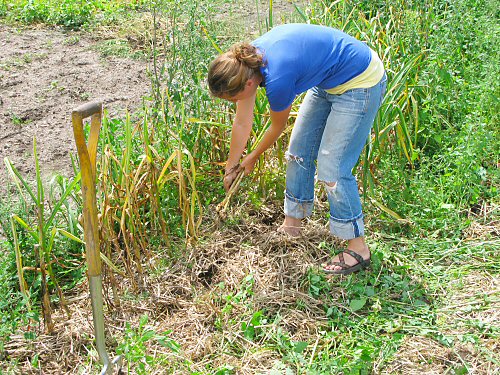
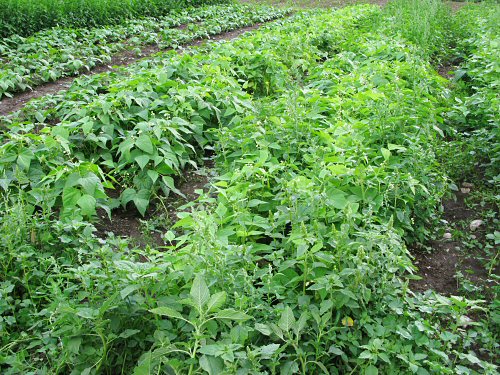
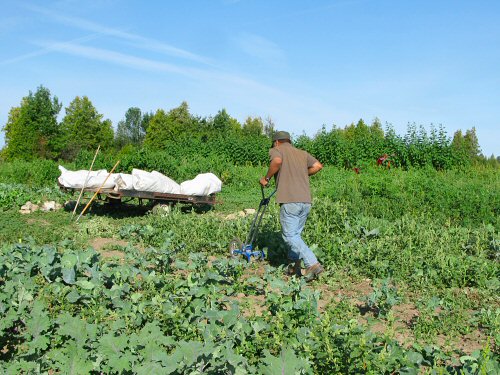
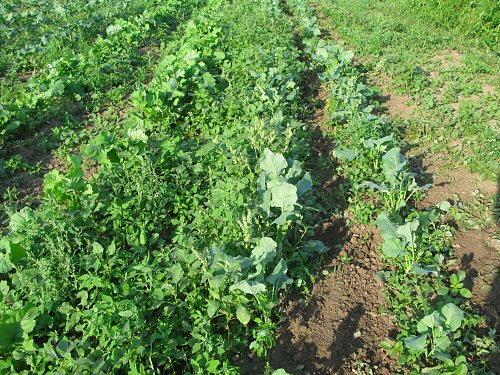
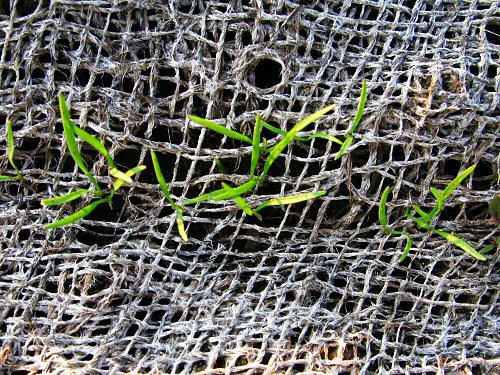
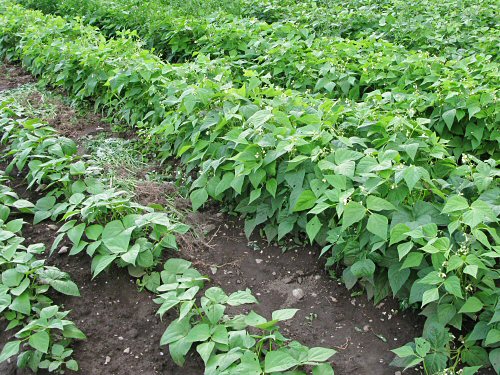
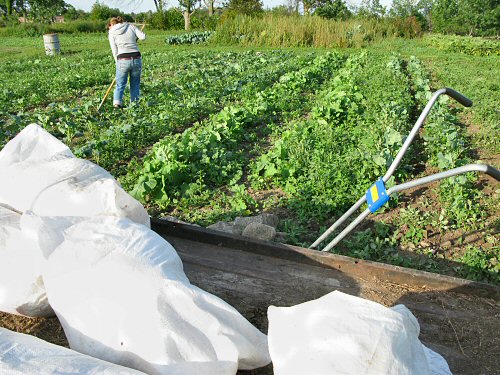
Three weeks ago, it was floating row cover everywhere. So, what was it worth? Today, I checked things out. Overall, growth has been startlingly slow, due to the lack of sun. This is really noticeable in the summer squash (above), which could be huge at this point, but…aren’t. Under cover, these zucchini (I didn’t check the variety) are doing fine, no cucumber beetle damage, but of course, weeds are doing fine as well: unmolested under there, pigweed runs rampant. I’ll take the cover off here in another week or so, and then there’ll be a whole lotta weeding to do… I removed the cover from the first beds of cauliflower (Snow Crown) and broccoli (below), they’re big enough to take a little flea beetle munching. The leaves have shaded out much of the potential weed action in the beds, but you can see a nice collection in the path (top center, where the row cover ends). The plants look untouched, although the flea beetles managed to get under and at the kale and collards, (they’re out of sight just to the left)—I left them covered, back in a week. If there’s any doubt about what the FBs will do, just check the radishes, which grow MUCH faster than these guys and can survive the damage…

Back with the cucurbits, the cucumbers are the most noticeably slow: after a month, they’re hardly bigger than the transplants they started as (hope it’s all going into the roots!)… I’ve cleared away the weeds between a couple of the plants, beetle damage is minimal (they tend to get in at the ends of rows, where the cover can get blown up by the wind), but there are weeds everywhere. Cover goes back on here for a while. Weird stunting weather and floating row cover: not the most peaceful and inspiring natural garden combo, but it should all straighten out in a bit… ;)

Measuring peak oil by the can

This tiny farm’s entire direct connection with the world of oil is simple: six red, 20-liter gas cans, three for gasoline, three for diesel. It’s a really stark way to watch spiralling gas prices and the so far bubbling-under peak oil panic, made more so for me because I don’t drive (never bothered to get a license), and I’ve lived 100% in big city cores until the farm—North America’s deep-set gas station culture had been a spectator thing for me. And now, gas is suddenly connected in a very straight-flowing line, from pump to a handful of tiny farming tools that perform clear and specific tasks. On the gas side, there’s the riding mower (mowing, mulch collecting, hauling stuff in trailer, used a lot), a walking rototiller (only moderately used since the wheel hoe last year), the pond irrigation pump (with so much RAIN, not used at all this year!), a weed eater (used only moderately), and another weed eater converted into a mini-cultivator (seldom used). On diesel: the Kubota compact tractor (rototilling, moving stuff with the front-end loader, quite used). That’s it! I filled three cans in mid-April, two diesel, one gas (above), today, two months later and all out, I filled two more, one of each. In my five years of tiny farm experience, cost has gone from $15 a can of gas (and quite a bit less for diesel), to about $30-35 a can (with diesel more expensive?!). It’s worrisome, but I don’t get too agitated, probably because the containers are so few and so relatively SMALL. But every time I’m tilling on the Kubota, or driving the length of the field loaded down with harvest and gear, I’m increasingly, acutely aware of the amount of work that comes out of a little gas, and what the manual labor alternative would be like. It’s like a little calculator program running in the back of my mind: how long would it take me to do this by hand? How about with help? What would it be like to do without? I feel great satisfaction when the six cans are filled and set in the drive shed all in a row: supplied for…a while! Of course, gas figures big in getting to the market and getting to town, and I pay my share there (I have an arrangement with Bob for the market season, and for the rest, I get lifts when others are going where I need to). And I also never forget how all those store shelves get filled. And how people get to market, pick up CSA shares, get to the farm. And I’ve started calculating highway mileage to reimburse everyone who volunteers here for their travel. Not to mention all the flying and driving it takes WWOOFers to get here from far and wide. And so on… Oil is everywhere, not easy to avoid or make sense of. At this point, for me, it still comes back to the cans: the color of oil is RED… :)

Plastic…fantastic?

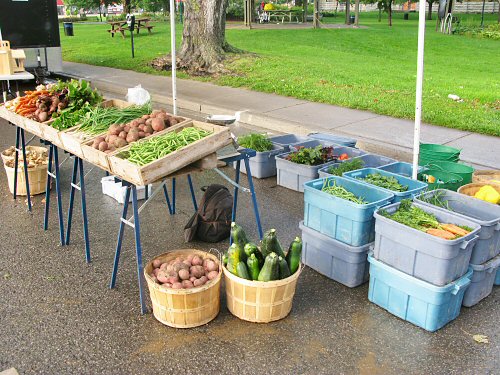
At the market today, greens were finally in great supply, with loads of mesclun and spinach: two giant, clear leaf bags full of each. I went home with quite a bit—no sold out sign this week!—which was great, ’cause I was selling right up to the end. And, as usual, I noticed all of the disposable plastic involved…

Greens, and market/CSA share harvests in general, usually involve lots of PLASTIC BAGS. In the beginning, this didn’t overly concern me on any level, other than that buying bags by the hundreds and thousands was kinda costly. But being on the dispensing side of this steady stream of plastic gradually made me realize how much of it is continuously being tossed out there FOR NO LASTING PURPOSE.

What got to me first wasn’t the environmental issue, but the fact that people were profiting off of this useless mass consumer habit of taking tons of “free” bags at every stop… Don’t like being fooled again and again… This culminated in one way for me about two years ago, when I stopped taking shopping bags for, like, 98% of my store shopping. Last year, I started cutting down on the way I offer shopping bags at the market: instead of automatically grabbing a bag for a customer as I asked if they needed one, I ask in a  leading way, kinda eying what they’re carrying already—not surprisingly, with all of the anti-plastic bag attention lately, the majority of people so far this year bring a basket or cart, or fit their purchases into a bag they already have.

I mean, to grow greens, it takes 40-60 days of watching, watering, weeding…and suddenly, in less than 24 hours, they’re harvested, bagged, distributed, and, hopefully, within another 2-3 days, EATEN. And the really useful life of the plastic in a bag of fresh-market greens is more like a very few hours, because once you’ve gotten your greens home, there are many more efficient ways to refrigerate them (like in a nice cotton bag, in a salad spinner, in a big bin,…). But there’s nothing that easily replaces the convenience of plastic for that last little trip between stand and home (a couple of people have asked that everything, greens and all, be tossed loose into their own shopping tote, which is kinda cool and should work no problem, but doesn’t sound too easy to encourage amongst ALL…).

So what am I getting at exactly, besides the OBVIOUS? Well, I guess it’s that plastic is curiously useful stuff, I’m not about to outright REJECT it in all its many handy shapes and forms, but I should learn more about it for a start… More as it unfolds! ;)

Outhouse deluxe

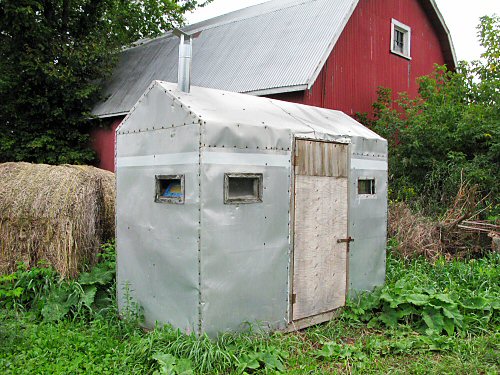
The outhouse updated! This Envirolet composting toilet, the deluxe AC electric model, is possibly the most unusual farm purchase I’ve made so far, mostly because it was quite expensive and I’m not 100% sure why I got it. With a hefty $500 off on special, it was still somewhere around $1,200, which on the tiny farm budget counts as a major purchase (the used John Deere riding mower cost the same, and it does fieldwork!). And considering that you can build a composting toilet for little or no money, from scrap wood… Call it divine inspiration, like: “You must get this toilet”? Anyhow, it’s here, it’s been here since around Feb. 2007 (the special offer was expiring), it hasn’t gone unthought-of or unmentioned,…and it’s finally, slowly, getting installed for this season! The general idea is to have facilities in the field, which is a lot more convenient than heading into the house. Still… These toilets do sound quite amazing: odorless, comfortable, able to compost six months of humanure into a thin layer in a slide-out tray. Models range from no power, to AC/DC (has a fan), to regular AC plug-in (fan plus heater for the coldest days). The more power, the higher capacity, as the fan or fan/heat speed up evaporation: this one is rated for 8 people x 3 “uses” per day. I guess I had visions of LOTS of toilet traffic from the field. And this attractive little waste-handler is quite an inviting intro to personal waste recycling, compared to a hole cut in a board (and you can use these in homes to replace regular flush toilets as well!)… For installation, the original plan was to build an enclosure, but this discarded ice fishing hut came up as a ready-built alternative. Converting it is only a few hours work, but it’s being done in little bits and pieces. First, the rotting door was removed and the frame widened to let the toilet in, the various built-in ice fishing conveniences—bench, shelves—were removed, and some rotting floor replaced. Next step, fitting the toilet’s ventilation pipe through the ceiling. And then, interior decoration! A coat of whitewash for a start… Coming soon!

Crops among the weeds

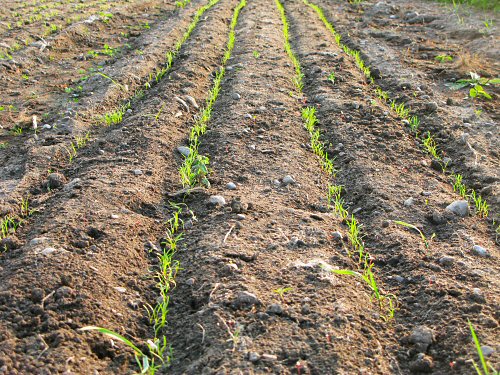
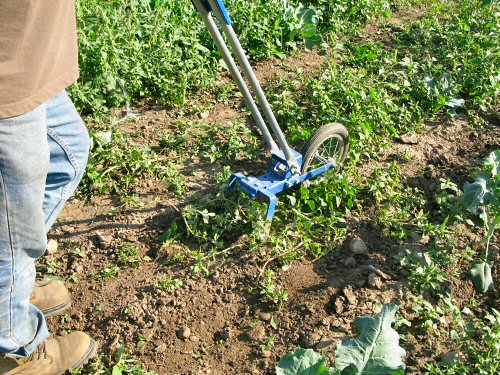
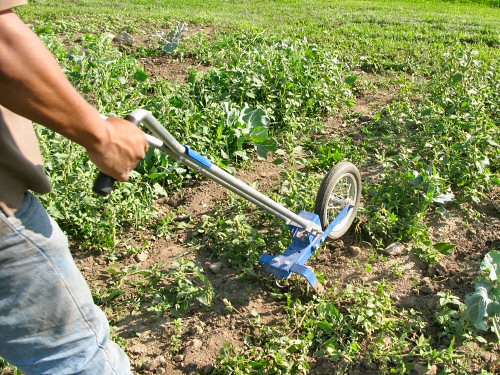
Weeded with the wheel hoe and hoop hoe, the onions looked impressively clear just six days ago, but after a few days of heat and moisture, the tiny weeds that were left shot up to the point where it’s time to do it all over again. Pigweed and lamb’s quarters, along with outbreaks of grass, are working to take over. It may look like a lot was missed. but weeding intensity depends on the crop. With onions, weeds tend to cluster close to the stems, so it usually seems easier to work more quickly and come back again, than spend double or triple the initial time, getting painstakingly close all around each plant (that’s how it seems, maybe not!). With the first section of tomatoes (below), things aren’t so advanced on the weed front, but there’s more grass in this area, and it’s still hard to see the crops in the general green haze of unwanted stuff growing. Hopefully, there will be enough grass mulch ready soon so we can extend the coverage between plants, and then onto the paths. This battle against weeds is the big one. All across the garden, both the veggies and what’s growing with them are at different stages, and require different weeding approaches. Typically, if you’re not using herbicides, tractor cultivation is the quickest way to keep the majority of the weed population down by working between rows. Even then, in-row weeding (between the plants) is still a hand job. It’s a LOT of work, and every few days that a section is not handled, the amount of work required increases as the weeds grow bigger and harder to kill. In a smaller market garden like this, with relatively short 50′ (15m) beds, the tractor is not an option; hand tools and methods rule. The idea is not to keep up this battle year in year out, but to progressively work smarter to reduce the load, through better timing and various techniques: mulching is the most obvious one, but there are lots of things to try. It’s not overnight, but things do improve as you go…!

Chickens, bull, fence…

The chickens have been loose by day for a couple weeks in a small, temporarily-fenced run in one of pens just off the barn. Today, the cows were let in to the pen to graze down the long grass. The rough plan was to let the chickens free-range around the whole area, which is about half an acre, and the cows would act as bodyguards, keeping out…predators. Dunno, sounds like good plan, livestock’s all pretty new to me… Consensus was the cows would not respect the chickenwire, so I went to take it down, just as Monty the Young Bull discovered it. I couldn’t help watch, kinda fascinated by the slow motion, low key destruction, as he methodically butted down the posts…scratching.

From one post to the next…

…and now, the chickens, at least, the Frey’s Dual Purpose and the couple of White Rocks that follow them outside…are free as they wanna be!

Shifting gears for summer…

The spring rush is over, and fieldwork is shifting into summer mode, from mainly planting to mainly weeding and watering, and then, HARVESTING. Seedlings for the most important crops and varieties are in, although there’s still quite a lot to transplant.

Here, we’ve just finishing another 100 or so tomatoes, with Lynn watering them in (the Redhead water breaker is GREAT, delivers as much water as you’ve got pressure, while softening the flow so that you’re not smashing or burying the seedlings). Creating a little basin around each seedling makes the most of hand watering in.

In my continuing experiment with shortening seedling production time, these are the youngest toms to go out ever, a third set started at the beginning of May, with their first true leaves now just coming in!

There are also more squash, melons, and a few more toms to transplant—in years past, I’d’ve been concerned about the date, but I’m learning to adapt the season’s resources (time, people, irrigation capacity,…) to the WEATHER.

Keep the workflow balanced is my new first mantra, so we also spent a few hours weeding today (Ryan dropped by to help for a few hours, he’s a new CSA-er this year who is also about to move his family to their own tiny farm at the end June!), instead of rushing on the last transplants.

It’s hard to measure, but for this type of small, diverse market gardening, in this time of extreme weather, things quite often don’t work out as they traditionally should. For example, the recent rain and cold, and now, more heat, have created a situation where the dominant weeds—pigweed, mallow, and lamb’s quarters—are seemingly slow, but are in fact about to explode. Weeding now will probably save way more time and deliver more harvest than putting off weeding just to transplant a few more beds a few days earlier.

I dunno, I’m figuring this out as I go, but I think traditonal garden rules and timing have to be increasingly bent as the weather gets crazier… I guess you could say: EXCITING TIMES! :)