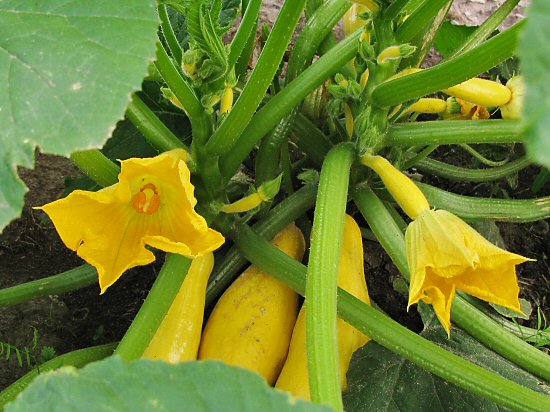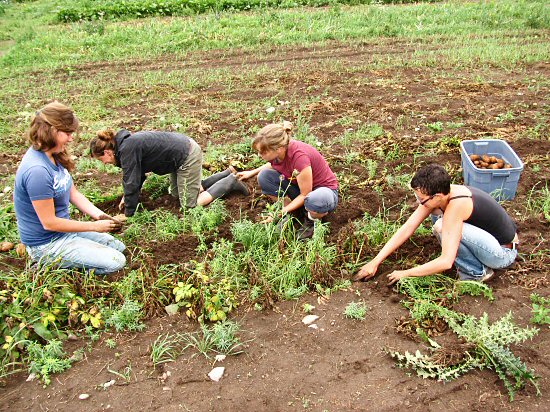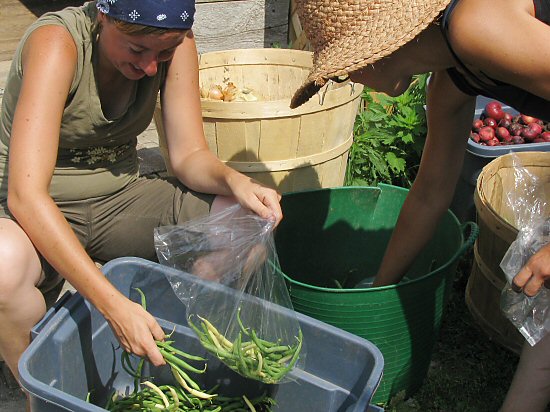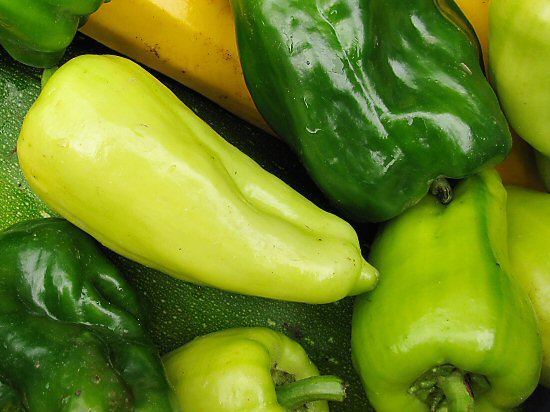
Harvested the season’s first sweet peppers, for the Monday CSA shares. They’re small…but tasty (that description has popped up a few times this year, as we pick early against the slow-growing weather and the flying by of time). The lime-yellow, tapering Gypsy (yellow-to-orange-to-red) are performing well once again, early and prolific, and the always-early, dark green bell peppers are Ace (green-to-red). Both varieties are F-1 hybrids (no seed saving), which isn’t great, but these guys are super-reliable in crazy weather, so I still plant ’em first… Peeking out from underneath, Ambassador (green) and Golden Dawn III (yellow) zucchini (also hybrids; GDIII is a mad producer, yellow zukes everywhere, on and on—another reliable standby that I’d love to replace with an open-pollinated variety)—after finally starting to take off a couple of weeks ago, the first planting of summer squash hasn’t looked back. So that’s something!
Mike (tfb)
Eggs from the wild
Four or five of the girls have been escaping every day, creating their own day pass, and doing a fair imitation of flying while they’re at it. In the morning, I open the chickenhouse door and barricade it with a strip of plastic fencing that leaves a 2′ gap at the top. After I leave, they hop up on the roost, propel themselves, furiously flapping, to the top of the fencing, perch there for a moment, and then head out.
I’m not sure if it’s always the same ones. There are 25 Shaver Red layers, and I haven’t spent enough time hanging out with them to really tell them apart. But I suspect it’s a gang.
They spend the day foraging far and wide around the farm, and return at night, waiting to be let back in. This has been going on for several days, since the meat birds left…
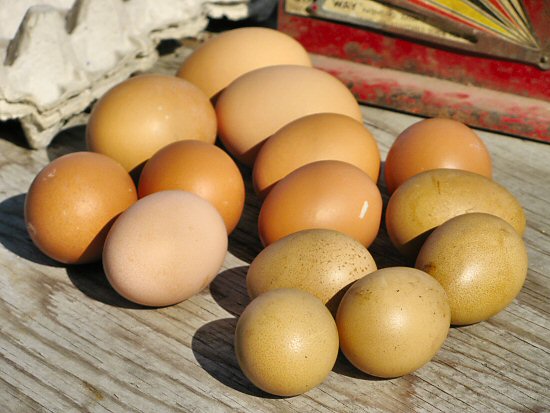
Today, Connor found a few eggs in a thicket they seem to like. Besides being a different color from all that exposure, the eggs are clearly getting SMALLER (they’re the ones in front). As varied and nutritious as their free-ranging diet may be, it’s lower in protein than the carefully concocted feed available inside. I guess that’s what’s up.
In any case, we’ll soon put up some kind of fence, cut out a chicken door, and they’ll have the best of both worlds: grass and bugs on the outside, protein-rich feed from the feed store inside, and a convenient place to lay. That will be our state-of-the-art in natural eggs for the next little while…
Chickens, frozen
There they are: 38 newly processed chickens, freezing solid in the chest freezer (39 minus the one we took to roast fresh). It’s the last stop before the table on what was a pretty fine meat bird run.
Like everything else on the tiny farm (and in life in general!), when you get down to freezing chickens, there are the details. What I noticed this year is the amount time it takes to actually freeze chickens solid. This wasn’t quite as apparent last year, when we started with under 20 processed birds. Here, checking out the new freezer’s manual, I loosely followed the advice against freezing too much at once. I put in half, around 20 chickens, for a few hours, then added the rest. I’ve also been rotating them—they freeze faster when they’re exposed—but after a day, they’re not all rock hard.
I have it in mind that the faster you freeze stuff, the better it is when you thaw it out: firmer, not mushy. Something about smaller ice crystals doing less cellular damage. Sounds plausible to me!
Luckily, the chickens came heavily pre-chilled from the processing house. Processing your own in any sort of quantity, I imagine you need a fair bit of refrigerator space to cool them down, or a walk-in cooler, or lots of chest freezers. Another thing to look into for…the future!
Of course, the whole freezing thing is another puzzle. It’s quick and easy, and works really well for all kinds of food. Newer chest freezers seem quite energy efficient: this 15 cu ft one uses 400 kWh a year, which is like keeping a 60W lightbulb on for 9 months (at current electricity rates around here, that’s about $50). Doesn’t sound so bad, and there’s room for lots more in there. Still, we’re trusting a lot to yet another plug…
FINALLY, there’s the sticker, another fine feature of commercially-processed chicken. The meat is Ontario government-inspected (a provincial inspector is always on-site, that’s the law), which is indicated by a little logo on the label. Plus you get the date, weight down to two decimal places of precision, AND a price-per-pound of your choice. I picked $4. These birds are for our own use—not for sale—but it’s always fun pulling out an EXPENSIVE farm chicken for dinner, as long as it’s priced kinda within reason…
Chickens to meat
The White Rock Cornish X meat birds are now…meat! Today was to-the-processing-house day. Up at 5:15 a.m. to get them rounded up for the trip. And it seemed to be a pleasant one for them. They arrived looking laid-back and content after a breezy 35-minute drive. This was gonna end up their “one bad day,” but so far, so chill.
To save an hour plus round-trip drive to pick up cages from the processor, we decided to load ’em directly in the trailer. The original idea was to cover it with a tarp, but I waited till the last minute (this morning at dawn) to fit it, and there was no easy way to get the tarp secure. So, a last-minute solution that turned out great: snow fencing and wire.
Three sections were cut from a roll, overlapped, and fastened with twists of light-gauge electric fence wire. Really quick, secure, easy. Perfect! At the processor, I helped hand off the birds right through the slaughterhouse door. And that was it: back at 5:30 p.m. for the pick-up.
The trip was smooth, but the end was still a little impersonal: in one processor house door, out the other. I hope to fill in that last killing step soon.
So there we are, 39 free-ranged chickens, after what seemed to be a happy, active, fast-growing, 11-week life, are now government-inspected, weighed (average about 7lbs/3kg), packed in plastic, and pre-chilled for the freezer. This seems pretty close to sane meat production. Chicken dinner!
Drizzly days
It’s been cloudy a lot this season, but the rain has kept pretty much to a reasonable number of rainy days and single downpours—it hasn’t been too WET. So, not that much fieldwork called for rain. Today was an exception, with a steady on-and-off drizzle from early morning that kept things watered down.
Lynn came out around 8:30 am to weed. Since it didn’t look like the sun would be showing up to dry things out, she finished a bed of onions (these are the last-planted onion seedlings, a fair bit behind the rest) and we called it a day for weeding.
In general, we try not to handle plants when they’re wet so as not to spread any sort of disease. This is a common caution for, for example, beans, and I’m not sure how it applies across the board to all garden veggies. Still, since wet work in the field is seldom fun anyway, it seems like a good rule in general: No weeding when wet!
So it’s…colors!
Cloudy, coolish weather continues, and the growing’s so slowwww… At the farmers’ market today, instead of all-new main season veggies, it’s kinda more of the same. No super-early tomatoes (Stupice!), not even BEANS (not even the super-early yellow wax beans…). But the root crops are doing well with the rain, and their colors are…refreshing. Here, purple Purple Haze carrots, and radish-red Chioggia beets, freshly misted, drenched with…color. That’s nice… :)
Packing shares: done!
CSA shares are packed for another Monday of on-farm pick-up! It’s one of those great hits of momentary satisfaction to see them all, 100% absolutely and finally done, waiting to be collected. Mel, Jordan (above), Michelle, and Tara were all in the field, and the whole harvest went by kinda quickly, maybe three hours. I’m also figuring out the easiest ways to use different spots around the new farm. Today, as a temporary improvement, we moved the long screen table into a tree-shaded part of the drive, allowing us to line up the bags in one row, instead of grouping them on two smaller tables indoors in a shed (it’s all in the details! :). Keeping the packing space uncluttered is kinda critical if you don’t want to spend half your time rechecking shares to make sure that they’ve got everything. When the set-up works, filling shares is really suprisingly satisfying. On the tiny farm, assembly lines can be fun!
In the share: baby leaf lettuce salad mix, baby zucchini, cauliflower, garlic scapes, young carrots, beets, new potatoes, curly& flat-leaf parsley.