People at work: hoophouse goes up!

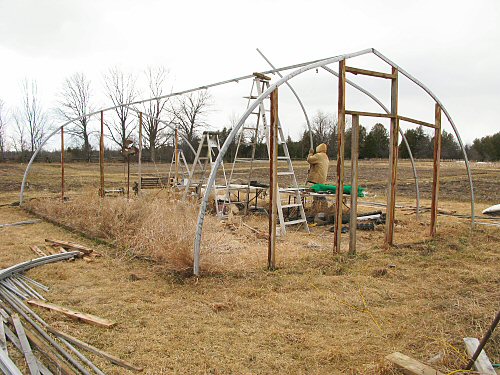
Another beautiful and busy day in the field, with Lynn, Mel, Jordan, Tara and, for her first full day, Andie, all variously raking, tilling and building. And eating lunch (can’t wait for proper farm food to kick in!). The most VISIBLE accomplishment today: we put up the frame of the hoophouse, which is the main part of the job. This was mostly done by Andrea and Jordan, first-time building for both of them, with me holding hoops, furnishing tools, and starting them out with some how-to advice. Working with light, pre-formed metal is particularly satisfying, things can go up fairly quickly, to produce dramatic results (or maybe it’s just me, waiting for that greenhouse!!!). It seemed like the satisfaction at the end was pretty deep! :)

Screwing the hoops to the ridge is the main structural task. We used the bucket on the Kubota compact tractor as a raisable platform…

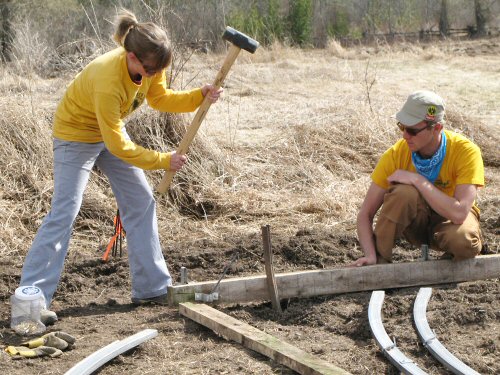
Since this is a re-assembly job, all the parts and pieces were there to be…assembled. First, lay out the 4×4 base, and pound in eight 3′ (0.9m) iron T-bar stakes to anchor the hoophouse. The T-bar is attached to the wood with lag bolts. Pounding was relatively easy, the ground is still soft, but a little bit of a workout. And if you look closely, near Andie’s foot and Jordan’s knee, you can see the brackets that the hollow steel hoops fit over, at 4′ (1.2m) spacing…

Next up, starting the frame. Attaching the first two pairs of hoops to the ridge is the trickiest part. The hoops slip over stubs in the ridge, then they’re screwed in place. A cordless drill and a couple of wrenches were all the tools we used. It’s wobbly at first, the more hoops you add, more stable it gets!

And there we are! Andie tightens up nuts on the cross-braces (purlins). In front, the lumber for an end wall is layed out. Halfway there. All in a tiny farm day’s work…
Fieldwork: Day 1

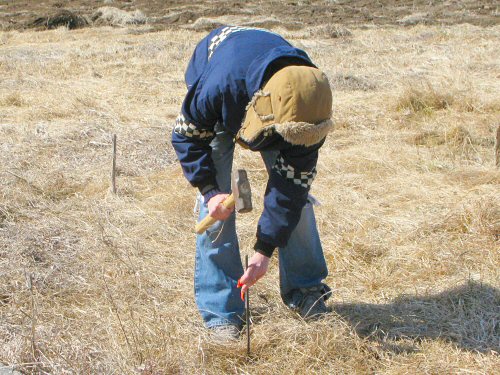
Sunny and quite warm (not as chilly as Mel’s deep-winter-ready, ear-flapped headgear might suggest). Probably 50°F+ (10°C) in the sun. Not the first nice, dry day this season, but this one became this farm’s official first fieldwork day of the year, just like that. We were only out for around three hours (including a walk to check on the beehives—there are some bees!—and the creek), but got a lot done, so it definitely counts as work in the field!

First, we selected a spot for the greenhouse, moving it from where we’d originally planned, to a more sheltered, overall all more PLEASING site. Pound in stakes at the roughly measured-in four corners, and admire the spot. The stakes are graphite tent pole sections Bob got at a yard sale long ago; flagged with orange surveyor’s tape, they’re great field markers. Normally you can just push ’em in, but here, Mel is using a mini-sledgehammer (above), because the ground is still frozen from a couple of inches (5cm) down…

Next up, sort all the hoophouse pieces. The steel ribs and braces are on the right. There’s a surprising amount of wood involved, and that’s now divided into what goes where. And then, we dumped all the hardware out of the barrel it’d been moved in: a bucket of assorted, screws, nuts and bolts, plus springlock (wire that attaches the plastic to the frame) and aluminum springlock channels.

A surprise find: the last five potted wintergreen plants (Mel is chosing some to take home). I’d put them in the barrel on top of a bunch of parts when we were moving the greenhouse, and forgotten them there. After spending an entire winter totally exposed outdoors, and the last couple of weeks tumbled down into a barrel full of wiry metal, they’re still alive and looking cheerful. Tough and pretty. With minty berries…

And so, the return of the greenhouse is underway. The GH is sorely missed and really needed! Just gotta wait till the ground thaws, so the area can be tilled up and the 3′ (0.9m) t-bar anchors that keep it from blowing away can be driven into the ground…!

Tiny farm moving – Part 3

Headed to the old farm to pick up the greenhouse. It’s only been a month since the main move, but the return to a place where I spent practically every day of the last six years felt strange. Inside the farmhouse, it was just a familiar space, but rounding the corner into the  barnyard, surrounded by all the old red buildings—barn, goat barn, drive shed—and then, walking into the field, that was different.

I guess this is the first real attachment to LAND that I’ve experienced. It was definitely unusual, not at all emotional, just a really strong, quiet sensation, a deep familiarity maybe describes it. I suppose the memories of all that thinking, observing, and working, tying together place and weather and ground conditions and seasons coming and going in one long, continuous arc, couldn’t help but leave their own type of mark. So that was interesting! :)

Bob had already started dismantling the farm stand, but that was so solidly put together, with thick, rough-cut cedar, heavy old fence boards, and 3″ nails (if you ever expect to move the things you build, for a few dollars more, consider screws!), that’s gonna be for another day. On to the hoophouse teardown…

The hoophouse is all screwed together, so taking it apart was easy. I’d considered lining up some extra hands for removing the plastic—there was a breeze, gusting to 4-5 mph (6-8kmph)—but Bob thought we’d be fine. And we were: the plastic skinned off amazingly easily, without catching the wind at all, and it didn’t disintegrate or tear…it will live again.

Around five hours later, and it’s all in pieces, ready to load up and take down the road. Going up and coming down are exactly the same, so I decided to take step-by-step pictures when we put it up again at the new farm…

Greenhouse overgrown

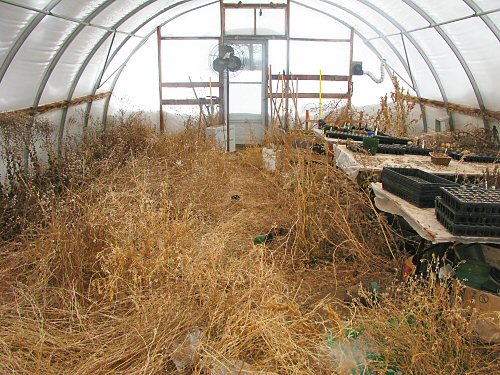
The greenhouse is still snowbound. I cleared away the east-side door to get in and check out what’s left to pack up for the new farm move, coming soon! Usually, I do a bit of greenhouse clean-up in the fall, and then around February, prep half the area for some early greens. This time around, I’ll take out the small stuff—there’s tools, the big industrial fan, a few plug sheets, and tons of plastic pots stored under the tables—lots of good gear! The tables will probably be left till March, after the melt-off, when we come for the greenhouse itself. Once the bubble is removed, this little winter oasis will merge into the rest of the field. The pleasantly golden-brown dead stuff is mainly arugula allowed to go wild…

Another snow day

Greenhouse and snow

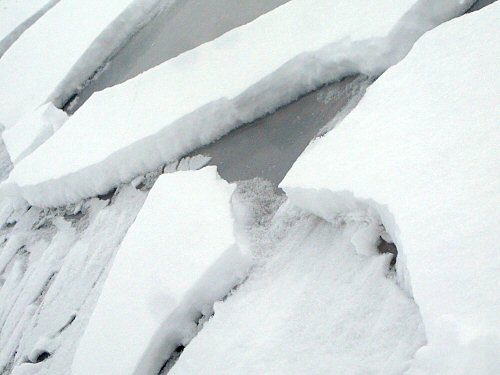
More snow. A few inches, I guess. I don’t pay attention any more, unless there’s too much snow to get out the door… I trudged out into the field, snow up to my knees, to check the greenhouse. It’s doing fine as usual, fully inflated (it has two layers of plastic, with a fan blowing air between) and shedding snow with ease. The greenhouse (and the veggie stand behind it) won’t be moved to the new farm until the snow clears and it’s easy to get at, hopefully sometime in March. I hope dismantling it doesn’t make it fall apart. The plastic is rated for four years, which means the UV resistance should be giving out any time now. I suppose the plastic will start to disintegrate. I don’t really know what happens when greenhouse plastic expires. Guess I’ll find out. Until then, I expect it to last forever! :)

View from the stand

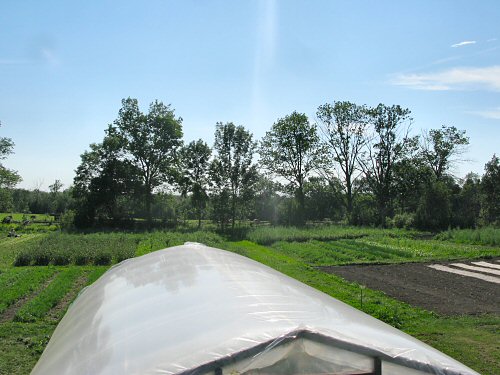
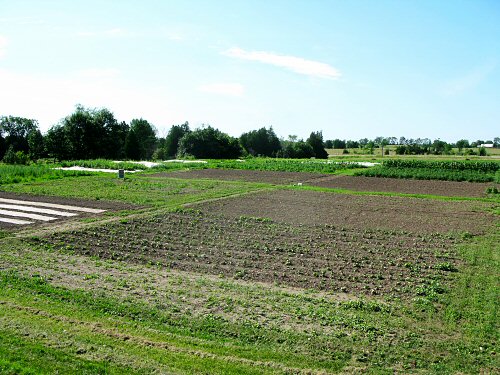
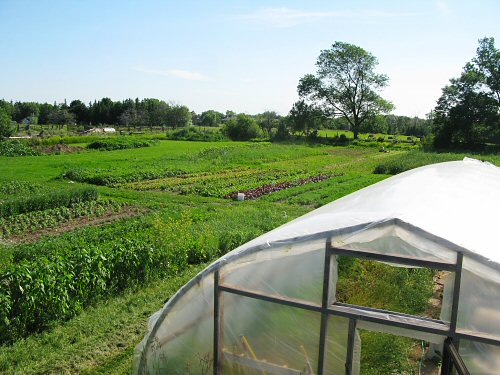
It’s mid-July, and on a (recently rare) sunshiney afternoon, things are looking OK. Better from a distance than up close, because a few sections, like the summer and winter squash, are quite severely in the weeds and in need of intensive hand pulling. And the ground remains almost constantly wet. Our moisture-retaining clay-loam soil, such an advantage in the usual near drought conditions we’ve had over the last three years, is now a bit of a hindrance. Sprawled tomatoes are particularly at risk if they don’t dry out against damp ground, and instead contract early blight (more about that another time!). Still, carpe diem, huh—seize the day! From atop the farm stand, the view is fine! We have the north end (above), with carrots under burlap (third planting), brassicas (newer transplants still under row cover), the cover in the far middle over squash, in front and more to the right, tomatoes, with a windbreak of giant sunflowers at the very right, and sweet potato bottom center. Open sections will include brassica transplants in a couple of weeks, and a fall cover crop. Out of sight to the north are onions…

In the middle, clockwise from the left, there’s a second planting of carrots, fifth mesclun right in the corner (with Maria weeding on the Greens Machine), garlic and parsnips, and potatoes in the distance (with more big WEEDS), the first planting of beets, carrots and green onions, and the edge of the third carrots under burlap from the first photo.

And then, the south end of the field, going left from the peak of the greenhouse, the garlic and Maia in the mesclun, the second planting of carrots and beets (that slash of of red is Bull’s Blood beets), the fourth mesclun , a weedy area with nasturtiums and tomatillos, and to the bottom left, herbs and flowers (fairly towering Jerusalem artichoke at the bottom left). (Guest photos by Lynn)

Greenhouse upgrades

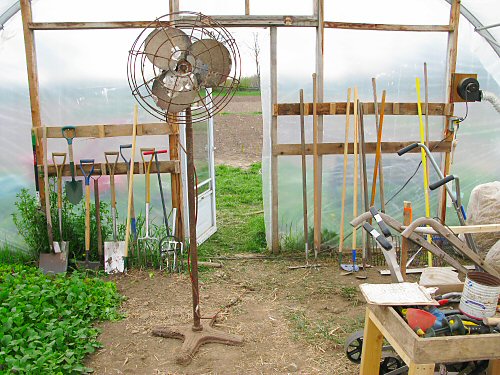
Another cloudy, cool, kinda chilly day. There’s always fieldwork to do, but this type of weather is also good for building, fixing, organizing…indoors. Today, some long-planned greenhouse upgrades. They may not look like much, but it’s a pretty big bunch of improvements! As part of Shannon’s kinda intensive “this is what I do around here,” hands-on experience (with full narration!) on this tiny farm, I showed her how to use a couple of basic power tools—cordless drill, chop saw—and she built simple legs for a wooden tray that I use for various small, often-used bits of gear (the tray’s shallowness is an automatic organizer: things can’t get really buried!). Really simple, rough carpentry, but if you haven’t used tools much or at all, and then you build something that’s immediately used in the course of the farming day…it all makes more sense! At the other end of the hoophouse, I put up another wooden crosspiece for leaning long-handled tools, and we separated the most-used and put the least used at the other end. Again, by avoiding a pile of stuff, everything’s easy to grab and put away. And then, we pounded a couple of 2×2 wooden stakes into the ground (pounding with a mini-sledgehammer was also on the farm experience menu today, I pound a lot of stakes for tomatoes every year as well…), and screwed another 2×2 as a crosspiece to make a leaning rack for the seeders and the wheel hoe (you can see one end on the right of the pic, one of the posts has orange tape on top). Finally, a machinery addition, a big, old, rusty, dangerous-looking high-volume fan on a really heavy iron stand. I’ve been meaning to work on greenhouse ventilation for ages…but always ended up using much smaller home-type fans. This one, which was actually being stored in the chickenhouse, I hadn’t noticed till now. It moves a ton of air, and reduces the temperature a full 10-15°F in the middle of a hot day. Cool! To look at, these little building projects are absolutely basic and kinda primitive, but they’re quick, easy, solid cheap, and really make a huge difference when you actually use them… (I just noticed in the pic how the right side of the end wall seems to be sagging, it doesn’t look that way at glance, I should check it out and see what’s up…)