Dog days of summer (a few)

The muggy wave continues, the sixth day or so of bright, swelteringly humid heat. Today was only 21°C (72°F), but the Humidex (or whatever exactly They call it) says it’s the equivalent to us humans of 40°C (110°F). It does feel that way. I can’t recall ever hearing a spread that big—quite weird, or maybe the Humidex got more accurate…

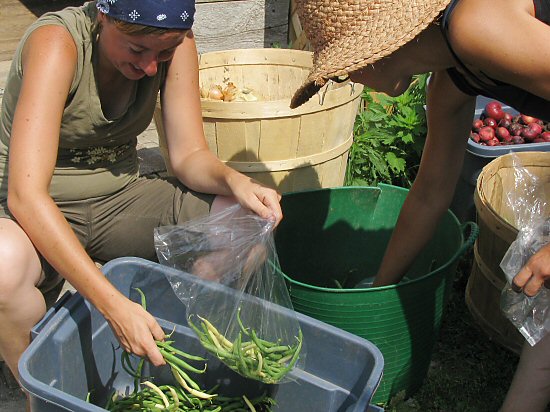
A smaller crew than usual this Monday morning as we harvested for CSA shares. Lynn and Mel (above) were out earlier, hitting the field at 7 am, partly to get a jump on the heat, partly because they both had to leave earlier as well. Michelle arrived around 8:30. Tara was tied up preparing for a short trip. Jordan, another Monday regular, is away for a couple of weeks, on various visits around the north-east.

People in the field. I still find it mildly unlikely and extremely cool each time one of our tiny field crews assembles for a day. Sometimes it’s a crew of two, other times, usually harvest Fridays and Mondays, the numbers swell (big for a tiny farm!).

We all head to the field for different reasons and different returns. The work is never endlessly tedious, we don’t go out and, say, pick beans for 8 hours, but we do get a lot done, and everyone does a bit of everything. You can find a little instant closure, where the start and end of a thing are all right at hand. You can learn to small-scale farm. You can chill out, take time to think—garden meditation while breathing some relatively fresh, country air and dabbling in the dirt. Chatting while veggie gardening can be great. It’s whatever you want it to be…

Today, it was hot. The shares were done by noon as planned. It’s all good! :)
Drizzly days

It’s been cloudy a lot this season, but the rain has kept pretty much to a reasonable number of rainy days and single downpours—it hasn’t been too WET. So, not that much fieldwork called for rain. Today was an exception, with a steady on-and-off drizzle from early morning that kept things watered down.

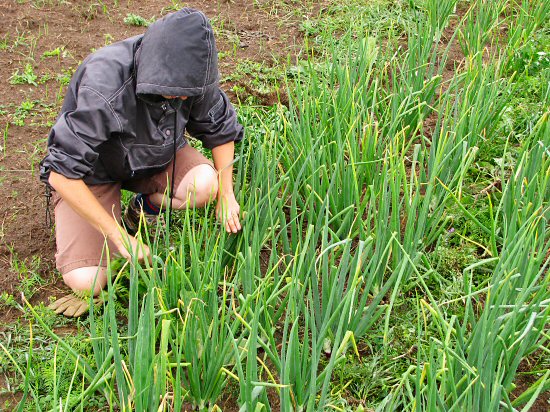
Lynn came out around 8:30 am to weed. Since it didn’t look like the sun would be showing up to dry things out, she finished a bed of onions (these are the last-planted onion seedlings, a fair bit behind the rest) and we called it a day for weeding.

In general, we try not to handle plants when they’re wet so as not to spread any sort of disease. This is a common caution for, for example, beans, and I’m not sure how it applies across the board to all garden veggies.  Still, since wet work in the field is seldom fun anyway, it seems like a good rule in general: No weeding when wet!

Packing shares: done!

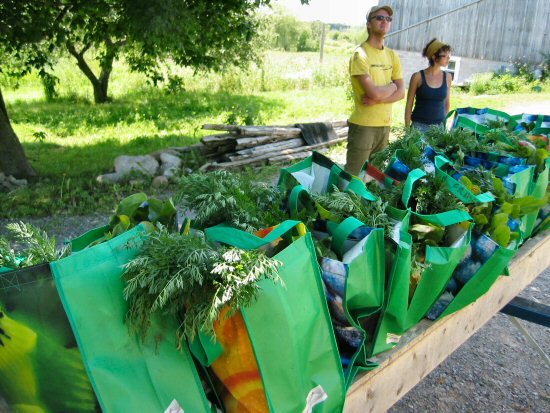
CSA shares are packed for another Monday of on-farm pick-up! It’s one of those great hits of momentary satisfaction to see them all, 100% absolutely and finally done, waiting to be collected. Mel, Jordan (above), Michelle, and Tara were all in the field, and the whole harvest went by kinda quickly, maybe three hours. I’m also figuring out the easiest ways to use different spots around the new farm. Today, as a temporary improvement, we moved the long screen table into a tree-shaded part of the drive, allowing us to line up the bags in one row, instead of grouping them on two smaller tables indoors in a shed (it’s all in the details! :). Keeping the packing space uncluttered is kinda critical if you don’t want to spend half your time rechecking shares to make sure that they’ve got everything. When the set-up works, filling shares is really suprisingly satisfying.  On the tiny farm, assembly lines can be fun!

In the share: baby leaf lettuce salad mix, baby zucchini, cauliflower, garlic scapes, young carrots, beets, new potatoes, curly& flat-leaf parsley.

Working the new potatoes

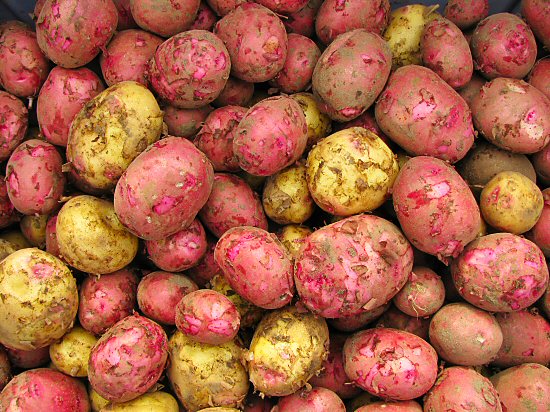
Another installment in the crazily labor-intensive tiny farming techniques series: Andie and Jordan in action, hand-digging for new potatoes without uprooting the plants! This one is hard to top for stunningly low hours-to-yield ratio. It makes picking peas and beans seem like something that goes by quick. Of course, for all its slowness, it has its rewards: beautiful little, amazingly fresh and tasty, new potatoes…and the plants still get to grow some more! Plus, if you don’t have to do it forever, it’s a lot of fun…

The “technique” is simple (and well-suited to the home veggie garden, but not too scalable). Gently feel around the base of the plant for anything that’s golf ball-sized or bigger (this batch is golf ball to XL egg). Stick to the surface, don’t dig too deep, and try not to break the single roots connected to other, littler, potatoes (you’ll easily feel the stringy roots). When you’re done, hill up the earth you’ve moved aside, and it’s on to the next one. That’s our method. ;)

Yield today was pretty good, about 2-3 per plant, and about 40 lbs (18kg) in all. Won’t go into the time per plant and the weight per tater…because I didn’t. Maybe a peaceful hour or so, with three people. We only did this for a CSA share treat, because today it worked out that we had the time. There are red skin/white flesh Chieftan, and yellow-flesh, Yukon Gold-like Penta.

The only downside to the hand scrabbling method: the delicious, delicate skins get quite roughed up. We’ll soon start pulling whole plants for young potatoes, and that tends to leave the skins in better shape (and goes MUCH faster).

Anyhow, slow food, for sure. Tasty!

Carrot-burlap method gets a twist

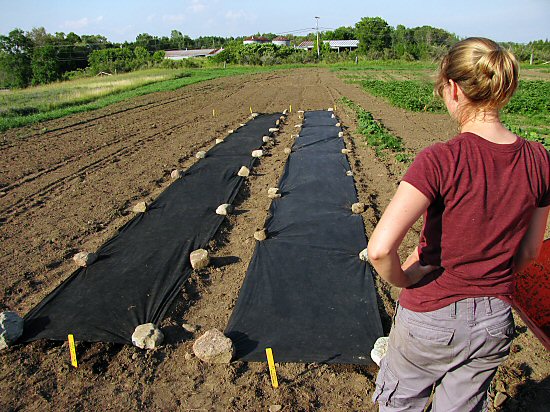
Here’s one of the more extreme displays of crazily labor-intensive tiny farming technique. Andie surveys our work, the result of deciding to try landscape fabric in place of burlap to help carrot seed germination. It’s actually a double experiment, because one of the beds is green onions.

The burlap method has been the way to start carrots around here for the last two seasons: tried and true. The main purpose is to preserve moisture in the seed drills, and the increase in heat helps as well.

After a good run, the first round of burlap expired, and I couldn’t find rolls of it in time for this season (I know it’s out there, somewhere). But, I spotted this gear, landscape fabric, a porous plastic mulch used to permanently suppress weeds in…landscaping. It’s light, and just wide enough (3’/30 cm) to cover 4 rows of carrots (that’s a little closer than usual for the bunching onions). I tried it on two beds earlier in the season, and it works fine!

One little problem: it tears easily, so how to hold it down? With the burlap, we made wire staples out of heavy gauge wire. Here, we placed a LOT of heavy rocks, close enough together that there’s no room for the wind to get under and start really pulling. This does the trick for now, but overall, it’s a little TOO intense. The hunt for burlap: still on!

Early season harvest day

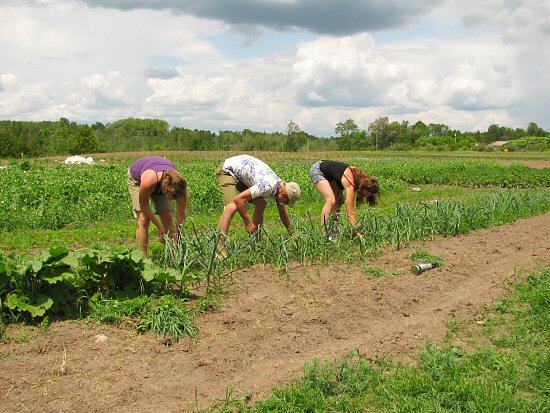
It’s a harvest Friday, second for the farmers’ market, and first for CSA, but the load is still light. After picking snap peas, we spent the day doing other field work. In the photo, Libby, Jordan and Michelle are hand-weeding the small strip of spring-planted garlic, and we spent some labor-intensive time thinning a 400′ (122m) of carrots, and several beds of beets (the thinnings were the beet greens harvest). In late afternoon, time to cut greens: spinach and mesclun. Plus a little parsley.

Checking back over the last four years, at this time, we had broccoli once, radishes usually, baby Swiss chard a couple of times. And, of course, garlic scapes. And, a couple of years, no peas yet. So, all in all, with the slightly slower planting schedule in this start-up this garden, and all the cloudy weather, we’re doing pretty well!

Last of the spring planting

It’s another week till the start of CSA shares and the first picking of peas, and at least 3 weeks until some of the heavier crops—broccoli, cauliflower, summer squash—are ready, so Friday’s are still about general fieldwork, not HARVEST. Just ahead of the end of spring, Lynn, Libby and Jordan planted out a last wave of winter squash and some fast-maturing (80-90) Neon pumpkins. That brings the spring planting to a close, a little later than usual, overall, but considering the first-year, start-up situation, really good!

We also put in one bed of melons under infrared-transmitting (IRT) plastic mulch (above).  For a couple of years, I planted 5-10 50′ beds under IRT mulch (more heat to the soil), but yield wasn’t worth the effort, including the extra watering (didn’t use drip tape under the plastic). This year, with one bed to focus on, it’s an experiment—we’ll try to give them extra special care!

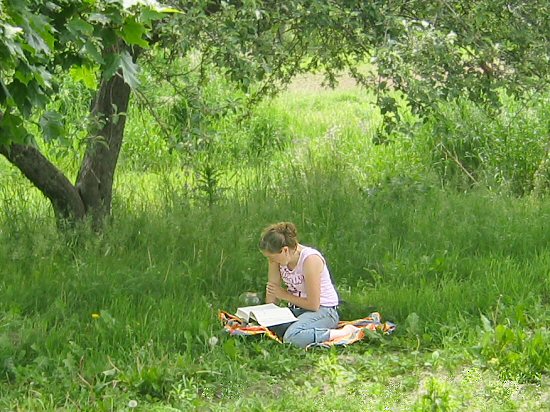
Lynn vanished early from lunch, only to be found reading her new herb book under a tree. This photo (below) doesn’t nearly capture the scene: it looked like an impossibly peaceful countryscape, from a simple, carefree world—fit for a postcard. We were laughing, and Jordan spontaneously got out his camera and took photos, too.  I asked her if she’d scouted the location for the setting (joking, but I can also be a bit of a cynic! :), she said it was just the best spot she could find for shade!