1440 onions

1440 onions

I’m sure I’ve taken this photo before, but somehow, it’s still new—the first transplants of the season! This is the look of 1,440 onions, starting out. These are 72-cell plug sheets, and the plan is to multi-plant four onions in each spot. Do a little multiplication—5 trays, 72 cells, 4 onions per—and the results are clear. Whether things will turn out exactly like this, perfect bushels of Red Globe red and Utah sweet Spanish, is anybody’s guess, but I’m quite confident we will get…something! :)

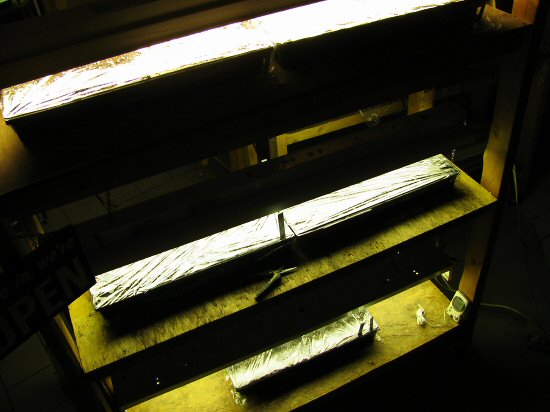
All the usual tools and methods for this tiny farm are back for another run. There are still at least a couple of years left on the roll of donated food-grade plastic wrap that I use (and re-use for the season) to hold moisture and increase heat, just until the tiny seedlings emerge. To check temperatures in this new seedling room, on the lowest shelf of the light rack, where it’s coldest, is one of the minimum/maximum digital recording thermometers. And of course, there are the trusty, home-built light racks themselves, with an assortment of T-12 and T-8 fixtures and Cool White fluorescent tubes, providing the bare minimum of heat and light to get things started.

I’m always up for trying new approaches and new gear, but a lot of the time, if it gets the job done and you’re already having fun, what more could you need?!
In the beginning, again

Seedling room set-up

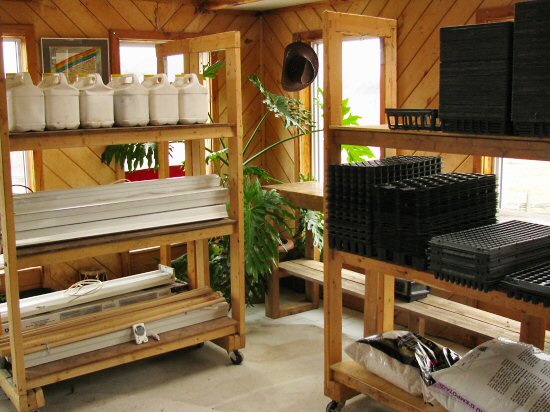
There is really no one absolute moment when a new growing season begins, so I guess today is as good as many to make the call. All the familiar gear is in a new farm home (there’s a bit of backstory here, that I’ll eventually get to in the About…), and right now,  we’re setting up the light racks and getting ready to seed. This will be my eighth season of tiny farming, and it should be an interesting one!

Fresh new garlic ARRIVES!

Music garlic

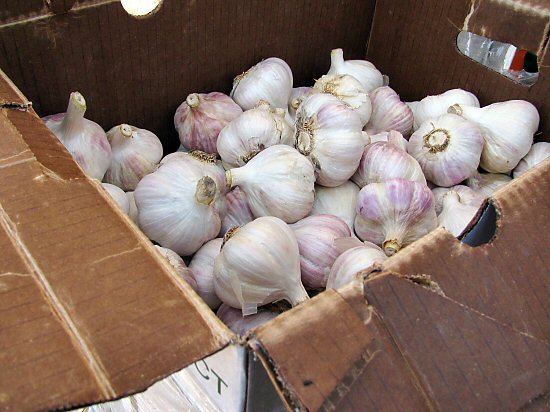
There’s almost no describing how pleased this morning’s delivery made me. Pretty happy! In two sturdy cartons, by FedEx Ground, 80 lbs of certified organic Music garlic, looking so fine! :) This shipment comes from a farmer named Warren, who grows a huge amount of garlic about 200 miles (320 km) from here—I’ve chatted with him about garlic, read his garlic literature, bought garlic from him before, a quirky and fun garlic grower indeed! And you certainly can’t have enough garlic… Possibly the WORST part of this mildly crazy tiny farm transition (moving farms from last year to this) was not being able to plant garlic last fall. On EVERY LEVEL, good garlic is GREAT…and if AT ALL POSSIBLE (it’s easy to grow!), you must have it around at all times! This season’s spring-planted garlic experiment did work out OK, but there wasn’t much of it, in number or in size.  Now, we get to go again… Cool!

(By the way, if you’re really into garlic, this is the, um, BEST GARLIC SITE EVER: Gourmet Garlic Gardens! It has everything…)

Garden in transition

Garden in transition

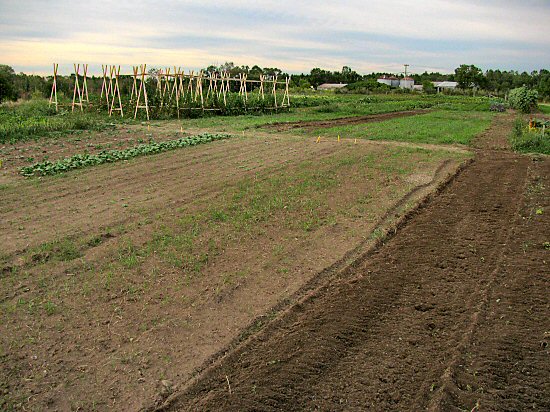
The weather is warm, the days still feel long (although, at 5:00 a.m. for Saturday market, I’m already waking up in the dark)—summer is in full effect, but you know the season’s soon changing because the field is clearing out. Today, I did some tilling, cleaning up before weeds get too established, and preparing for a last seeding of spinach for fall harvest (a gamble, for sure).

In the pic, a couple more passes to the left of the freshly turned strip and we’ll be at the edge of the previous spinach planting, barely visible, seeded about 3 weeks ago. To the left of that, a half-bed of bok choi, delicious and miraculously untouched by flea beetles, at tiny baby stage from seedlings transplanted at the beginning of the month. Beside the bok choi, beds of broccoli and cauliflower, also set out 4 weeks ago, and looking pretty good for harvest in October.

This section was planted out at the start of the season to snap peas, lettuce, and the first spinach. After adding in some of the handy pelletized alfalfa, it gets to go round again!

In the next section (top right of the photo, which is…east), I’ve started tilling in an overgrowth of grass and vetch, where more peas and the first plot of potatoes used to be. That section is done for the year, and may get a protective cover of fall rye, as a green manure to be turned under in spring.

In the market garden, it’s always one thing after another… :)

Carrot-burlap method gets a twist

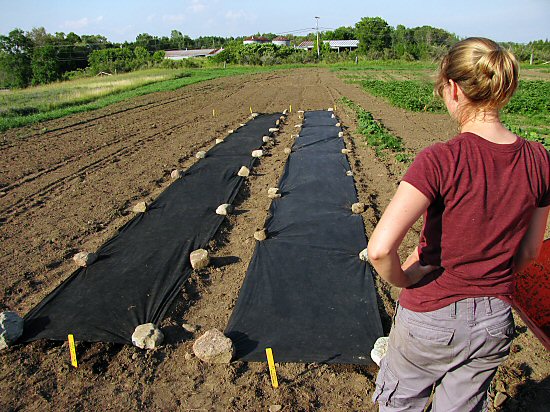
Here’s one of the more extreme displays of crazily labor-intensive tiny farming technique. Andie surveys our work, the result of deciding to try landscape fabric in place of burlap to help carrot seed germination. It’s actually a double experiment, because one of the beds is green onions.

The burlap method has been the way to start carrots around here for the last two seasons: tried and true. The main purpose is to preserve moisture in the seed drills, and the increase in heat helps as well.

After a good run, the first round of burlap expired, and I couldn’t find rolls of it in time for this season (I know it’s out there, somewhere). But, I spotted this gear, landscape fabric, a porous plastic mulch used to permanently suppress weeds in…landscaping. It’s light, and just wide enough (3’/30 cm) to cover 4 rows of carrots (that’s a little closer than usual for the bunching onions). I tried it on two beds earlier in the season, and it works fine!

One little problem: it tears easily, so how to hold it down? With the burlap, we made wire staples out of heavy gauge wire. Here, we placed a LOT of heavy rocks, close enough together that there’s no room for the wind to get under and start really pulling. This does the trick for now, but overall, it’s a little TOO intense. The hunt for burlap: still on!

Another rainbow

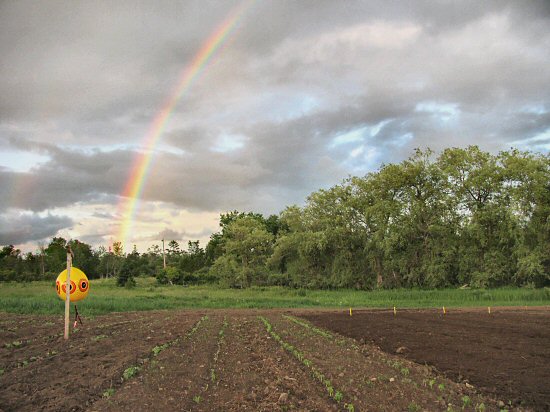
It’s almost “yet another rainbow,” but not quite. We’ve seen a good collection so far this season, including quite spectacular horizon-to-horizon double rainbows two nights in a row. Which means there’s been lots of rain, and all the cloudiness that goes with it. It’s nowhere near as miserably wet as last season, though—rainfall this year has actually been great, averaging around the golden inch-a-week (2.5cm-a-week)—but 4-5 mainly cloudy days out of 7 is slowing things down.

How slow? The first summer squash that should’ve popped in size in a few sunny days, has been slowly expanding for well over a week. Root crops like beets, carrots, potatoes, aren’t affected as much, and seem to love the rain. But toms, peppers, eggplant and the whole cucurbit family (squash, melons, cucumber) are in slow motion, maybe a week or two from where they’d be with lots of sun.

Still, all in all, everything is growing along well enough, and we’re bound to hit a sunny stretch. Right?

In the photo, a third planting of green and yellow snap beans, with scare ball in place to scare off birds (it seems to work). To the right, a freshly tilled section, waiting for a third planting of spinach… This weather’s great for summer spinach!

Hand-tended

Hand-tending pumpkin transplant

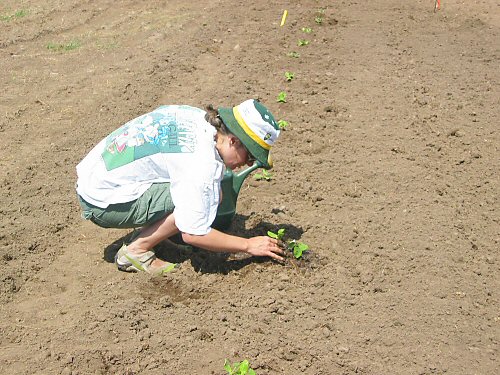
“Hand-tended” is one of the phrases that usually gets popped into the occasional bit of promotional writing about this market garden. Sounds good! If asked (hasn’t happened so far), I’d explain that we don’t use many machines, most of the garden work is done with hand tools, or just hands, as in, hand-weeding, or plucking off bugs…by hand. And lots of time is spent through the season, crouching and crawling around, checking out what’s going on with particular plantings of this or that. Which all seems pretty cool. :)

Today, Tara and I hand-transplanted two beds of early-maturing Neon pumpkins (above), along with a few more Snack Jack (tiny pumpkins bred for producing lots of tasty seed). The Neons are 70-80-day hybrid, kinda freakishly quick to mature (pumpkins are mostly 100+ days).

At this point in the season here, it’s getting kinda late for winter squash and pumpkins, but there are a few beds still to fill in, so a bunch of 70-85-day varieties, coming up in pots in the greenhouse, will be heading out to the field over the next week. With anything but the worst in cold and cloudy weather over the next three months, they should size up just fine!