
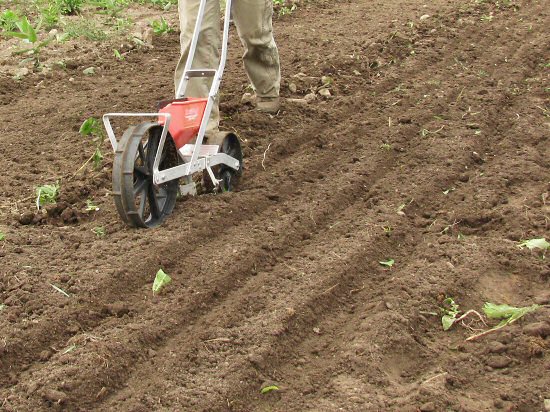
Today, the last direct seeding of the season: spinach, radish, Asian greens mix, arugula, and a lettuce blend for baby leaf… Here, Tracy does the honors with the always-generous Earthway seeder, laying down thick lines of Rebel radish. But is it…too late? Well, who knows?! In good summer conditions, all of these crops can be ready to harvest in 40 days or so from seeding, but the sun is getting weaker now. Hopefully, this round will come up fast, catch the last of the reasonably strong light through September—there WILL be lots of sun!—then continue growing slowly until ready for the last couple of markets through the end of October. That is the…plan. Fresh young veggies at season’s end are a welcome treat! If it doesn’t work out, oh well (and we may get a chance to do a few days at the indoor market in November). In any case, we have the space and the seed, and pushing for the absolute latest planting date seems to me always worth the gamble. Seeing what happens is kinda…exciting!
lettuce
Garden in transition
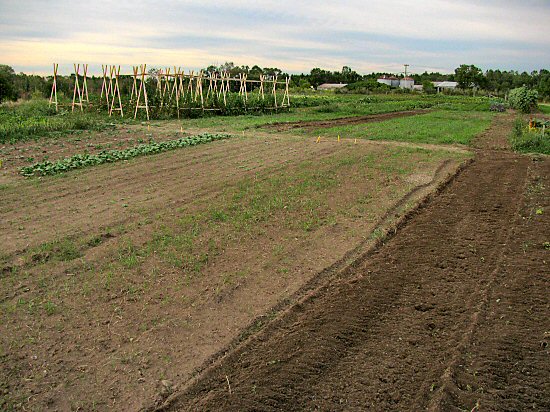
The weather is warm, the days still feel long (although, at 5:00 a.m. for Saturday market, I’m already waking up in the dark)—summer is in full effect, but you know the season’s soon changing because the field is clearing out. Today, I did some tilling, cleaning up before weeds get too established, and preparing for a last seeding of spinach for fall harvest (a gamble, for sure).
In the pic, a couple more passes to the left of the freshly turned strip and we’ll be at the edge of the previous spinach planting, barely visible, seeded about 3 weeks ago. To the left of that, a half-bed of bok choi, delicious and miraculously untouched by flea beetles, at tiny baby stage from seedlings transplanted at the beginning of the month. Beside the bok choi, beds of broccoli and cauliflower, also set out 4 weeks ago, and looking pretty good for harvest in October.
This section was planted out at the start of the season to snap peas, lettuce, and the first spinach. After adding in some of the handy pelletized alfalfa, it gets to go round again!
In the next section (top right of the photo, which is…east), I’ve started tilling in an overgrowth of grass and vetch, where more peas and the first plot of potatoes used to be. That section is done for the year, and may get a protective cover of fall rye, as a green manure to be turned under in spring.
In the market garden, it’s always one thing after another… :)
Baby veggies go to market
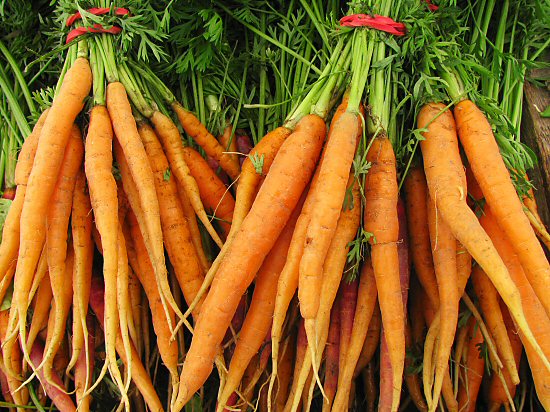
You can’t go wrong with baby carrots, it seems. They are, well, cute (I’ve heard people say that way more than once). So you can buy them and eat them, or maybe stick ’em in a clear vase full of water for a while (idea!)… In any case, these Nelson carrots are not only fun to look at, and small, they’re pretty tasty! Nice crunch, and good sweetness for summer. Because of the kinda slow-growth in this cloudy weather, we took the time to do a second carrot thinning, just to harvest these (often, at this point, they’d be bigger, and we’d start digging up whole rows).
Also along for the ride, and sold out quite early, baby beets, mostly the candy-striped Chioggia (below), with a few red Kestrel in there. And, a couple of varieties of lettuce, the super-red Granada oakleaf and the butterhead Kendo. Both have a strong, bold taste, able to hold their own in sandwiches or…anywhere else. Plus, not in sight, all-lettuce mesclun (well, baby leaf mix).
Along with the last of the Sugar Ann snap peas, that was it for a fairly rainy, kinda rained-out Saturday at the farmers’ market… Still, fun!
Chickens: ranging too far
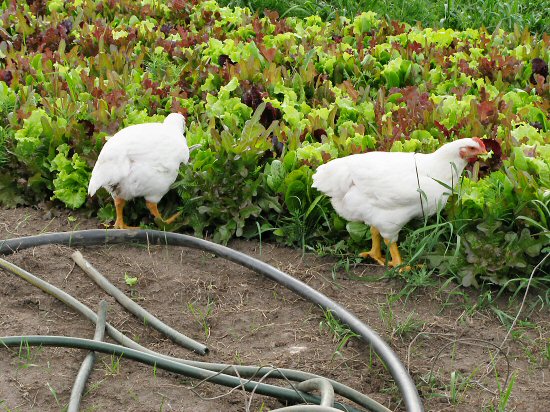
These guys, the White Rock Cornish X meat birds, have free-ranged too far, making it to the edge of the veggie garden in the big field. Luckily, although it looks good in the photo, this all-lettuce mesclun is done, cut at least twice and now too full of damaged and crowded, stretched leaves to make harvesting for market worthwhile. So, the chickens are actually putting it to good use. But of course, they won’t stop here.
So far, they’ve been completely free to roam during the day. I count and shut ’em in out of harm’s way at night, and pop open the door soon after sunrise. If they found farm life dull, they could hit the road and head to town, just like that. Instead, they tend to wander further from home bit by bit.
I’ve been watching their circle of foraging territory gradually expand away from the chickenhouse. A few advance scouts lead the way, sometimes alone, or in twos or threes. Eventually, over a couple of days, more follow. It’s fun to watch the process, and they seem to appreciate the freedom (since they use it), but it’s still three weeks to Processing Day, and they’ll keep on exploring right into the garden. Time for some fencing action…
(In front, pieces of old hose and water pipe are being sorted out on a clear patch of ground.)
Local beef
A cool change with the much bigger farmers’ market we’re at this year is the easy access to lots more local food from other market vendors. We’re there every Saturday, and so are they! (Nothing better for really appreciating a farmers’ market than being both a seller and a buyer…).
The biggest change for me is, suddenly, there’s all sorts of LOCAL MEAT. There’s beef, bison, chicken, emu, rhea (ostrich-like), plus a cured-meat-and-sausage vendor, a butcher, and more (venison and elk, I think, and there must be pork in there as well). Still haven’t gone through it all, but I have started to taste my way through the beef. This week, I’m on to a second beef farm.
My sampling approach is simple: buy a steak cut (I prefer rib) and some ground, expensive and…less so. In the first taste test, the beef was certified organic and 100% grass-fed. Today’s, also certified, is fed a combination of grass (pasture in summer, hay in winter, of course) and corn silage, all grown on their farm.
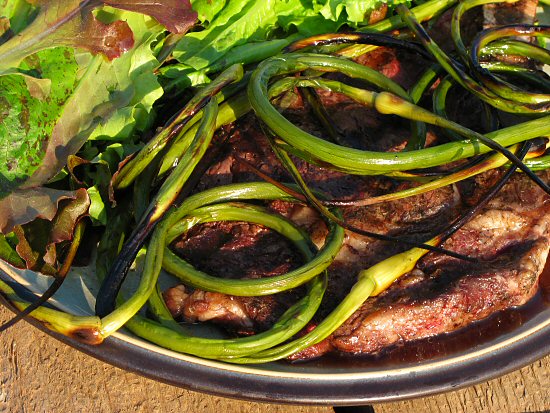
The meal is pretty local: rib steak, grilled to medium-rare and lightly salted, topped with grilled garlic scapes, tossed in a salt, pepper and olive oil, and our all-lettuce mesclun, just cut, with a drizzle of olive oil and a splash of apple cider vinegar.
The scapes are from our market stand neighbors (it’s so sad not having our own fall-planted garlic in the garden this year!), happen to be organic, gotten on a trade for mesclun. The beef was purchased for full price (vendors give each other a 10% discount here, but I didn’t bother to identify myself just for the savings, I’m sure we’ll get to know each other over the summer…!).
All in all, totally tasty, and even easier to buy and cook than to write about! :)
Ways to spread
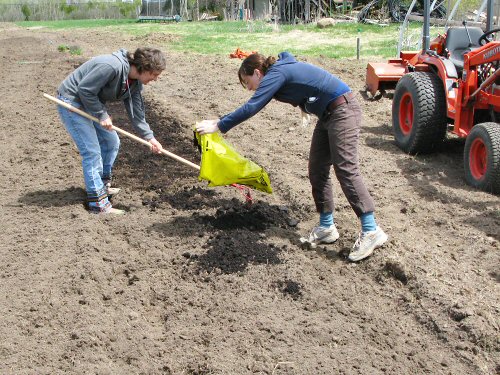
This has gotta be the most painstaking way to plant out two acres of veggies! To recap: different sections of the two fields are at different stages of tillage (Peter down the road has had to come back a couple of times to disc, and there’s STILL a small section to go), and of course there was no time to spread manure in the fall. It’s even a little more complicated, with a fair amount of chopped up sod getting in the way. Sooo, we’re working a few beds at a time, with different treatments depending on the crop.
Here, Tara and Lynn prepare a 50′ x 3′ (15.2m x 0.9m) bed for baby lettuce for mesclun. Because it’s seeded densely and grows quickly, we decided to apply a fair amount of that expensive certified organic compost, and then reuse this bed for at least one or two more mesclun plantings later in the season.
Spreading from Bags Method 1: We brought over a stack of 40lb (18kg) bags in the bucket of the Kubota compact tractor, emptied 8 bags one by one, and lightly raked them in. Thinking about it afterwards, it seemed easier to empty the bags into the bucket, use a shovel to spread, then rake it in. An extra step, but overall quicker to incorporate.
Definitely hand-work, especially compared to loading up an 8-ton manure spreader and driving it around with a big tractor, like we mostly used to do! Good thing we’re only giving this special treatment to a few beds for salad greens. And it is all getting done…
Last day of summer in the garden!
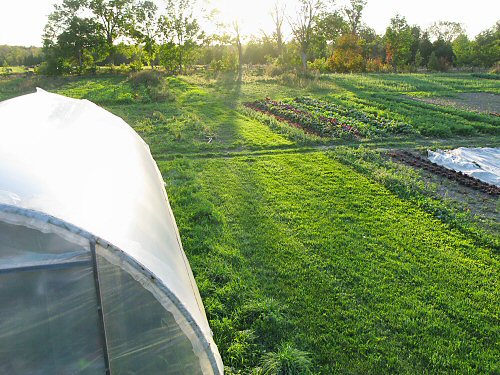
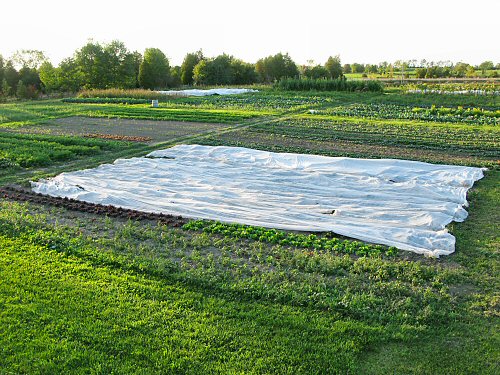
Here we are at the end of the calendar summer, a season of crazy weather largely gone by! Cooler fall conditions have been around for a couple of weeks now, with ample frost watch nights, so summer’s end at this point is only…ceremonial. Still, there’s that little twinge of melancholy that comes with the official end… The fall harvest is looking fine, with lots of brassicas, a good deal of lettuce, and the last of the fall spinach in the north end of the field (above), along with some last tomatoes, lots of peppers and eggplant, spared by frost so far. There’s also Jerusalem artichoke and potatoes, still in the ground. Green beans! And, of course, that section of sweet potato, fully row covered…
Moving down the field, there are the last plantings of beets and carrots, parsnips, some Swiss chard, and lots of mowed but still untilled empty sections…

At the south end of the garden, the herbs and flowers are all hanging in there—row cover has kept even the super-cold-sensitive basils alive and well. If I’ve missed anything in the rundown, well, it’ll still be there!